
Put fixed commitments on the page first
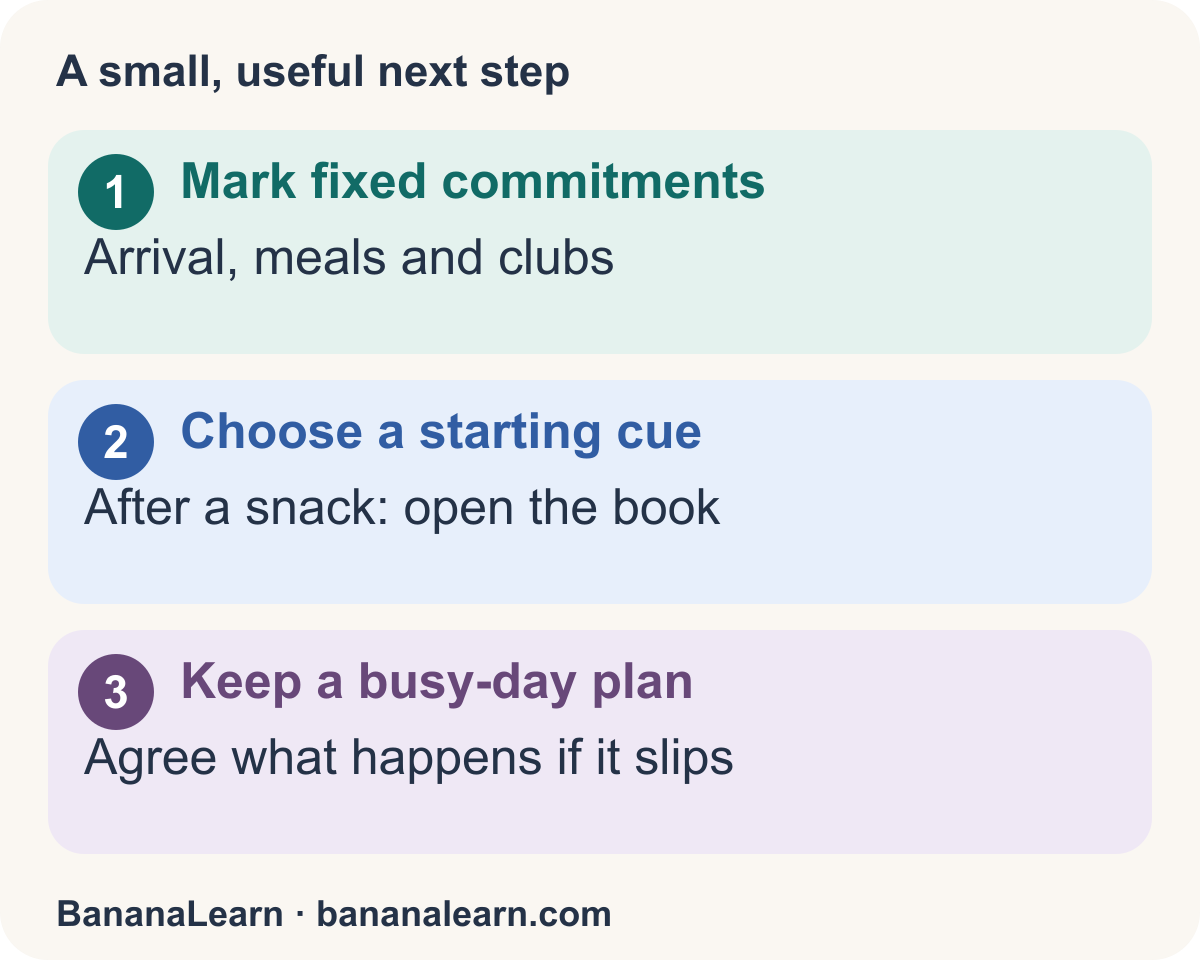
Write down arrival time, transport, clubs, family meals and the evening wind-down. Include where your child actually is: at home, with a relative or in after-school care. A routine requiring a quiet desk at 4 pm will not work if the child is travelling then.
Next, ask what usually happens between arriving and beginning homework. Is the bag still in the car? Does your child need food? Is an adult available to read the instruction? Make those steps visible. A routine should reduce repeated decisions, not add a second set of tasks for the family to fail.
The examples below are invented schedules showing how blocks can fit. They are not recommended homework durations, sleep schedules or expectations for a particular age. Use the teacher’s workload guidance and your family’s circumstances to choose suitable times.
Example A: home at 3:30 pm
| Example time | What happens | Transition cue |
|---|---|---|
| 3:30–4:00 | Put the bag away, have a snack, talk or rest. | Put the homework sheet in the agreed tray. |
| 4:00–4:40 | Play or another chosen activity. | Finish the current round and collect the book. |
| 4:40–5:00 | Attempt the agreed piece of homework. | Mark any question that needs help. |
| After 5:00 | Check what remains, then fit family time, dinner and wind-down around actual commitments. | Decide the next step instead of extending work automatically. |
The 20-minute work block illustrates a place in the afternoon, not a rule. If the assignment needs a different amount of time, discuss where it fits. If the child repeatedly reaches the end without understanding the first question, use our homework time log to identify the sticking point.
Example B: home at 5:30 pm after a club
A late-arrival day needs its own plan. Copying the early-arrival schedule and shifting everything two hours later can crowd out dinner and rest. Look at what is genuinely due and what can be prepared on a different day.
| Example time | What happens |
|---|---|
| 5:30–6:00 | Arrive, unpack and eat or rest as the family needs. |
| 6:00–6:15 | Complete one suitable school task or clarify what remains. |
| From 6:15 | Protect the existing dinner and wind-down plan; arrange support for unfinished work. |
This does not mean a child should stop an assignment after exactly 15 minutes. It shows why a late day has less capacity. If compulsory work will not fit, agree expectations with school in advance where possible. A message explaining the constraint is more useful than completing the work for the child.
Make the change from play to work understandable
Agree the transition before play starts: “After we put the drawing away, we will read the first instruction.” Give a reminder that matches the activity. Stopping midway through a board-game turn or an unfinished model can create avoidable friction. Where possible, choose a natural stopping point.
Let your child make a real choice within the plan: reading or Maths first, kitchen table or another suitable space, a spoken check-in or showing the completed question. Keep the choice small enough to act on. For families working across homes or with different carers, a short shared sequence may be easier to maintain than exact clock times.
A visual plan can use four words or pictures: arrive, reset, schoolwork, pack. Add play and other activities wherever they belong in your evening. Avoid using access to every enjoyable activity as a reward for perfect work. The aim is a workable evening with learning included.
Use a fallback plan and review the week
A busy-day version might be: locate the assignment, attempt the most important agreed part, note the difficulty and pack the bag. It should be clear who will contact school if work remains. Do not let a fallback quietly become an expectation that a child rushes or skips tasks without the teacher knowing.
At the end of a few ordinary days, ask: which transition needed reminders, which block was unrealistic and what could be prepared earlier? Change one part. If homework regularly occupies the whole evening, explore the task and workload rather than making the chart more detailed.
For quiet shared time, try a flexible reading routine. For a playful learning activity when it suits the day, use one of our offline family Maths games. Neither needs to be added as compulsory extra homework.
Further reading: Harvard Graduate School of Education: supporting children with homework. The scenarios, examples and resources here are original BananaLearn materials.
Our after-school plan
Write the commitments that are fixed before adding flexible activities. Make a realistic version for one ordinary day and one busy day.
A completed example
Day / arrival: Club day / 5:30
Fixed commitments: Dinner and existing wind-down
Homework starting cue: After unpacking and a snack
Fallback if it will not fit: Record unfinished work and agree support with school
Opens a separate sheet with the completed example and writing space. Save it as a PDF or print it using your browser. No account is required.
Questions parents ask
Should homework always come before play?
Families and children differ. Choose an order that fits the day, then make the transition clear. Check what happens in practice rather than treating one order as universally correct.
Do we need exact times?
Use times for fixed commitments. A short sequence may work better for flexible activities, especially when transport or family schedules vary.
What if the plan is missed?
Restart at the next useful step. Discuss the obstacle later and simplify an unrealistic plan; a missed block does not require filling the rest of the evening with catch-up work.
Would a teacher help with the next step?
BananaLearn offers 1-on-1 Maths, English and Science tutoring. Tell us your child’s grade, curriculum and what they are finding difficult so we can discuss a suitable fit.
Ask about a free 50-minute session