Find x and y where two straight lines cross
A straight angle measures 180°. One ray can split it into two adjacent angles; more rays can split it into more angles. The total stays 180° as long as the angles exactly fill the same half-turn.

- Find y using the upper half-turn: 68° + y = 180°, so y = 112°.
- Find x using the left half-turn: y + x = 180°, so x = 68°.
- Check the result: x is vertically opposite the given 68° angle. Vertically opposite angles are equal.
The letters alone do not determine an answer. In a different diagram, x or y may mark a different region. Identify which angles share a straight line before choosing 180° or another rule.
Try it: replace 68° with 47° in this same diagram.
y = 180° − 47° = 133°. Then x = 180° − 133° = 47°. Check 47° + 133° = 180°.
For a larger diagram, see parallel and intersecting lines or practise the algebra with one-step equations.
Start with the meaning
Know that a right angle measures 90° and a full turn measures 360°. You should be able to subtract whole numbers and solve a simple missing-number statement.
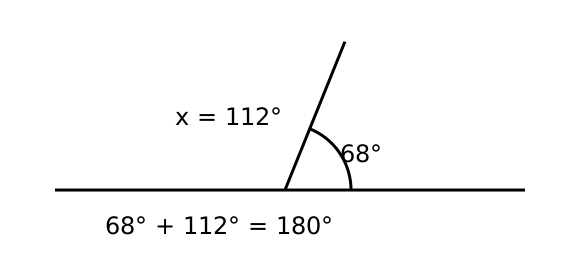
Identify the half-turn
Find the shared vertex and the two opposite rays that form a straight line. The region on one side of the line is a half-turn. A ray inside this region splits it into adjacent angles.
The angles total 180° because together they reconstruct that straight angle. Their drawn sizes may be approximate; use the labelled measures and stated relationships.
Subtract the known angle
For adjacent angles a and b filling the straight angle, a + b = 180°. If a = 68°, then b = 180° − 68° = 112°.
Check 68° + 112° = 180°. An acute angle below 90° paired with one other angle on a straight line must have an obtuse partner above 90°.
Add several known parts first
If three adjacent angles fill the half-turn, add the known parts before subtracting. With 35° and 80° known, the third is 180° − (35° + 80°) = 65°.
Subtracting from 360° would use a full turn rather than the half-turn shown. Make a small arc around the region you are actually filling.
Do not use the rule without the relationship
Two angles somewhere in the same diagram do not necessarily total 180°. They need to form the straight angle, or have another stated relationship proving that sum.
If lines are not marked straight and the question does not state the relationship, the measures may be insufficient. Do not assume an angle is 90° merely because a drawing looks square.
Which angle rule should you use?
Angles that meet without gaps or overlaps along one side of a straight line add to 180°. First identify the straight line and the shared vertex, then write an equation. Being next to another angle is not enough on its own.
| What the diagram shows | Relationship | Example |
|---|---|---|
| A straight angle split into adjacent parts | The parts total 180° | 68° + x = 180°, so x = 112° |
| A right angle split into adjacent parts | The parts total 90° | 28° + x = 90°, so x = 62° |
| Angles filling one complete turn | The parts total 360° | 90° + 120° + x = 360°, so x = 150° |
| Two straight lines crossing | Vertically opposite angles are equal | If one angle is 68°, its opposite is 68° |
Two unknown angles can use the same variable
On a straight line, one angle is x + 15° and the adjacent angle is 2x°. Add the expressions: x + 15 + 2x = 180. Collect the x terms to get 3x + 15 = 180; subtract 15 to get 3x = 165; divide by 3 to get x = 55.
The question asks for the angles, so finish by substituting: x + 15° = 70° and 2x° = 110°. Check 70° + 110° = 180°. The value of x is not automatically the measure of either angle.
Write the reason as well as the answer
A complete solution can be short: “x = 180° − 47° = 133°, because adjacent angles on a straight line total 180°.” Use the labelled values, not how wide the sketch appears. A diagram may not be drawn to scale.
Two checks before moving on
Two separate angles measure 40° and 140°. Must they share a straight line?
No. They are supplementary because their measures total 180°, but they may be at different vertices. A straight-line pair also needs the shared vertex and adjacent arrangement.
Three adjacent angles on one side of a straight line are 2x°, x° and 30°. Find every angle.
2x + x + 30 = 180, so 3x = 150 and x = 50. The angles are 100°, 50° and 30°. Their sum is 180°.
Worked examples, step by step
Example 1: A 68° angle and x fill a straight angle. Find x.
- Write 68° + x = 180°.
- Subtract 68° to get x = 112°.
- Check 68° + 112° = 180°.
Example 2: Three adjacent angles are 35°, 80° and y. Together they form a straight angle.
- Add the known angles: 35° + 80° = 115°.
- y = 180° − 115° = 65°.
- Check all three: 35° + 80° + 65° = 180°.
Example 3: Adjacent angles x and 2x fill a straight angle. Find both.
- x + 2x = 180°, so 3x = 180°.
- Divide by three: x = 60°. The other angle is 120°.
- The angles differ, but together 60° + 120° = 180°.
Common mistakes and useful repairs
Using 90° for any pair of adjacent angles
Adjacent means next to each other. The total depends on the full region: a right angle is 90°, a straight angle is 180°, and a full turn is 360°.
Trusting the apparent size of a sketch
A diagram may not be to scale. A straight-line mark, right-angle square or written condition is evidence; appearance alone is not.
Try before revealing
Quick understanding check
Read the check answers
180°. A straight angle is a half-turn.
148°. 180° − 32° = 148°.
Free missing angles on a straight line worksheet
Try eight questions on the 180° rule, from one missing angle to simple algebra. Open an answer below each question or print the worksheet with a separate worked answer key.
Name: ____________________ Date: __________
Two adjacent angles fill a straight angle. One is 47°. Find the other.
Show answer and reasoning
133°. 180° − 47° = 133°.
One angle in a straight-angle pair is 125°. Find its partner.
Show answer and reasoning
55°. 125° + 55° = 180°.
Three adjacent angles fill a straight angle: 25°, 90° and x. Find x.
Show answer and reasoning
65°. 180° − (25° + 90°) = 65°.
Two equal angles fill a straight angle. Find each.
Show answer and reasoning
90°. 180° ÷ 2 = 90°.
Angles x and 3x form a straight angle. Find both.
Show answer and reasoning
45° and 135°. 4x = 180°, so x = 45° and 3x = 135°.
A child finds the partner of 70° as 290°. Explain the error.
Show answer and reasoning
The partner is 110°. They subtracted from 360°, a full turn, instead of 180°, a half-turn.
Two angles measure 80° and 100° at different vertices. Can you conclude they form a straight angle?
Show answer and reasoning
No. Their measures total 180°, but different vertices do not make one adjacent straight-angle pair.
Adjacent angles x + 20° and x + 40° fill a straight angle. Find both angles.
Show answer and reasoning
80° and 100°. 2x + 60° = 180°, so x = 60°. Substitute into each expression, then check the total.
Angles on a straight line: find missing angles with worked examples — worked answer key
133°. 180° − 47° = 133°.
55°. 125° + 55° = 180°.
65°. 180° − (25° + 90°) = 65°.
90°. 180° ÷ 2 = 90°.
45° and 135°. 4x = 180°, so x = 45° and 3x = 135°.
The partner is 110°. They subtracted from 360°, a full turn, instead of 180°, a half-turn.
No. Their measures total 180°, but different vertices do not make one adjacent straight-angle pair.
80° and 100°. 2x + 60° = 180°, so x = 60°. Substitute into each expression, then check the total.
Choose the next practice step
Use the questions in this guide to practise this specific skill. If you need another explanation, compare the closest worked example with your own drawing before trying a fresh problem.
Help at home: Turn before calculating
Open a book flat or rotate a pointer through a half-turn. Compare it with a quarter-turn and a full turn. Then draw one ray splitting the half-turn and label one angle.
Ask your child to point to the full 180° region before writing the subtraction. If they use 360°, revisit the turn rather than repeating the arithmetic.
Keep one example of your child’s own working. If the same confusion returns across fresh questions, share that attempt with their teacher and ask which next step fits their current learning.
Questions students and parents ask
Are supplementary angles always next to each other?
No. Supplementary describes two angles whose measures add to 180°. A linear pair is adjacent and forms a straight angle; the terms describe different conditions.
Does the line need to be horizontal?
No. Rotating a diagram does not change its angle measures. Opposite rays still form a straight angle in any orientation.
About this resource
BananaLearn created these explanations, diagrams and practice questions. They are not reproduced textbook or past-exam questions. School sequences differ; use the prerequisites to choose a starting point. Read how we prepare learning guides.
Curriculum and teaching references used to check scope:
Match Maths support to your child’s class
If this topic is causing difficulty in schoolwork, start with your child’s current board and class. These guides explain the syllabus, show teaching examples and help you decide what to ask before booking.
Topic sequences can differ between schools and books. Choose the class your child attends. For another class, browse Maths tuition for Classes 1–10; for a school outside India, check curriculum and time-zone fit.
Choose your next learning step
- Linear equations — Practise solving for an unknown before finding the angle.
- When homework takes hours — Separate an unclear instruction from a missing concept.
- Help with algebra — Connect the symbol to what the unknown represents.
If your child knows 180° but finds it difficult to choose the right rule or form an equation, bring one question to a free 50-minute class.
Ask about a free 50-minute class