Maths · Suggested Class 10
Section Formula & Midpoint: Class 10 Worked Examples
A point one-third of the way from A to B is closer to A. Yet the section formula gives A the larger weight. A journey split into equal steps makes that apparent reversal clear.
Original BananaLearn guide · 2 November 2026
On a phone, swipe across the illustration to read every label.
Start with a journey, not a memorised formula
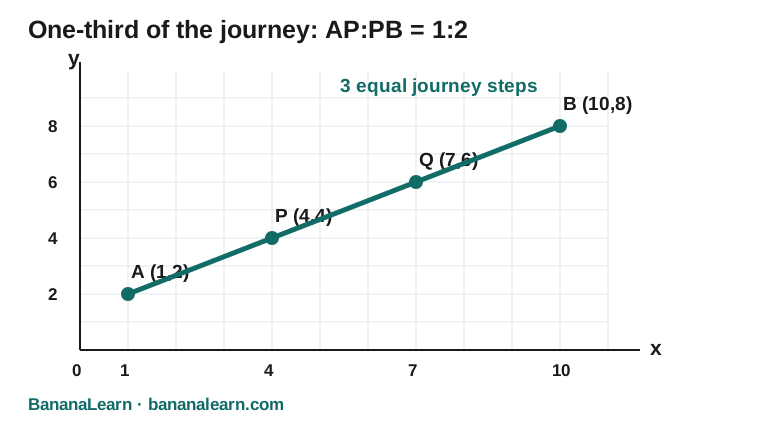
Let A = (1, 2) and B = (10, 8). Travelling from A to B changes x by 9 and y by 6. Split that journey into three equal steps. Each step adds 3 to x and 2 to y. After one step you reach P = (4, 4); after two, Q = (7, 6). Both points lie on the same segment.
If AP:PB = 1:2, P is one of the three parts along the journey from A. The ratio describes the two lengths AP and PB, in that order. It does not mean that P is halfway or that its x and y coordinates have ratio 1:2. Draw the endpoints and mark which piece is called m before calculating.
Derive the internal section formula
Write A = (x₁, y₁), B = (x₂, y₂), with AP:PB = m:n and m,n positive. The fraction of the full journey completed is m/(m+n). Therefore x = x₁ + [m/(m+n)](x₂−x₁), and y = y₁ + [m/(m+n)](y₂−y₁). This journey form works for horizontal, vertical and sloping segments.
Expanding and collecting terms gives P = ((nx₁+mx₂)/(m+n), (ny₁+my₂)/(m+n)). The weight on A is n, while the weight on B is m. A point near A retains more of A’s coordinates. This is a weighted average of the endpoints, so each coordinate lies between the corresponding endpoint values. A decreasing coordinate causes no problem: its change is negative.
Worked example: a 2:1 split across the axes
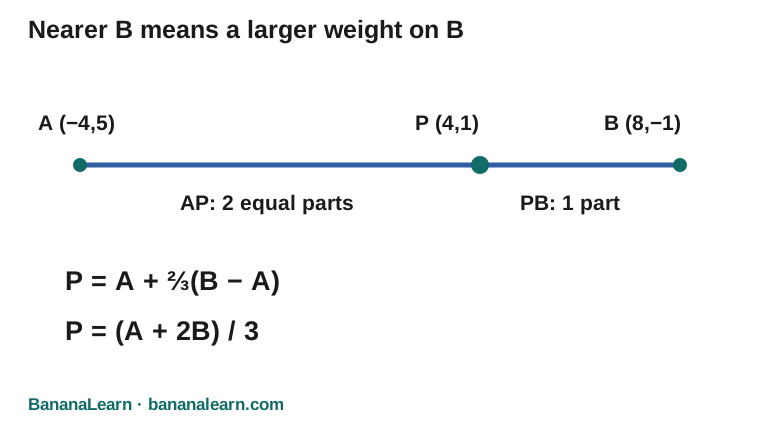
A = (−4, 5), B = (8, −1), and AP:PB = 2:1. Use m=2, n=1. Then x = [1×(−4)+2×8]/3 = 12/3 = 4, and y = [1×5+2×(−1)]/3 = 3/3 = 1. Thus P = (4, 1). Keep negative coordinates in brackets so that their signs stay attached.
Check the journey: B−A = (12, −6). Two-thirds of that is (8, −4). Adding it to A gives (4, 1). P is closer to B, as a 2:1 split requires. Reversing the endpoint names would require reversing the ratio too: BP:PA = 1:2 describes the same point.
On a phone, swipe across the illustration to read every label.
Midpoint is the equal-weight case
A midpoint M has AM:MB = 1:1. Substituting m=n gives M = ((x₁+x₂)/2, (y₁+y₂)/2). For endpoints (−3, 7) and (5, −1), the midpoint is (1, 3). Average x with x and y with y; do not combine an x coordinate with a y coordinate.
A midpoint need not have integer coordinates. The midpoint of (0, 0) and (3, 5) is (1.5, 2.5). These decimals do not indicate an error. If a problem asks for an exact value, fractions such as 3/2 and 5/2 are equally suitable. A horizontal segment keeps its y coordinate; a vertical segment keeps its x coordinate.
Worked example: recover a missing endpoint
Suppose A = (−2, 6) and the midpoint M = (3, 1). Let B = (u,v). From (−2+u)/2 = 3, multiply by 2 to get −2+u=6, so u=8. From (6+v)/2=1, get 6+v=2, so v=−4. Thus B=(8,−4).
Check by averaging the proposed endpoints: (−2+8)/2=3 and (6−4)/2=1. Alternatively B=2M−A, computed coordinate by coordinate. Merely doubling M would forget the known endpoint and usually give the wrong answer.
Worked example: find the ratio from a point
A=(0,2), P=(3,4), B=(9,8). In the x direction, AP changes by 3 and PB by 6, giving 1:2. Check y as well: AP changes by 2 and PB by 4, also 1:2. Therefore AP:PB=1:2. For collinear points between A and B, the same fraction of each nonzero coordinate change must have been completed.
One coordinate alone is insufficient to prove that a point lies on a segment. If P had been (3,5), its x split would still be 1:2 but its y split would be 3:3. These disagree, so P would not be on AB. For a vertical line use y changes; for a horizontal line use x changes. Avoid dividing by a zero change.
Trisection and a coordinate-axis question
To trisect A=(−2,1) and B=(7,10), divide the change (9,9) into three steps of (3,3). The two internal points are (1,4) and (4,7), corresponding to ratios 1:2 and 2:1. Giving just one point does not complete a trisection question.
Where does A=(−4,2) to B=(6,7) cross the y-axis? At the crossing x=0. The x change from A is 4 out of the total 10, so the completed fraction is 2/5 and AP:PB=2:3. The y coordinate is 2+(2/5)×5=4. The crossing is (0,4). This is an internal crossing because 0 lies between −4 and 6.
Errors worth catching before the answer
Write the ratio beside the diagram, then name m and n. Check whether the answer lies between the endpoints and whether it is nearer the expected endpoint. A between-coordinate check is necessary but does not by itself prove collinearity; also check the common journey fraction.
This lesson covers internal division with positive ratios. External division needs a different interpretation and denominator; it is not obtained by inserting a negative ratio without explaining what it means. Class and board sequences vary. Use your current textbook or school syllabus to check the required scope before using this as an exam revision list.
A checking record for every coordinate problem
Copy this record into a notebook. Fill each blank using your own example or the activity above.
On a phone, swipe across a wide table to see every column.
| Record | Write this before finishing |
|---|---|
| Endpoint order | A=___, B=___ |
| Length ratio | AP:PB=___:___ |
| Journey fraction | AP/AB=___ |
| Coordinate result | P=(___,___) |
| Independent check | Same fraction in x and y? Between endpoints? |
12 questions with explained answers
Try each question first. Open the explanation to check your reasoning. These are original BananaLearn questions, not official exam questions.
A=(2,4), B=(8,10). Find the midpoint.
Check answer and reasoning
(5,7)
Average corresponding coordinates: (2+8)/2=5 and (4+10)/2=7.A=(−5,3), B=(1,−7). Find the midpoint.
Check answer and reasoning
(−2,−2)
The coordinate sums are −4 and −4; divide each by 2.A=(0,1), B=(12,7), AP:PB=1:2. Find P.
Check answer and reasoning
(4,3)
One-third of the change (12,6) is (4,2); add it to (0,1).For the same A and B, find the 2:1 division point.
Check answer and reasoning
(8,5)
Complete two-thirds of the journey: (0,1)+(8,4).A=(3,−2), B=(3,10), AP:PB=1:3. Find P.
Check answer and reasoning
(3,1)
The line is vertical. One-quarter of the y change 12 is 3, so y=−2+3=1.A=(−6,5), B=(4,5), AP:PB=3:2. Find P.
Check answer and reasoning
(0,5)
Three-fifths of the x change 10 is 6. The y coordinate stays 5.A=(−1,8) and midpoint M=(2,3). Find B.
Check answer and reasoning
(5,−2)
B=2M−A=(4−(−1),6−8). Averaging A and B returns M.A=(2,2), P=(5,4), B=(11,8). Find AP:PB.
Check answer and reasoning
1:2
The x changes are 3 and 6; the y changes are 2 and 4. Both reduce to 1:2.Trisect the segment from (0,−3) to (9,6).
Check answer and reasoning
(3,0) and (6,3)
The full change (9,9) has three equal steps of (3,3). Add one step and two steps to A.Where does (−6,1) to (3,7) meet the y-axis?
Check answer and reasoning
(0,5), at ratio 2:1
x=0 is 6/9 of the way from A, so y=1+(2/3)×6=5.A learner uses (2A+B)/3 for AP:PB=2:1. What went wrong?
Check answer and reasoning
The weights were reversed.
For AP:PB=2:1 the point is nearer B, so use (A+2B)/3, coordinate by coordinate.Is P=(2,5) on the segment A=(0,1), B=(6,7)?
Check answer and reasoning
No.
The x journey fraction is 2/6=1/3, but the y journey fraction is 4/6=2/3. A single common fraction is required.
Choose your next learning step
- Check lengths with the distance formula
- Revisit coordinate order
- CBSE Class 10 Maths: syllabus and teaching support
- ICSE Class 10 Maths: check the required syllabus
Explore BananaLearn games, learning resources and tutoring. Maths is our priority; English and Science tutoring are also available. Share your current schoolwork when checking teaching fit.
Sources and scope
Explanations, activities, diagrams and practice are original BananaLearn work. Class labels suggest a learning level; school sequences and current textbook editions can differ. Sources checked 2 November 2026.
How we prepare guides · Report a correction
Share the complete guide: https://bananalearn.com/learn/class-10-section-formula-midpoint.html