Maths · Suggested Grade 4
12-Hour and 24-Hour Time: Class 4 Examples & Practice
12:00 AM is midnight, but 12:00 PM is noon. Those two exceptions explain why simply adding 12 to every PM time gives wrong answers.
Original explanations and practice by BananaLearn · Published 31 October 2026
On a small screen, swipe across the illustration to read every label.
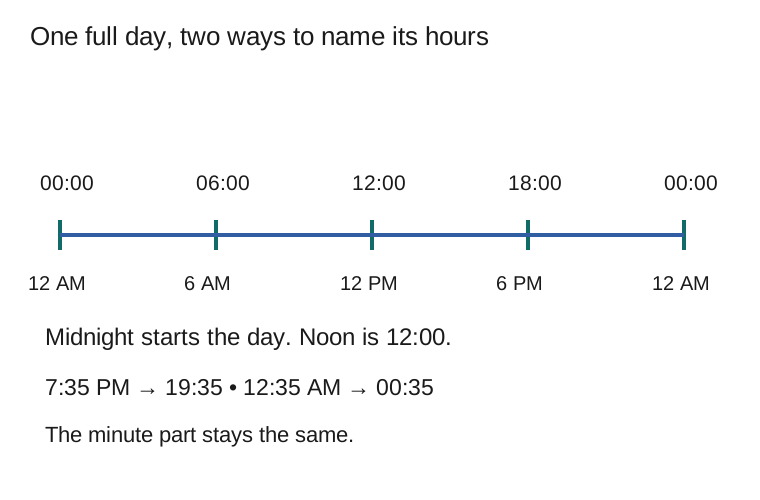
Two ways to name the same moment
A 12-hour clock labels the hours 1 to 12 and adds AM or PM. AM covers midnight up to before noon; PM covers noon up to before the next midnight. A 24-hour clock records hours from 00 to 23, so the day does not need AM or PM labels.
Minutes do not change when you convert. The 35 minutes in 7:35 PM remain 35 minutes in 19:35. A leading zero makes an early hour unambiguous in a timetable: 7:05 AM is written 07:05. We use 00:00 for the beginning of a day and include a date when midnight could be misunderstood.
The four conversion cases
For 1 to 11 AM, keep the hour and use two digits if needed: 8:20 AM becomes 08:20. For 12 AM, replace 12 by 00: 12:20 AM becomes 00:20. For 12 PM, keep 12: 12:20 PM becomes 12:20. For 1 to 11 PM, add 12: 8:20 PM becomes 20:20.
The important choice is which case applies. Do not write 24:20 for 12:20 PM, and do not write 00:20 for noon. Some transport systems use 24:00 for the end of a stated date; this beginner guide uses 00:00 with the following date instead, so the calendar boundary is explicit.
Worked example: convert an afternoon activity
Football starts at 4:45 PM. Because 4 is between 1 and 11 and the label is PM, add 12 to the hour: 4 + 12 = 16. The start is 16:45. The minute part stays 45; this is conversion of a time label, not addition of a duration.
To convert 16:45 back, subtract 12 from the hour because it is greater than 12. This gives 4:45 PM. Reverse-checking is useful: if your answer returns to a different AM/PM label, the original conversion needs checking. The number 16 does not mean sixteen hours have passed since the activity began.
Worked example: midnight and the date
A coach departs at 00:15 on Tuesday. This is 12:15 AM on Tuesday, shortly after Monday has ended. It is not Tuesday lunchtime. If a message only says midnight Tuesday, ask for the date and a 24-hour time rather than guessing which evening the writer means.
Draw the boundary: Monday 23:50, Tuesday 00:00, Tuesday 00:15. The first gap is 10 minutes and the second is 15 minutes. That also shows why subtracting the displayed hour numbers directly is not a sensible elapsed-time method across midnight.
Worked example: read a short timetable
A train leaves at 09:35 and arrives at 11:10. Read these as 9:35 AM and 11:10 AM. Count 25 minutes to 10:00, then 60 minutes to 11:00, then 10 minutes to 11:10: the journey lasts 95 minutes, or 1 hour 35 minutes.
A later service departs at 14:35, which is 2:35 PM. A 24-hour label makes these services easier to distinguish. Keep time conversion separate from duration: 14:35 is a moment, while 95 minutes is an amount of time. Our elapsed-time guide develops more crossing-hour problems.
Mistakes a clock drawing can reveal
If a learner changes 7:50 PM to 19:62, check whether 12 was added to minutes as well as hours. If 12:30 AM becomes 12:30 at noon, return to the day boundary. If 13:00 is called 3 PM, partition the hour into 12 + 1 rather than looking only at its last digit.
An analogue clock repeats its face twice every day. A drawing of its hands alone cannot tell you AM or PM. Supply a context, such as breakfast or an evening journey, or give the label directly. Otherwise both morning and evening answers may be reasonable.
Make a one-day schedule, then check it
Choose five familiar activities and record their times in both formats. Include one morning activity, noon, an afternoon activity, an evening activity and midnight with a date. Compare the order on a full-day number line, not just on the circular clock face.
For a quick understanding check, ask why 12:05 PM stays 12:05 but 1:05 PM becomes 13:05. A child who explains the noon boundary has a stronger method than one who remembers add 12 as a universal rule. Keep calculations short enough to explain before adding complex timetables.
Make your own daily timetable
Copy the record into a notebook or use it to organise your own answer. Blank spaces are for your work.
| Activity and date | 12-hour time | 24-hour time |
|---|---|---|
| Morning activity | ___ | ___ |
| Noon | 12:00 PM | 12:00 |
| Afternoon activity | ___ | ___ |
| Midnight at the start of the next date | 12:00 AM | 00:00 |
10 questions with explained answers
Try the questions before opening the answers. Explain the reason, then try a changed example to check your understanding.
Convert 6:25 AM.
Show answer and explanation
06:25
An AM hour from 1 to 11 stays the same.Convert 6:25 PM.
Show answer and explanation
18:25
Add 12 to 6; keep the minutes.Convert 12:40 AM.
Show answer and explanation
00:40
This is forty minutes after midnight.Convert 12:40 PM.
Show answer and explanation
12:40
Noon keeps the hour 12.Write 21:05 in 12-hour form.
Show answer and explanation
9:05 PM
21 − 12 = 9.Write 00:05 in 12-hour form.
Show answer and explanation
12:05 AM
00 labels the midnight hour.Write 11:59 in 12-hour form.
Show answer and explanation
11:59 AM
This is just before noon.What time follows Monday 23:59 by one minute?
Show answer and explanation
Tuesday 00:00
The day changes at midnight.A lesson runs from 15:20 to 16:05. How long?
Show answer and explanation
45 minutes
40 minutes to 16:00, then 5 more.Can a clock face showing 3:00 tell you AM or PM by itself?
Show answer and explanation
No
Its hands repeat their positions twice per day; context is needed.
Keep the ideas connected
For help with a school-learning difficulty, bring one attempted question to a discussion about tutoring and curriculum fit. Maths is our priority; English and Science tutoring are also available.
Sources, scope and sharing
The examples, diagrams and practice are original BananaLearn work. Grade labels suggest a learning level; teaching sequences and school requirements can differ. Official sources below support the stated facts and resource links. These activities are independent resources, not official exam questions or endorsed campaign materials.
How we prepare learning guides · Report a correction
Share this guide: https://bananalearn.com/learn/class-4-12-hour-24-hour-clock.html