
Start with the key idea
Use a or an before a singular countable noun when introducing one non-specific member of a group. Choose a before a consonant sound and an before a vowel sound. Use the when the listener can identify which person or thing you mean. Some sentences, including general plural statements, need no article.
1. Start with one countable thing
A book means one book, without identifying a particular book for the listener. An apple works the same way. Book and apple are singular countable nouns: you can say one book, two books, one apple, two apples.
A singular countable noun normally needs a determiner in an ordinary complete sentence. Say “I bought a pen”, “I bought the pen” or “I bought my pen”. “I bought pen” is not the usual complete form. A and an are not added before another determiner: write my pen, not a my pen.
A and an do not mean different quantities. Both introduce one. The change between them makes pronunciation smoother; it does not tell whether the object is big, small, important or familiar.
2. Choose a or an by the next sound
Say the word immediately after the gap. If its first sound is a vowel sound, use an: an orange, an egg, an umbrella. If it starts with a consonant sound, use a: a table, a pencil, a banana.

Spelling is a useful clue, but sound decides. Hour has a silent h in standard pronunciation, so an hour is natural. Uniform begins with the consonant sound heard at the start of you, so a uniform is natural. One also starts with a “w” sound: a one-day trip.
Listen to the phrase as you would actually say it. Do not teach “an before every written vowel” as an absolute rule. The examples hour and uniform show why that shortcut fails.
3. An adjective can change the article
Compare a bag and an old bag. Bag has not changed, but the next spoken word has. Old begins with a vowel sound, so an fits. Compare an apple and a green apple: green begins with a consonant sound.
Keep the article at the start of the noun phrase. “An unusually heavy box” takes an because unusually is the next spoken word. At Grade 4, begin with one clear adjective before using longer phrases.
When correcting a sentence, read the whole phrase aloud rather than looking only at the final noun. Underline the word directly after the article and explain its first sound. That gives a repeatable method for a new example.
4. Use the when the reader can tell which one
Read: “I found a shell. The shell had a pink stripe.” The first sentence introduces a shell. The second refers back to that same shell, now identifiable to the reader. This is one common reason for the, not the only reason.
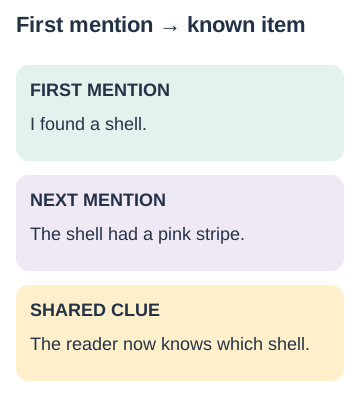
A phrase can identify something on its first mention: “Please pass the book beside your elbow.” The shared situation and the description tell the listener which book. Do not insist that a noun must appear earlier before the can be used.
The works with singular and plural nouns and with uncountable nouns when the reference is identifiable: the cup, the cups on the tray, the water in this bottle. Ask “Which one or which group?” and look for the shared clue.
5. Some sentences need no article
“Dogs need water” is a general statement about dogs and water. Dogs is plural and water is uncountable in this use. Do not put a before either word. “The dogs in our garden need the water in that bowl” identifies a particular group and a particular supply.
To count an amount of an uncountable substance, name a unit or container: a glass of water, a bowl of rice, two pieces of advice. The article belongs with glass, bowl or piece. The material word is not suddenly being counted in the same way as a pencil.
Names usually do not take an article: Asha lives in Delhi. Some geographical and institutional names follow different conventions; learn those in context rather than adding the before every place name. This guide focuses on ordinary noun phrases, not every naming exception.
6. Check meaning before marking an answer wrong
Without context, “I saw a dog” and “I saw the dog” can both be correct. The first introduces a dog; the second assumes the listener can identify it. A good exercise supplies enough context or accepts a justified alternative.
Use a three-question routine: Is the noun singular and countable in this use? Can the reader identify the intended thing? If a or an is needed, what sound comes next? This connects grammar to meaning instead of treating it as a spelling game.
For independent writing, ask for a two-sentence story that first introduces something and then refers back to it. Later change the adjective and check the article again. For example, change a box to an empty box while keeping the same story.
5 worked examples with reasoning
1. Choose “a” or “an”: ___ honest answer.
- Honest has a silent h in standard pronunciation.
- The next sound is a vowel sound.
- Write an honest answer.
2. Complete: “I bought ___ kite. ___ kite is blue.”
- The first sentence introduces one non-specific kite: a kite.
- The second refers to that same kite, now known.
- I bought a kite. The kite is blue.
3. Change “a basket” by adding the adjective empty.
- The new phrase is article + empty + basket.
- Empty starts with a vowel sound.
- Write an empty basket.
4. Repair “She gave me an advice.”
- Advice is uncountable in this use.
- Use some advice, or count a unit: a piece of advice.
- Do not choose a merely because advice starts with a different letter.
5. Can “Open the window” be correct on the first mention?
- Yes, if the shared situation makes the window identifiable.
- For example, the speaker points to the one closed window beside the listener.
- Earlier mention is not required when another clear clue identifies it.
Save the guide or print the practice
Download to save or share
Complete guide with answers (PDF) · Worksheet without answers (PDF) · Worksheet and answer key (PDF)
Try each task before opening its answer. Give an example or reason, not only a label.
16 practice questions with explanations
Try each task before opening its answer. Give an example or reason, not only a label.
Write an answer and your reason before opening the explanation. Check the reasoning as well as the final answer.
- Sound
Choose a or an: ___ elephant.
Answer and reasoning
An elephant.
Elephant begins with a vowel sound.
- Sound
Choose a or an: ___ university.
Answer and reasoning
A university.
University begins with a “y” consonant sound.
- Sound
Choose a or an: ___ hour.
Answer and reasoning
An hour.
The h is silent in standard pronunciation.
- Adjective
Choose a or an: ___ red umbrella.
Answer and reasoning
A red umbrella.
The next sound belongs to red, not umbrella.
- Adjective
Choose a or an: ___ old pencil.
Answer and reasoning
An old pencil.
Old begins with a vowel sound.
- Context
I found ___ coin. ___ coin was under my chair.
Answer and reasoning
A coin; the coin.
Introduce one coin, then refer back to it.
- Known
Choose the usual article: Please pass ___ bowl beside your hand.
Answer and reasoning
The bowl.
The description identifies the intended bowl.
- General
For a general statement, write a, an, the or no article: ___ cats need food.
Answer and reasoning
No article.
The sentence refers to cats generally.
- Uncountable
Repair “I drank a water” using a container.
Answer and reasoning
I drank a glass of water.
Glass is the singular countable container.
- Determiner
Repair “I opened a my book.”
Answer and reasoning
I opened my book.
Do not put a before the determiner my.
- Sound
Choose a or an: ___ one-way road.
Answer and reasoning
A one-way road.
One begins with a “w” sound.
- Meaning
Can “I saw ___ bird” have more than one correct answer without context?
Answer and reasoning
Yes: a bird or the bird.
A introduces it; the assumes an identifiable bird.
- Plural
Repair “an apples” without making it singular.
Answer and reasoning
Apples, some apples or the apples, depending on meaning.
A and an do not directly introduce plural countable nouns.
- Create
Write two sentences introducing a box and then referring back to it.
Answer and reasoning
For example: I found a box. The box held buttons.
First introduce the object; then use the known reference.
- Edit
Change “an orange” to include the adjective small.
Answer and reasoning
A small orange.
Small supplies the next consonant sound.
- Reason
Why is checking the first letter alone unreliable?
Answer and reasoning
The first spoken sound can differ from the written letter.
An hour and a uniform show the two directions of the mismatch.
Use the ideas without looking at the notes
Write three new phrases: one that uses a, one that uses an and one that uses the. Explain the sound or the shared clue for each. Then write a general plural statement with no article.
Common questions
Is an used before every vowel letter?
No. Sound decides: a uniform begins with a consonant sound, while an hour begins with a vowel sound.
Can the be used before a plural noun?
Yes: the books on the desk identifies a particular group.
Does the always mean the noun was mentioned earlier?
No. A shared situation or identifying phrase can make the reference clear on its first mention.
Why do we say an old car but a car?
The word immediately after the article changes from car to old, so the initial sound changes.
Is every article gap limited to one answer?
No. Some require more context. A and the can express different valid meanings.
Connect your learning
Ask about guided English learning if your child needs help explaining these ideas.
About this guide
Original explanations, examples, diagrams and practice by BananaLearn. The grade label indicates the intended learning level; this is not an official textbook extract or exam paper.