English · Suggested Class 5 · school sequences vary
Subject & Predicate: Class 5 Examples and Sentence Practice
“The tiny boat beside the reeds drifted away.” The sentence is about the boat, but its subject is more than one word. Split the sentence where the main verb begins.
Start here
In a basic statement, the subject names who or what the sentence is about; the predicate says something about that subject and includes the verb.
On a narrow screen, swipe the diagram or open it full size.
Find a section, worked example or practice question
See the two jobs in a statement
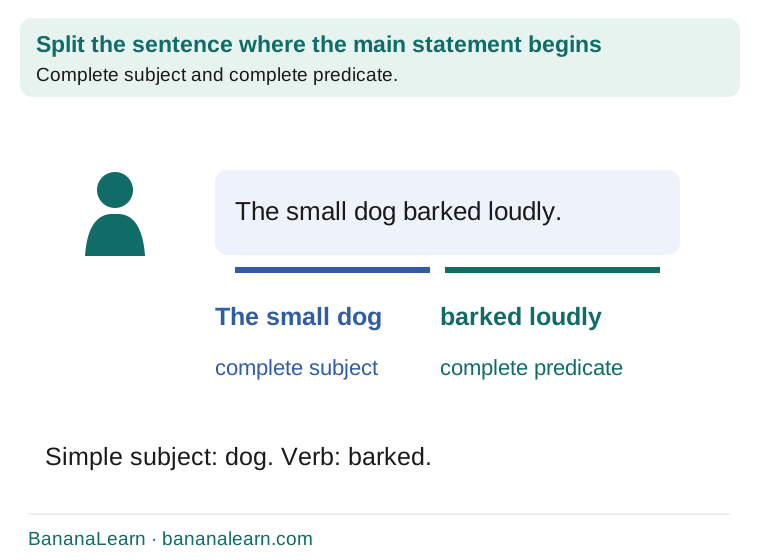
In “The small dog barked loudly”, the complete subject is “The small dog” and the complete predicate is “barked loudly”. The main subject word is dog. The verb barked begins the information given about it.
The complete subject can include describing words and phrases. Taking only the first word would leave “The” as the subject, which does not identify what the sentence is about.
Find the verb before dividing the sentence
Look for the verb or verb group, then ask who or what goes with it. In “Three children have finished the model”, the verb group is have finished and its subject is Three children.
Do not split the verb group in half. Here the predicate is “have finished the model”, not only “finished the model”. Helping verbs belong with the main verb.
Complete subjects and simple subjects
In “The blue bicycle near the gate needs a new tyre”, the complete subject is “The blue bicycle near the gate”. The simple subject is bicycle. The phrase near the gate describes which bicycle.
School instructions may ask for either the complete subject or the simple subject. Name the kind in your answer. This avoids marking two answers as contradictory when they describe different levels of the sentence.
On a narrow screen, swipe the diagram or open it full size.
The subject is not always an action-doer
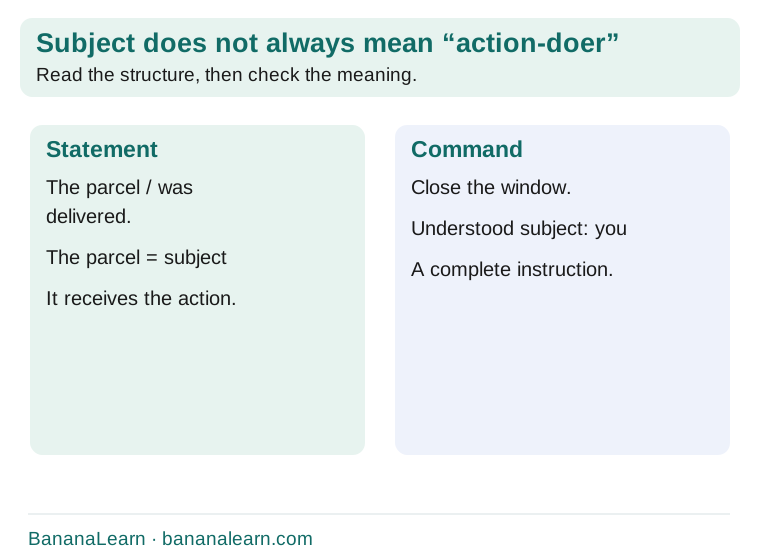
In “The parcel was delivered”, the subject is The parcel even though it did not deliver anything. In “My sister is tired”, My sister is the subject and is tired is the predicate; tired describes her state.
Use the doer question as a helpful starting point for simple action sentences, not a rule that covers every sentence. Linking verbs and passive sentences show why grammar and real-world action are not identical.
Joined subjects and joined predicates
“Asha and Ben carried the box” has the joined subject Asha and Ben. “Asha lifted the lid and checked the contents” has one subject and two joined actions inside its predicate.
A sentence can therefore have more than one subject word or more than one main verb. Look for what is joined before deciding that every and begins a new complete sentence.
Commands often leave you unstated
In “Close the window”, the understood subject is you and the expressed predicate is Close the window. A command can be a complete sentence even without a written subject.
This is a special sentence pattern. Do not add you to the written text unless the task asks you to show the understood subject. Write “understood subject: you” in an analysis exercise.
Repair a missing subject or predicate
“The children beside the pond” names a group but gives no main statement about it. Add a predicate: “The children beside the pond counted the ducks.” “Carried the basket” needs a subject in an ordinary statement: “Mina carried the basket.”
Fragments can appear intentionally in headings or conversation. These exercises practise complete school-writing statements, where the missing part needs to be supplied.
Practise with one scene
Describe a child building a kite. Start with “The child tied the string.” Expand the subject to “The child in the yellow coat” and the predicate to “tied the string carefully to the wooden frame”. The two jobs remain the same.
For a quick home check, ask the learner to underline the complete subject once and the complete predicate twice, then circle the simple subject. Explain disagreements using the sentence rather than guessing from its first word.
See the reasoning
Worked examples and checks
1. Divide: “The old bridge across the stream shook in the wind.”
Verb: shook. What shook? The old bridge across the stream.
Complete subject: The old bridge across the stream. Predicate: shook in the wind.
Simple subject: bridge. Across the stream describes the bridge; it is not a second subject.
2. Divide: “Our team has won the match.”
Keep has won together as the verb group.
Subject: Our team. Predicate: has won the match.
The match is what was won, not the subject.
3. Analyse: “Please place the books on the shelf.”
This is a command directed to you.
Understood subject: you. The expressed instruction is the predicate.
Please adds politeness; it is not the subject.
Try, explain, check
12 questions with explained answers
Try each task before opening its explanation. These are original BananaLearn questions, not official exam or past-paper questions. Where several answers can work, the explanation gives the criteria.
Give the complete subject: “The red bus arrived late.”
Check answer and reasoning
The red bus Arrived is the main verb; the sentence is about that bus.
Give the predicate of the same sentence.
Check answer and reasoning
arrived late It tells what happened to the subject.
Give the simple subject: “Two noisy parrots sat nearby.”
Check answer and reasoning
parrots Two and noisy modify the main subject noun.
Give the complete subject: “The girl with the green bag waved.”
Check answer and reasoning
The girl with the green bag The phrase identifies which girl.
Divide: “They have been waiting outside.”
Check answer and reasoning
They / have been waiting outside Keep the complete verb group in the predicate.
Who or what is the subject in “The cup was broken”?
Check answer and reasoning
The cup It receives the action; subject does not always mean doer.
Find the predicate: “My uncle is a painter.”
Check answer and reasoning
is a painter The linking verb and following description belong together.
Find the joined subject: “Ravi and Noor cleaned the table.”
Check answer and reasoning
Ravi and Noor Both names share the predicate.
Find the joined actions: “The puppy ran and jumped.”
Check answer and reasoning
ran and jumped One subject performs both actions.
What is the understood subject in “Listen carefully”?
Check answer and reasoning
you It is a command.
Repair “The colourful kite above the trees” as a statement.
Check answer and reasoning
For example: The colourful kite above the trees dipped suddenly. The original group needed a predicate; several meaningful completions are possible.
Repair “Found a shell” as an ordinary statement.
Check answer and reasoning
For example: Leela found a shell. A named subject completes the statement; a different suitable subject is also valid.
A checking record to use in your notebook
Copy these headings and fill them for one worked task, then for a fresh attempt. Use your own evidence rather than copying the model answer.
Question or sentence
What am I being asked to explain?
Model or evidence
Which diagram, rule or passage detail supports my method?
Work
What steps connect the question to the answer?
Independent check
Can I substitute, recount, trace a path or check the text?
Original BananaLearn explanations, examples, illustrations and practice. Source facts checked 7 November 2026. Suggested levels are learning guides, not a claim that every board or textbook uses the same sequence.