Science · Suggested Class 6 · school sequences vary
Earth Rotation, Revolution & Seasons: Class 6 Guide
India has winter while Australia has summer. Both places share the same Earth–Sun distance. The explanation needs a tilted planet, not a “nearer means summer” rule.
Start here
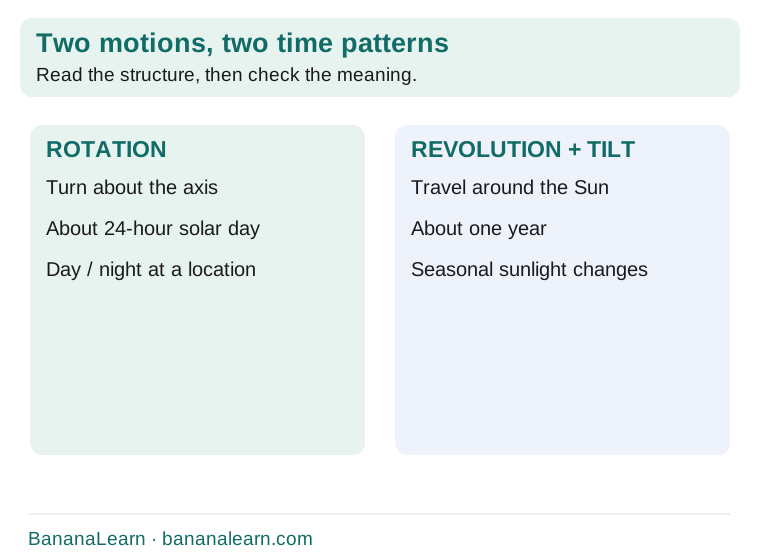
Rotation helps produce day and night. Revolution is Earth’s yearly orbit; its tilted axis changes sunlight angle and daylight duration through the year.
On a narrow screen, swipe the diagram or open it full size.
Find a section, worked example or practice question
Separate two motions
Earth rotates about an imaginary axis through its poles. The solar day is about 24 hours. Earth also revolves around the Sun, taking about a year for one orbit. These motions happen together.
A spinning globe travelling around a lamp can represent both, but the model must show which motion is being discussed. One turn and one trip around the lamp are different actions.
Explain day and night
The Sun illuminates roughly one half of Earth at a time. Rotation carries a location into and out of the illuminated region. The Sun’s apparent daily movement across the sky is largely a result of this rotation.
The exact time spent in daylight varies with season and latitude. Near the poles there can be periods without a daily sunrise or sunset, so “every location gets twelve hours of day” is not a universal rule.
Keep the axis direction approximately fixed
Earth’s axis is tilted about 23.4° from a line perpendicular to its orbital plane. Over a single year its direction in space remains approximately fixed. As Earth moves around the Sun, the hemispheres take turns leaning towards the Sun.
Do not point the North Pole towards the lamp at every position in an orbit model. That changes the axis direction and prevents the model from representing the seasonal change correctly.
On a narrow screen, swipe the diagram or open it full size.
Connect tilt with heating
A hemisphere tilted towards the Sun generally has longer daylight and more direct midday sunlight. The energy is delivered over a smaller surface area than when the same incoming beam meets the surface at a shallow angle.
Both effects contribute to seasonal heating. The coldest and hottest dates do not have to coincide with the solstices because land, oceans and atmosphere store and transfer heat.
Compare June and December
Around the June solstice, the Northern Hemisphere is tilted towards the Sun and the Southern Hemisphere away. Around the December solstice, the roles reverse. Northern and southern seasonal timing is therefore opposite.
India and the UK are north of the equator; Australia and New Zealand are south. Local climates also depend on rainfall, altitude, oceans and other factors, so this model is not a complete weather forecast.
What equinox means in the model
Around the March and September equinoxes, neither hemisphere is tilted towards the Sun in the same seasonal sense. Day and night are approximately equal in duration in many locations.
Actual sunrise/sunset definitions and atmospheric refraction mean the measured daylight period need not be exactly twelve hours on that date. Use approximately when describing this school model.
Why distance alone fails
Earth’s orbit is slightly elliptical, and Earth is nearest the Sun around January. That is during northern winter and southern summer. One shared distance cannot explain opposite seasons at the same time.
An exaggerated oval can make distance look like the dominant effect. Label a model “not to scale” and use the consistent axis direction and light angle as the teaching features.
A safe model-and-explain task
Draw a Sun and four Earth positions on paper. Mark parallel tilted axes, label north and south and draw incoming rays. Explain one location’s day/night change by rotation and a seasonal comparison by orbit position.
Use supplied diagrams instead of looking at the Sun or using a hot lamp. The final check is an explanation: which part of your model produces a daily change, which a yearly change and which details are simplified?
See the reasoning
Worked examples and checks
1. A learner says, “December is cold because Earth is farther from the Sun.”
Ask what season Australia has at the same time. Its summer contradicts a shared-distance explanation.
Earth is actually near its closest point around January.
Use the northern hemisphere’s shorter daylight and less direct sunlight to explain the seasonal pattern.
2. Choose the motion responsible for a classroom moving from daylight into night.
Follow one location on Earth as the globe turns.
The location enters the half facing away from the Sun.
This is rotation; a complete orbit is not required for one night.
3. Predict the hemispheres around the June solstice.
Keep Earth’s axis direction fixed as it orbits.
North leans towards the Sun: northern summer and southern winter.
This is an astronomical seasonal model; local rainfall patterns need separate explanation.
Try, explain, check
12 questions with explained answers
Try each task before opening its explanation. These are original BananaLearn questions, not official exam or past-paper questions. Where several answers can work, the explanation gives the criteria.
What is rotation?
Check answer and reasoning
Earth turning about its axis It differs from travelling around the Sun.
What is revolution?
Check answer and reasoning
Earth travelling around the Sun One orbit takes about a year.
Which motion mainly explains the daily cycle?
Check answer and reasoning
Rotation It changes a location’s direction relative to the Sun.
Is every night everywhere twelve hours long?
Check answer and reasoning
No Latitude and season affect daylight duration.
What is the approximate axial tilt used here?
Check answer and reasoning
23.4° It is measured from the perpendicular to the orbital plane.
Should the North Pole point at the Sun at every orbit position?
Check answer and reasoning
No The axis direction stays approximately fixed over a year.
Which hemisphere leans towards the Sun around December?
Check answer and reasoning
Southern Hemisphere It has its astronomical summer season.
Can India and Australia have opposite seasons simultaneously?
Check answer and reasoning
Yes They are in different hemispheres.
Is Earth nearest the Sun in northern summer?
Check answer and reasoning
No Its nearest point is around January.
Does a solstice guarantee the hottest or coldest local day?
Check answer and reasoning
No Heat storage and weather create other timing effects.
Are day and night exactly twelve hours at every equinox location?
Check answer and reasoning
Not necessarily Measured sunrise/sunset and atmospheric effects matter.
Name one limitation of a paper orbit model.
Check answer and reasoning
For example: sizes and distances are not to scale A model preserves selected relationships rather than every physical detail.
A checking record to use in your notebook
Copy these headings and fill them for one worked task, then for a fresh attempt. Use your own evidence rather than copying the model answer.
Question or sentence
What am I being asked to explain?
Model or evidence
Which diagram, rule or passage detail supports my method?
Work
What steps connect the question to the answer?
Independent check
Can I substitute, recount, trace a path or check the text?
Original BananaLearn explanations, examples, illustrations and practice. Source facts checked 7 November 2026. Suggested levels are learning guides, not a claim that every board or textbook uses the same sequence.