
Start with the key idea
Heat is energy transferred because of a temperature difference. Net spontaneous transfer is from hotter to cooler regions. Conduction transfers energy through interactions within material, convection involves bulk movement of a fluid, and thermal radiation transfers energy by electromagnetic waves, including through a vacuum.
1. Separate heat from temperature
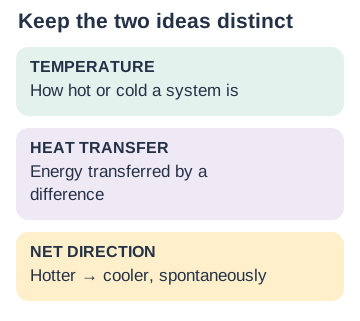
Temperature describes how hot or cold a system is in a way that predicts the direction of thermal energy transfer. Heat is energy in transfer because of a temperature difference. Saying an object “contains heat” can hide the distinction between stored internal energy and a transfer process.
A small hot cup and a large warm bucket can have different temperatures and different amounts of internal energy. Temperature alone does not tell you the total thermal energy associated with all the material. At this level, compare hotness and quantity carefully.
When a warm object touches a cooler one, net spontaneous transfer is towards the cooler object. Transfer continues towards thermal equilibrium, where there is no temperature difference driving a net transfer between them.
2. Conduction transfers energy through material
If one end of a metal spoon becomes warm, energy can be transferred along the spoon. The material as a whole does not have to travel from one end to the other. Interactions between particles, and mobile electrons in metals, help carry energy.
Metals are often good thermal conductors. Wood and many plastics conduct much less effectively under ordinary conditions, which is one reason they can be used in handles. A handle’s safety also depends on thickness, temperature and design; no material label makes a hot object safe to grab.
Touch alone is not a reliable thermometer. Metal and wood at the same room temperature can feel different because they exchange energy with your hand at different rates. Do not infer that the metal must have a lower temperature solely from that feeling.
3. Convection involves the movement of a fluid
Liquids and gases can flow. When a region of fluid is heated, it often expands and becomes less dense than nearby cooler fluid. Under gravity, this can set up rising warmer fluid and sinking cooler fluid, creating circulation.
The fluid itself transports energy as it moves. Convection is therefore different from conduction through a stationary solid. A simple circulation diagram is a model; real patterns depend on the container, heating position and surrounding conditions.
Warm air rising does not mean “heat always rises”. Conduction can transfer energy sideways or downward, and radiation can travel in many directions. Rising is a feature of some buoyancy-driven fluid motion, not a universal rule for all thermal transfer.
4. Radiation does not need a material medium
Thermal radiation is electromagnetic energy emitted by matter because of its temperature. It can travel through empty space, which explains how energy from the Sun reaches Earth. It also occurs between everyday objects at ordinary temperatures.

A warm surface can transfer energy by radiation without touching another object. Absorption, reflection and emission depend on material and surface properties as well as wavelength. Simple school comparisons of dark and shiny surfaces need the other conditions controlled.
All objects above absolute zero emit thermal radiation; a cooler object still emits it. Net radiative transfer between a warmer and cooler body is towards the cooler one under the simple comparison. Avoid saying cold objects emit nothing.
5. Insulation reduces transfer; it does not create warmth
A coat helps reduce energy loss from a warm body. Trapped air can reduce conduction and bulk circulation when held in small spaces. The coat does not generate a person’s body heat by itself. A blanket around ice can also slow energy entering from warmer surroundings.
A vacuum flask combines several features. A vacuum gap strongly reduces conduction and convection across that gap, while reflective surfaces reduce radiative transfer. The stopper and other solid connections still provide pathways, so a flask is not perfectly insulating.
Choose explanations that identify the relevant pathway. “It keeps things hot” describes an effect; “it reduces transfer through the wall and gap” begins to explain why. The same design can help keep cold contents cold by slowing incoming energy.
6. Several methods can operate together
A pot on a stove can involve conduction through metal, convection in the liquid and radiation from hot surfaces. The question may ask which mechanism dominates a particular part of the route, rather than demanding one label for the entire scene.
For a safe reasoning activity, draw the route from a warm object to its surroundings. Mark solid contact, moving fluid and radiation across a gap. Use photographs or teacher demonstrations instead of handling flames, hot metal or boiling water.
When comparing insulation, control starting temperature, container size, contents and observation time. A slower temperature change is evidence for reduced net transfer under those conditions. It does not prove the material blocks every form of energy transfer.
5 worked examples with reasoning
1. A spoon handle warms while its bowl sits in hot water.
- Energy passes through the solid spoon.
- The spoon need not flow from bowl to handle.
- Conduction is the main mechanism along the spoon.
2. Warm water rises and cooler water sinks in a heated beaker.
- The liquid itself moves.
- Bulk fluid motion transports energy.
- This is convection.
3. Energy from the Sun crosses space.
- Space does not provide a continuous fluid for convection.
- Electromagnetic radiation can travel through a vacuum.
- Radiation explains the transfer.
4. A blanket slows the melting of ice in a warm room.
- The room is warmer than the ice.
- Insulation slows energy entering the ice.
- A blanket does not only work for keeping warm things warm.
5. Why does a vacuum flask still need reflective surfaces?
- The vacuum reduces material-mediated transfer across the gap.
- Radiation can still cross the gap.
- Reflective surfaces help reduce that remaining pathway.
Save the guide or print the practice
Download to save or share
Complete guide with answers (PDF) · Worksheet without answers (PDF) · Worksheet and answer key (PDF)
Try each task before opening its answer. Give an example or reason, not only a label.
14 practice questions with explanations
Try each task before opening its answer. Give an example or reason, not only a label.
Write an answer and your reason before opening the explanation. Check the reasoning as well as the final answer.
- Direction
What is the net spontaneous direction of heat transfer?
Answer and reasoning
Hotter to cooler.
A temperature difference drives the transfer.
- Conduction
Does conduction require the whole solid to move?
Answer and reasoning
No.
Energy is transferred through interactions within the material.
- Convection
Which states of matter support ordinary bulk convection?
Answer and reasoning
Liquids and gases.
They can flow.
- Radiation
Which mechanism can cross a vacuum?
Answer and reasoning
Radiation.
Electromagnetic waves do not require a material medium.
- Misconception
Is “heat always rises” correct?
Answer and reasoning
No.
Some warm fluids rise, but energy can transfer in other directions.
- Touch
Why can room-temperature metal feel cooler than wood?
Answer and reasoning
It can draw energy from your hand faster.
Feeling alone does not establish a lower temperature.
- Insulation
Does a coat create body heat by itself?
Answer and reasoning
No.
It mainly reduces transfer from the body.
- Cold
Can insulation slow ice melting?
Answer and reasoning
Yes.
It reduces incoming energy from warmer surroundings.
- Flask
Why is a vacuum gap useful?
Answer and reasoning
It greatly reduces conduction and convection across the gap.
Radiation still needs consideration.
- Emission
Does a cool object emit no thermal radiation?
Answer and reasoning
No.
Objects above absolute zero emit radiation.
- Combined
Can one cooking scene involve all three mechanisms?
Answer and reasoning
Yes.
Different parts of the route can use different pathways.
- Fair test
Name one control when comparing containers.
Answer and reasoning
For example: equal starting temperature and equal water amount.
Unequal starting conditions can confuse the comparison.
- Safety
Should a learner touch hot metal to identify conduction?
Answer and reasoning
No.
Use a diagram or supervised demonstration.
- Explain
Why is “it keeps things hot” incomplete as an explanation?
Answer and reasoning
It states the effect without the transfer mechanism.
Explain which pathways are reduced.
Use the ideas without looking at the notes
Sketch a warm drink cooling in a cup. Label one solid-contact route, one fluid-motion route and one radiative route. Explain how a lid or insulating sleeve changes the transfer.
Common questions
Are heat and temperature the same?
No. Heat is energy transferred because of a temperature difference; temperature describes thermal state.
Why does convection occur in fluids?
Fluid can move in bulk, carrying energy; density differences often drive natural circulation.
Does radiation need air?
No. It can travel through a vacuum.
Can insulation keep something cold?
Yes. It can slow energy entering from warmer surroundings.
Is only one mechanism active at a time?
No. Several can act together.
Connect your learning
Ask about guided Science learning if your child needs help explaining these ideas.
About this guide
Original explanations, examples, diagrams and practice by BananaLearn. The grade label indicates the intended learning level; this is not an official textbook extract or exam paper.