
Start with the key idea
In photosynthesis, green plants use light energy to make sugars from carbon dioxide and water, releasing oxygen. Chlorophyll helps absorb light. Plants also need mineral nutrients and carry out respiration. Most green plants are autotrophs, but some plants obtain nutrients through parasitic, symbiotic or insect-trapping relationships.
1. Distinguish food-making from absorbing minerals
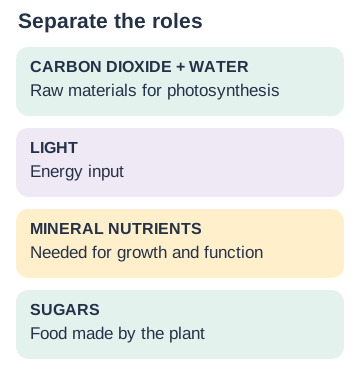
Animals obtain organic food by eating other organisms or their products. A green plant can make sugars from simple raw materials using light energy. This is autotrophic nutrition. The plant still depends on its environment for resources.
Roots absorb water and dissolved mineral nutrients. Those minerals are essential, but they are not the same as the sugars produced in photosynthesis. Fertiliser supplies nutrients; it does not replace the plant’s need for light, water and carbon dioxide.
Much of the carbon in a growing plant’s organic material comes from carbon dioxide in the air. A simple claim that all new plant mass comes from soil is therefore wrong. Water and mineral nutrients also contribute to the living system.
2. Follow the inputs and products
The simplified word equation is carbon dioxide + water → glucose + oxygen, using light energy and chlorophyll-containing structures. This school equation summarises a complex process rather than showing every intermediate step.
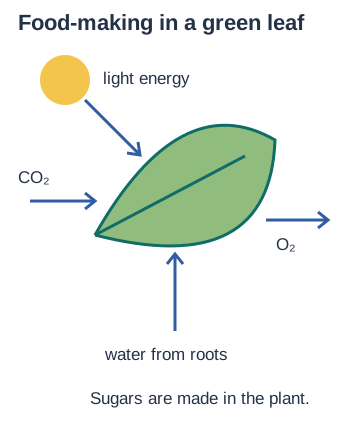
Carbon dioxide reaches leaves through gas exchange, often involving stomata. Water is absorbed by roots and transported through the plant. Chlorophyll in chloroplasts helps capture light energy. Sugars can be used in respiration, growth or storage.
Oxygen is released during photosynthesis. In a simple diagram, distinguish material arrows from the light-energy arrow. Light is energy entering the process; it is not a molecule that is converted into a piece of plant tissue.
3. Explain why leaves are useful food-making structures
Many leaves have a broad surface that can intercept light. Their tissues contain chloroplasts, and their internal spaces and stomata support gas exchange. Veins help move water and products. Structure and function fit together.
Leaves are not the only green parts that can photosynthesise. Green stems can also contribute. Likewise, a variegated leaf may have areas with less chlorophyll, so not every visible region has the same capacity. State the typical pattern without making it absolute.
Plants regulate gas exchange and water loss. Stomata are not simply permanently open holes. Their behaviour depends on conditions and species; the Grade 7 model introduces their role without claiming every plant follows the same daily schedule.
4. Plants respire as well as photosynthesise
Respiration releases usable energy from food in cells. Plants carry it out in living tissues during day and night. Photosynthesis requires suitable light, but respiration does not stop when the Sun sets.
During bright conditions, a green plant’s photosynthesis may exceed respiration, producing a net release of oxygen. In darkness, photosynthesis stops while respiration continues, so the net gas exchange differs. Net observation is the combined result of processes.
Avoid saying “plants breathe only carbon dioxide” or “plants do not need oxygen”. Aerobic respiration uses oxygen. The processes have different purposes: photosynthesis stores energy in organic compounds, while respiration releases usable energy from them.
5. Compare other nutrition relationships
A parasitic plant such as Cuscuta obtains resources from a host plant. Its nutrition is different from that of an ordinary green plant making most of its own food. Parasitism benefits the parasite at a cost to the host.
Insectivorous plants such as pitcher plants usually photosynthesise but trap animals to obtain scarce mineral nutrients, especially nitrogen, from their bodies. Saying they eat insects because they cannot make any food misses the distinction between sugars and minerals.
In symbiosis, organisms can live in close association with mutual benefit. Rhizobium bacteria associated with legume roots can make atmospheric nitrogen available in compounds the plant can use; the bacteria receive resources from the plant. Fungi are not plants, so mushroom nutrition should not be used as proof that all plants absorb dead matter.
6. Use experiments as evidence, not rituals
A starch test can provide evidence related to photosynthesis under controlled conditions. However, boiling leaves and using alcohol or iodine require trained supervision and appropriate safety precautions. This page uses the reasoning behind the test rather than directing children to heat chemicals at home.
To interpret an investigation, identify the variable changed, the comparison and what the test actually detects. Finding starch is not the same as directly watching every step of sugar production. Pre-existing stored starch and uncontrolled light can affect a weak design.
For independent practice, draw an input-output diagram and explain what would change if light or carbon dioxide were unavailable. State assumptions, such as a healthy green plant and sufficient time for a measurable effect, instead of claiming an immediate visible result.
5 worked examples with reasoning
1. Explain why fertiliser is not a substitute for sunlight.
- Fertiliser supplies mineral nutrients.
- Light supplies energy for photosynthesis.
- They serve different roles.
2. Write the simplified photosynthesis word equation.
- Carbon dioxide and water are raw materials.
- Glucose and oxygen are products in the school summary.
- Add light energy and chlorophyll as required conditions, not as material products.
3. Does a plant stop respiration at night?
- No. Living cells continue using energy.
- Respiration continues while photosynthesis lacks light.
- The net gas exchange changes.
4. Why does a pitcher plant trap insects if it is green?
- It can make sugars through photosynthesis.
- Its habitat may provide too little of certain mineral nutrients.
- Trapped insects supplement those nutrients.
5. Why is a starch test not a complete direct measurement of photosynthesis?
- It detects starch present in the tested tissue.
- Storage and earlier conditions can influence that result.
- A controlled comparison is needed to support the intended conclusion.
Save the guide or print the practice
Download to save or share
Complete guide with answers (PDF) · Worksheet without answers (PDF) · Worksheet and answer key (PDF)
Try each task before opening its answer. Give an example or reason, not only a label.
14 practice questions with explanations
Try each task before opening its answer. Give an example or reason, not only a label.
Write an answer and your reason before opening the explanation. Check the reasoning as well as the final answer.
- Input
Name the two material inputs in the simplified equation.
Answer and reasoning
Carbon dioxide and water.
Light supplies energy rather than matter.
- Energy
What is sunlight’s role?
Answer and reasoning
Energy input.
It powers the food-making process.
- Pigment
What does chlorophyll help do?
Answer and reasoning
Absorb light.
It is involved in capturing energy for photosynthesis.
- Product
Name a gas released in photosynthesis.
Answer and reasoning
Oxygen.
It appears among the products in the school summary.
- Roots
What do roots normally absorb from soil?
Answer and reasoning
Water and dissolved mineral nutrients.
These differ from sugars made in the plant.
- Location
Can a green stem photosynthesise?
Answer and reasoning
Yes.
Leaves are common main sites, but not the only possible green tissue.
- Respiration
Do plants respire during the day?
Answer and reasoning
Yes.
Photosynthesis and respiration can occur at the same time.
- Night
What happens to photosynthesis in darkness?
Answer and reasoning
It stops for lack of light in the ordinary process.
Respiration continues in living cells.
- Mass
Does all new plant dry mass come from soil?
Answer and reasoning
No.
Carbon dioxide supplies carbon for organic compounds.
- Pitcher
Why can an insectivorous plant still be autotrophic for sugars?
Answer and reasoning
It photosynthesises while obtaining extra minerals from prey.
Food energy and mineral needs are distinct.
- Parasite
What is a host in a parasitic relationship?
Answer and reasoning
The organism from which the parasite obtains resources.
The host is harmed or bears a cost.
- Legume
What do associated Rhizobium bacteria help provide?
Answer and reasoning
Usable nitrogen compounds.
They participate in nitrogen fixation in the root association.
- Classification
Are mushrooms plants?
Answer and reasoning
No.
They are fungi, a separate group.
- Safety
Should a child heat alcohol for a leaf test alone?
Answer and reasoning
No.
Such laboratory procedures require trained supervision and safety controls.
Use the ideas without looking at the notes
Draw separate arrows for carbon dioxide, water, light energy, sugars and oxygen. Then write one sentence each about photosynthesis, respiration and mineral uptake so their roles remain distinct.
Common questions
Is fertiliser plant food in the same sense as glucose?
No. It supplies mineral nutrients, while photosynthesis makes sugars.
Do plants need oxygen?
Yes, for aerobic respiration in living tissues.
Do all plant parts photosynthesise?
No. The capability depends on suitable structures and pigments; many roots do not.
Why do insectivorous plants catch insects?
They commonly supplement mineral nutrients while still photosynthesising.
Is a starch test a home activity?
The usual heated chemical procedure requires trained supervision; use the explanatory model here.
Connect your learning
Ask about guided Science learning if your child needs help explaining these ideas.
About this guide
Original explanations, examples, diagrams and practice by BananaLearn. The grade label indicates the intended learning level; this is not an official textbook extract or exam paper.