Maths · Suggested Grade 7–8
Percentage vs Percentage Points: Class 7–8 Examples
A score rising from 40% to 50% goes up by 10 percentage points—but the relative increase is 25%. Both statements can be right because they answer different questions.
Original explanations and practice by BananaLearn · Published 1 November 2026
On a small screen, swipe across the illustration to read every label.
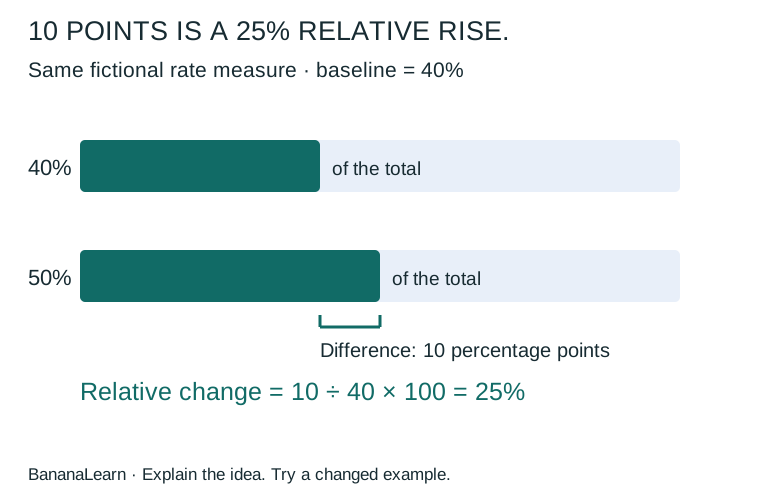
Two questions hidden in one comparison
A percentage-point difference subtracts two percentages directly. A relative percentage change compares the change with the original value. Moving from 40% to 50% gives 50 − 40 = 10 percentage points. Relative to the original 40%, that difference is 10/40 × 100 = 25%.
Always label the type of change. Saying increased by 10% can be ambiguous when the starting value is itself a percentage. Write either 10 percentage points or a 25% relative increase. This guide compares numerical rates and fictional data; it does not establish an improvement in any real class.
Worked example with equal-sized groups
Imagine two fictional surveys of 100 responses each. The first records 40 choosing the library; the second records 50. Their rates are 40% and 50%. The rate difference is 10 percentage points. The selected-response count also increased by 10 because both totals happen to be 100.
The relative rate increase remains 10/40 = 1/4 = 25%. Multiplying the original rate by 1.25 checks it: 40% × 1.25 = 50%. The multiplier operates on the rate, not on the percentage-point label.
When the group sizes change
Now compare 40 out of 100 with 100 out of 200. Rates are again 40% and 50%, so the percentage-point change is still 10 and the relative rate increase is still 25%. But the count rises from 40 to 100: a 150% count increase. These are three different measurements.
A useful report names the numerator, denominator and rate in both periods. If group composition changed, even a correctly calculated rate difference does not by itself explain its cause. Do not claim that a particular lesson, app or policy caused the change just because the percentages differ.
Decreases need the original base too
A rate falls from 60% to 45%. The change is −15 percentage points, or a decrease of 15 percentage points. The relative decrease is 15/60 × 100 = 25%. Use the original 60 as the base, not the new 45.
Reversing the journey gives a different relative change: 45% to 60% is an increase of 15/45 × 100 = 33⅓%. The percentage-point difference has the same magnitude in both directions, but the relative percentage has a different denominator.
Translate a relative change back into a rate
A fictional rate of 20% increases by 10% relative to itself. Ten per cent of 20% is 2 percentage points, so the new rate is 22%. It is not 30%. In multiplier form, 20% × 1.10 = 22%. If the instruction had said an increase of 10 percentage points, then the answer would be 30%.
For a relative decrease of 20% from a rate of 50%, use 50% × 0.80 = 40%. The percentage-point fall is 10. Reading the unit before calculating prevents the most common error: treating the two descriptions as interchangeable.
Zero and the limits of the formula
A rise from 0% to 5% is a rise of 5 percentage points. A standard relative percentage increase cannot be calculated because its denominator would be zero. Do not call it a 5% relative increase or an infinite percentage improvement. State the before-and-after rates and the point change.
For meaningful comparisons, the two rates should describe comparable quantities. A percentage of students and a percentage of marks are not automatically the same measure. Check what each percentage means before applying subtraction, even when the arithmetic looks simple.
Write a clear explanation
A complete model sentence is: In the fictional equal-sized surveys, the share choosing the library rose from 40% to 50%, a 10-percentage-point rise and a 25% increase relative to the original rate. If the audience needs only the absolute rate difference, the first change measure may be sufficient.
Use the record below to separate rates, point difference and relative change. Parents can ask Which number is the original base? and What exactly is being counted? A correct answer should preserve the units and acknowledge when a cause or unique-person count has not been established.
Keep three measurements separate
Copy the record into a notebook or use it to organise your own answer. Blank spaces are for your work.
| Change | Point difference | Relative change | Base used |
|---|---|---|---|
| 40% → 50% | +10 points | +25% | 40% |
| 60% → 45% | −15 points | −25% | 60% |
| 20% → 22% | +2 points | +10% | 20% |
| Your comparison | ___ | ___ | ___ |
12 questions with explained answers
Try the questions before opening the answers. Explain the reason, then try a changed example to check your understanding.
30% to 45%: point increase?
Show answer and explanation
15 percentage points
45 − 30 = 15.30% to 45%: relative increase?
Show answer and explanation
50%
15/30 × 100 = 50.80% to 60%: point decrease?
Show answer and explanation
20 percentage points
80 − 60 = 20.80% to 60%: relative decrease?
Show answer and explanation
25%
20/80 × 100 = 25.20% rises by 10% relative. New rate?
Show answer and explanation
22%
20 × 1.10 = 22.20% rises by 10 percentage points. New rate?
Show answer and explanation
30%
20 + 10 = 30.50% decreases by 20% relative. New rate?
Show answer and explanation
40%
50 × 0.8 = 40.40% to 50%: which original base finds relative change?
Show answer and explanation
40%
Use the starting rate.45% to 60%: relative increase?
Show answer and explanation
33⅓%
15/45 = 1/3.0% to 5%: standard relative increase?
Show answer and explanation
Undefined
The formula would divide by zero; point increase is 5.40/100 to 100/200: count increase?
Show answer and explanation
150%
The count grows by 60 from an original 40.Does a rate increase prove an app caused it?
Show answer and explanation
No
Causation requires evidence beyond the rate comparison.
Keep the ideas connected
For help with a school-learning difficulty, bring one attempted question to a discussion about tutoring and curriculum fit. Maths is our priority; English and Science tutoring are also available.
Sources, scope and sharing
The examples, diagrams and practice are original BananaLearn work. Grade labels suggest a learning level; teaching sequences and school requirements can differ. Official sources below support the stated facts and resource links. These activities are independent resources, not official exam questions or endorsed campaign materials.
How we prepare learning guides · Report a correction
Share this guide: https://bananalearn.com/learn/class-7-percentages-percentage-points.html