
Start with the key idea
Use the school’s actual topic list, then check whether you can describe an idea, apply it and explain evidence. This guide revisits selected familiar science themes with original practice; it is not a complete current NCERT syllabus, official examination paper or substitute for the school’s prescribed textbook.
1. Make the checklist about actions, not chapter ticks
Begin with the teacher’s current scope and textbook edition. List only the topics that belong to the learner’s course. The examples below cover selected ideas in plant nutrition, heat, indicators, changes, circuits and evidence; schools and textbook editions may organise them differently.
Beside each topic, write an action: explain how plants make food, compare heat transfer, interpret an indicator result or justify whether a change forms a new substance. Record independent, with support or needs teaching after a suitable task. A confidence rating can start a conversation, but should be checked against work.
If a topic has not yet been taught, mark it not yet studied. Revision cannot replace the first explanation of a new idea. Use the worksheet to identify a next step rather than to assign a permanent ability label or a formal science level.
2. Explain plant nutrition as a connected process
Green plants can make sugars through photosynthesis using carbon dioxide and water with light energy captured by chlorophyll. Oxygen is released. At this level, connect the inputs, the role of light and the products instead of remembering a list of words without relationships.
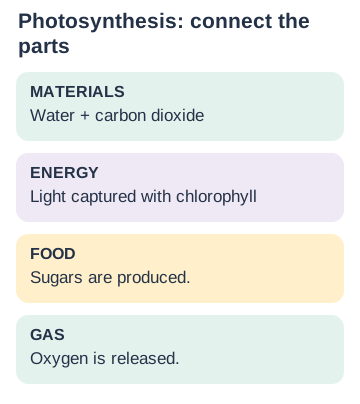
Roots absorb water and mineral nutrients from the soil, but soil is not the plant’s ready-made food. Distinguish the materials absorbed from the sugars produced through photosynthesis. Plants also respire; photosynthesis is not a replacement for all the other processes of living cells.
When interpreting an investigation, ask what was changed, what was observed and what the result can support. A simple class demonstration can illustrate an idea, but do not overstate it as proof of every part of plant nutrition. Follow the teacher’s laboratory instructions; this guide does not ask children to heat chemicals or perform unsupervised tests.
3. Keep temperature and heat transfer distinct
Temperature describes how hot or cold something is on a temperature scale. Heat is energy transferred because of a temperature difference. In an ordinary situation, net heat transfer is from the hotter object or region to the cooler one until conditions change or thermal equilibrium is approached.
Conduction transfers energy through interactions within a material without bulk movement of the material as a whole. A metal spoon in warm water can warm along its handle. Convection involves movement within a fluid, while radiation can transfer energy without requiring a material medium. Use examples to distinguish the mechanisms.
Feeling is not a reliable way to compare temperatures across materials. A metal and wooden object in the same room can feel different because they transfer energy at different rates. Do not touch hot objects to test this explanation; use teacher-provided data or a safe discussion example.
4. Read chemical evidence carefully
An acid–base indicator changes appearance under different conditions. In the familiar litmus test, an acidic solution turns blue litmus red, while a basic solution turns red litmus blue. A single unchanged strip may not distinguish all possibilities: unchanged red litmus alone does not prove a solution is acidic.
Never taste an unknown substance to identify it. Household materials and cleaning products can be hazardous, and mixing chemicals is not a suitable unsupervised revision activity. The questions here use stated observations, so they can be answered without handling substances.
A physical change alters features such as state or shape without producing a different substance in the simple examples used here. Melting ice leaves water as the substance. Rusting iron forms new substances and is a chemical change. Reversibility can be a clue in some examples, but “easy to reverse” is not a complete definition of physical change.
5. Follow the complete path in an electric circuit
In a simple cell–wire–bulb circuit, the components need a complete conducting path for a steady current. An open switch breaks the path. A bulb that does not light can have several causes, including an open connection, a depleted cell or a faulty bulb; one symptom does not identify the cause by itself.
A conductor allows charge to move readily compared with an insulator in the relevant conditions. Metals are commonly used for conducting wires, while suitable insulating coverings help prevent unintended contact. These are basic descriptions, not instructions for working with household electrical supplies.
Use diagrams and teacher-supervised low-voltage classroom equipment where appropriate. Never investigate mains sockets, exposed household wiring or electrical appliances as a home science task. A revision question can test the circuit idea safely through a described switch position or diagram.
6. Revise explanations and fair comparisons
A useful science answer links a claim with an observation and a scientific idea. For example, “The bulb went out when the switch opened because the conducting path was broken” is more explanatory than “because electricity stopped”. Name the relevant change and why it matters.
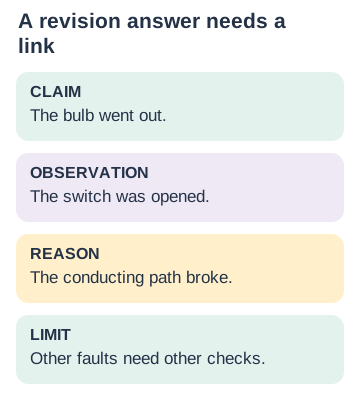
In a comparison, change the factor being investigated while keeping other relevant conditions as similar as possible. If testing how a covering affects cooling, starting temperature, amount of water, container and timing need attention. This is a planning example; adults and teachers should decide any safe practical procedure.
After correcting a response, try a different application and explain the limit of the evidence. One observation may support a hypothesis without excluding every alternative. Keep a short error log with the original claim, the corrected explanation and a fresh check rather than copying an entire chapter again.
My science explanation checklist
Complete a row of thinking for one actual school topic. Mark it independent, with support, not yet studied or needs teaching; these labels describe the attempt, not the learner.
School topic and textbook section: ____________________
One action I should be able to do: ____________________
My explanation or labelled model: ____________________
Evidence or example that supports it: ____________________
What the evidence does not establish: ____________________
Support needed and next fresh task: ____________________
Save the full guide to keep this record with the explanations. The separate worksheet contains the practice and decision questions; use its answer version to check your reasoning.
5 worked examples with reasoning
1. Correct “plants get their food ready-made from soil”.
- Roots absorb water and mineral nutrients.
- Green plants can make sugars through photosynthesis using carbon dioxide and water with light energy.
- Distinguish absorbed materials from the food produced.
2. Explain why a metal object can feel cooler than wood in the same room.
- The objects may be at the same room temperature.
- Metal can transfer heat away from a warmer hand more quickly.
- The different sensation does not prove different starting temperatures.
3. Red litmus stays red in an unknown solution.
- That observation alone does not establish acidity.
- An acidic or neutral solution can leave red litmus unchanged in the usual school model.
- Use the other stated indicator evidence rather than guessing or tasting.
4. Classify melting ice and rusting iron.
- Melting changes state while the substance remains water.
- Rusting forms new substances.
- The examples illustrate physical and chemical change respectively.
5. A bulb goes out after a switch is opened.
- Opening the switch breaks the conducting path.
- The simple circuit is no longer complete.
- The observation supports the path explanation; other bulb failures would need separate checks.
Save the guide or print the practice
Download to save or share
Complete guide with answers (PDF) · Worksheet without answers (PDF) · Worksheet and answer key (PDF)
Answer all twenty science questions using the stated observations. Explain your reasoning. No practical experiment is needed.
20 practice questions with explanations
Answer all twenty science questions using the stated observations. Explain your reasoning. No practical experiment is needed.
Write an answer and your reason before opening the explanation. Check the reasoning as well as the final answer.
- Plants
Name two raw materials used in photosynthesis.
Answer and reasoning
Carbon dioxide and water.
Light supplies energy; it is not listed here as a material substance.
- Plants
What role does chlorophyll play in the school-level explanation?
Answer and reasoning
It helps capture light energy.
That energy is used in photosynthesis.
- Plants
Is soil the plant’s ready-made food?
Answer and reasoning
No.
Roots absorb water and minerals; sugars are made through photosynthesis in green tissues under suitable conditions.
- Plants
Name a gas released during photosynthesis.
Answer and reasoning
Oxygen.
It is one of the products.
- Heat
In the ordinary case, which way is net heat transferred between hot and cool objects?
Answer and reasoning
From the hotter object to the cooler one.
The temperature difference drives the transfer.
- Heat
A spoon handle warms from its end in warm water. Name the main transfer process along the solid spoon.
Answer and reasoning
Conduction.
Energy transfers through the material without bulk flow of the spoon.
- Heat
Which heat-transfer mechanism can occur through empty space?
Answer and reasoning
Radiation.
It does not require a material medium.
- Heat
Does a cooler-feeling metal block necessarily have a lower temperature than nearby wood?
Answer and reasoning
No.
Different rates of heat transfer can produce different sensations.
- Indicator
Blue litmus turns red in a stated test. What does this indicate in the usual school model?
Answer and reasoning
An acidic solution.
That is the characteristic litmus response to acidity.
- Indicator
Red litmus turns blue. What does this indicate?
Answer and reasoning
A basic solution.
That is the characteristic response to basic conditions.
- Indicator
Does unchanged red litmus alone prove acidity?
Answer and reasoning
No.
Neutral conditions can also leave it unchanged.
- Safety
Should an unknown solution be tasted to identify it?
Answer and reasoning
No.
Use the stated observations or teacher-approved methods.
- Change
Classify melting ice.
Answer and reasoning
Physical change.
The substance remains water while its state changes.
- Change
Classify rusting iron.
Answer and reasoning
Chemical change.
New substances form.
- Definition
Is easy reversibility a complete definition of physical change?
Answer and reasoning
No.
The key distinction in these examples is whether a new substance forms.
- Circuit
What does opening a switch do in a simple circuit?
Answer and reasoning
Breaks the conducting path.
A steady current cannot continue around that open path.
- Circuit
Does an unlit bulb prove the switch is open?
Answer and reasoning
No.
A depleted cell or faulty connection or bulb may also explain it.
- Safety
Should a learner investigate a household mains socket for this worksheet?
Answer and reasoning
No.
Use descriptions, diagrams or appropriate teacher-supervised low-voltage equipment.
- Fair test
Name two conditions to keep similar when comparing how coverings affect cooling.
Answer and reasoning
For example, starting temperature and amount of water.
Other relevant conditions such as container and timing also matter.
- Revision
What should follow copying a corrected explanation?
Answer and reasoning
A fresh application with a reason.
Copying does not by itself show the idea can be used.
Use the ideas without looking at the notes
Use the school’s topic list. For each idea, explain the process, apply it and identify supporting evidence. Keep physical and chemical changes distinct, interpret indicators from sufficient information and use safe described examples. Record support and revisit a fresh task.
Common questions
Is this a complete Class 7 NCERT checklist?
No. Match it with the school’s current book and scope; these are selected original revision examples.
Do we need to perform experiments to answer the worksheet?
No. All questions can be answered from the described situations and explanations.
Should confidence alone decide which topics are secure?
No. Check an explanation or suitable application and record support needed.
How should an unclear answer be revised?
Identify the missing idea, write a reasoned correction and try a different example.
Connect your learning
Ask about one-to-one learning support if your child needs help explaining these ideas.
About this guide
Original explanations, examples, diagrams and practice by BananaLearn. The grade label indicates the intended learning level; this is not an official textbook extract or exam paper.