
Start with the key idea
In active voice, the subject performs the action. In passive voice, the receiver of the action becomes the grammatical subject, using a suitable form of be plus a past participle. The actor can be included with by when it matters.
1. Understand the change in focus
In “The team repaired the bridge”, the team is the subject, repaired is the action and the bridge is the object receiving that action. In “The bridge was repaired by the team”, the bridge becomes the grammatical subject. The event is the same, but the reader’s attention begins in a different place.
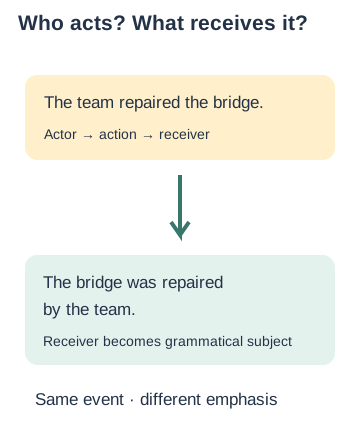
Do not define subject simply as the doer in every sentence. That description works for many active examples, but a passive subject receives or undergoes the action. Identifying grammatical function is more reliable than asking only who did something.
The passive is useful when the receiver or result matters most, the actor is unknown, or the actor is obvious from context. It is not automatically more formal, better or worse than active voice. Choose the form that makes the intended message clear.
2. Find the object before transforming
Start with an active sentence that has an object: “Lena opened the window.” Move the object into subject position: “The window …”. Add the correct form of be and the past participle: “The window was opened …”. Include “by Lena” if the actor is important.
Keep pronoun forms correct. “She helped him” becomes “He was helped by her.” Him changes to he because it becomes the subject; she changes to her after the preposition by. These are grammatical role changes, not arbitrary substitutions.
Check agreement with the new subject. “They cleaned the rooms” becomes “The rooms were cleaned”, not was cleaned. The original actor’s number does not control the passive verb once a different subject is in place.
3. Preserve tense and use the past participle
The passive needs a suitable form of be plus the past participle of the main verb. Present simple uses am, is or are: “The room is cleaned.” Past simple uses was or were: “The room was cleaned.” A future example uses will be: “The room will be cleaned.”

The past participle is not always identical to the simple past form. Write becomes wrote in simple past but written as a participle. “They wrote the notice” therefore becomes “The notice was written”, not was wrote. Learn irregular participles through complete examples.
For a modal such as can or must, use modal + be + past participle: “The form must be signed.” The word signed does not make the whole sentence past tense; the auxiliary structure carries the time or modal meaning.
4. Recognise continuous and perfect patterns
For present continuous, use am/is/are being plus past participle: “They are painting the gate” becomes “The gate is being painted.” The word being keeps the ongoing-action meaning. Leaving it out changes the aspect to a general present passive.
For present perfect, use has/have been plus past participle: “They have repaired the road” becomes “The road has been repaired.” The new singular subject road takes has. In past perfect, had been is used regardless of singular or plural subject.
Work with the time meaning before memorising a table. Ask whether the action is habitual, completed, ongoing or presented with a connection to the present. Some very complex passive combinations are grammatically possible but awkward; a clear active rewrite may serve the reader better.
5. Know when a passive transformation does not fit
An ordinary passive transformation needs an object to promote. “The baby slept” has no direct object, so “Sleep was slept by the baby” is not an appropriate transformation. Likewise, linking-verb sentences such as “Mina is happy” are not active actions waiting to become passive.
A form of be does not by itself prove passive voice. “The child is running” is active continuous; “The child is tired” may describe a state. Look for the relationship between actor, action and receiver instead of circling every is or was.
When converting a passive sentence back to active, you may need an actor that the original omitted. “The window was broken” does not tell us who broke it. Do not invent a named person and present that invention as equivalent information.
6. Use voice as an editing choice
Compare “We will send your report on Friday” with “Your report will be sent on Friday.” The first makes responsibility explicit; the second foregrounds the report but leaves the sender unstated. In instructions, notices and explanations, decide which emphasis helps the reader.
A by-phrase is optional when the actor is irrelevant, but it should remain when it carries important information. “The poem was written by Asha” loses a key fact if the question is who wrote the poem. Avoid treating deletion of by as an automatic final step.
After transforming, audit subject agreement, tense or aspect, participle form and meaning. Read both sentences aloud and check that you have not changed a possibility into a certainty, a future action into a past one, or an unknown actor into a guessed person.
5 worked examples with reasoning
1. Change: Lena opened the window.
- The object window becomes subject.
- Past simple needs was + opened.
- The window was opened by Lena.
2. Change: They clean the rooms.
- Rooms is plural.
- Present simple passive uses are cleaned.
- The rooms are cleaned by them; omit the actor only if unimportant.
3. Change: She wrote the notice.
- Move notice to subject position.
- Use was and the participle written.
- The notice was written by her.
4. Change: They are repairing the bridge.
- Preserve the ongoing meaning.
- Use is being repaired for the singular bridge.
- The bridge is being repaired by them.
5. Can “The baby slept” be transformed in the same way?
- Find a direct object; there is none.
- There is no receiver to promote to subject.
- Do not force a passive transformation.
Save the guide or print the practice
Download to save or share
Complete guide with answers (PDF) · Worksheet without answers (PDF) · Worksheet and answer key (PDF)
Try each task before opening its answer. Give an example or reason, not only a label.
14 practice questions with explanations
Try each task before opening its answer. Give an example or reason, not only a label.
Write an answer and your reason before opening the explanation. Check the reasoning as well as the final answer.
- Identify
In “Ravi kicked the ball”, what receives the action?
Answer and reasoning
The ball.
It is the direct object.
- Transform
Change: Asha painted the wall.
Answer and reasoning
The wall was painted by Asha.
Past simple becomes was + past participle.
- Agreement
Change: They washed the cups.
Answer and reasoning
The cups were washed by them.
The new subject is plural.
- Present
Change: They deliver the letters.
Answer and reasoning
The letters are delivered by them.
Use present simple passive.
- Future
Change: We will finish the work.
Answer and reasoning
The work will be finished by us.
Keep will and add be + participle.
- Modal
Change: You must sign the form.
Answer and reasoning
The form must be signed by you.
The modal meaning stays must.
- Pronoun
Change: She helped him.
Answer and reasoning
He was helped by her.
Pronouns change according to grammatical role.
- Participle
Repair: The letter was wrote yesterday.
Answer and reasoning
The letter was written yesterday.
Written is the past participle.
- Continuous
Change: They are cleaning the room.
Answer and reasoning
The room is being cleaned by them.
Being preserves the continuous meaning.
- Perfect
Change: They have repaired the road.
Answer and reasoning
The road has been repaired by them.
Singular road takes has.
- Limit
Can “The bird flew” be passivised by moving an object?
Answer and reasoning
No direct object is present.
Do not invent a receiver.
- Identify
Is “Mina is running” passive?
Answer and reasoning
No.
It is active continuous.
- Meaning
May an unknown actor be replaced with a guessed name?
Answer and reasoning
No.
That adds unsupported information.
- Choice
Why might a writer omit the by-phrase?
Answer and reasoning
The actor may be unknown, obvious or unimportant.
The omission should serve meaning.
Use the ideas without looking at the notes
Write one active sentence in present, past, future, continuous and perfect form. Change each to passive, then underline the auxiliaries and explain which information becomes the focus.
Common questions
Is passive voice always bad writing?
No. It is useful when the receiver, result or unknown actor is the focus.
Does every sentence with was use passive voice?
No. Was also appears in descriptions and active continuous forms.
Must a passive sentence include by?
No. Include the actor when useful or necessary.
Why use written instead of wrote after was?
The passive requires a past participle.
Can every active sentence become passive?
No. The basic transformation requires a suitable object.
Connect your learning
Ask about guided English learning if your child needs help explaining these ideas.
About this guide
Original explanations, examples, diagrams and practice by BananaLearn. The grade label indicates the intended learning level; this is not an official textbook extract or exam paper.