
Start with the key idea
A linear equation in two variables has the form ax+by+c=0, with a and b not both zero. A solution is an ordered pair (x, y) satisfying it. Over the real numbers, one such equation represents a straight line and has infinitely many solutions.
1. Recognise what makes the equation linear
In 2 x+3 y=12, each variable appears only to the first power, and there is no product xy. The constants multiply the variables and the terms are added. Rewriting gives 2 x+3 y −12=0.
An equation such as x²+y=12 is not linear in x and y. Neither is xy=12. A zero coefficient is allowed: x=4 is linear even though y does not appear explicitly. At least one variable coefficient must be nonzero.
The pair of coefficients also explains a special case. In 0 x + 0 y = 6, the left side is always zero, so there are no solutions. In 0 x + 0 y = 0, every pair works. Neither fits the stated definition with at least one nonzero variable coefficient, and neither represents one ordinary line.
2. Test an ordered pair by substitution
The pair (1, 4) means x=1 and y=4 in that order. In 2 x+y=6, substituting gives 2×1+4=6. The pair satisfies the equation. Reversing coordinates gives (4, 1), which produces 9 and fails.
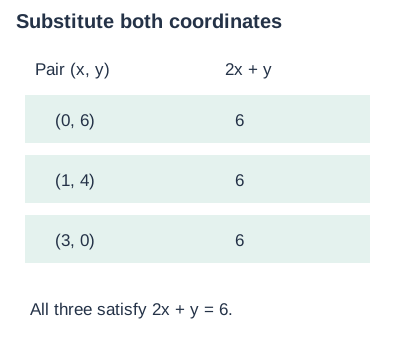
A solution is the pair together, not either coordinate on its own. If someone says “x=1 is the answer”, ask what y must be. With x fixed at 1 here, y must be 4.
Try a table with columns x, y, left side and right side. For the proposed pair (2, 4) in 2 x + y = 6, the left side is 8 and the right side is 6. Writing both values exposes the failure. Do not adjust the equation or exchange the coordinates merely to make a candidate work.
3. Generate solutions systematically
Rearrange 2 x+y=6 as y=6−2 x. Choose x values and calculate their matching y values. For x=0, 1, 2, 3 the y values are 6, 4, 2, 0. Record each as a pair.
The chosen x values do not have to be positive integers. x=1.5 gives y=3, and x=−1 gives y=8. Restrictions may come from a story, but the algebraic line itself contains real-number solutions.
There is freedom in choosing one coordinate because only one relation connects the two. This does not mean y can be chosen independently after x has been fixed. For y = 6 − 2 x, choosing x = 2 forces y = 2. The freedom concerns selecting a starting coordinate, not ignoring the relation.
4. Plot points and draw the line
For x+y=4, pairs (0, 4),(1, 3),(4, 0) lie on the same straight line. Plot x horizontally and y vertically, label the axes and use a consistent scale. Draw a straight line through the points.
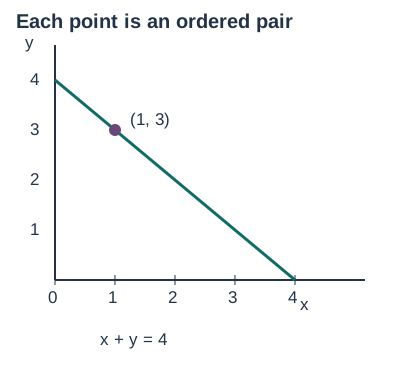
Two distinct points determine a line, but calculating a third point is a useful error check. If it does not lie on the line, revisit substitution or plotting. Do not connect points with a zigzag merely because they were listed in a different order.
The graph labels equal steps of one on each axis; check the numerical scale before reading a point. Axes need not have identical physical scales, but unequal scales change how steep a line looks. Judge solutions by coordinates rather than by a visual guess about the line’s angle.
5. Read horizontal and vertical lines correctly
The equation y=3 fixes the vertical coordinate while x may vary, so it is a horizontal line. The equation x=−2 fixes the horizontal coordinate while y may vary, so it is vertical.
Intercepts are where a line meets an axis. On the x-axis, y=0; on the y-axis, x=0. Some lines have no intercept on one axis: y=3 never meets the x-axis. Do not force an intercept that does not exist.
For an intercept example, 2 x + y = 6 meets the vertical axis at (0, 6) and the horizontal axis at (3, 0). A learner who writes (6, 0) for the first point has exchanged the axes. State which coordinate is zero before calculating the other one.
6. Apply the story’s restrictions after solving
If adult tickets cost ₹100 and child tickets ₹60, a total of ₹400 gives 100 a+60 c=400. The algebra permits many real pairs, but ticket counts must be whole and non-negative. Check those restrictions separately.
For this example, 4 adults and 0 children works, as does 1 adult and 5 children. A fractional number of tickets would not fit the purchase story. One equation usually cannot determine a unique pair without another condition, such as the total number of tickets.
To find all ticket-count pairs in the example, let a range from zero to four and calculate c = (400 − 100 a)/60. Only a = 1 and a = 4 give non-negative whole-number values for c. A short systematic table establishes completeness more reliably than guessing two pairs and assuming there are no others.
5 worked examples with reasoning
1. Test (2, 3) in 3 x+y=9.
- Substitute x=2, y=3.
- 3×2+3=9.
- The pair is a solution.
2. Find a solution of x+2 y=8 with y=3.
- x+6=8.
- x=2.
- The ordered pair is (2, 3).
3. Find the intercepts of 2 x+y=6.
- Set x=0 to get (0, 6).
- Set y=0 to get (3, 0).
- These two points locate the line.
4. Describe x=5.
- The x-coordinate stays 5.
- All y values are permitted algebraically.
- The graph is a vertical line.
5. Does one equation x+y=10 determine one unique pair?
- No: (0, 10),(4, 6) and many others work.
- A second independent condition may select one pair.
- State any context restrictions before choosing candidates.
Save the guide or print the practice
Download to save or share
Complete guide with answers (PDF) · Worksheet without answers (PDF) · Worksheet and answer key (PDF)
Try each task before opening its answer. Give an example or reason, not only a label.
14 practice questions with explanations
Try each task before opening its answer. Give an example or reason, not only a label.
Write an answer and your reason before opening the explanation. Check the reasoning as well as the final answer.
- Test
Does (1, 2) satisfy x+y=3?
Answer and reasoning
Yes.
1+2=3.
- Test
Does (2, 1) satisfy 2 x+y=4?
Answer and reasoning
No.
2×2+1=5.
- Find
For x+y=7 and x=3, find y.
Answer and reasoning
4.
3+y=7.
- Find
For 3 x+y=12 and y=0, find x.
Answer and reasoning
4.
3 x=12.
- Form
Is xy=5 linear?
Answer and reasoning
No.
It contains a product of variables.
- Form
Is x²+y=5 linear?
Answer and reasoning
No.
x is squared.
- Graph
Is y=−2 horizontal or vertical?
Answer and reasoning
Horizontal.
The y-coordinate is fixed.
- Graph
Is x=−2 horizontal or vertical?
Answer and reasoning
Vertical.
The x-coordinate is fixed.
- Intercept
Find the y-intercept of x+2 y=8.
Answer and reasoning
(0, 4).
Set x=0.
- Intercept
Find the x-intercept of x + 2y = 8.
Answer and reasoning
(8, 0).
Set y=0.
- Order
What does (−1, 5) mean?
Answer and reasoning
x=−1 and y=5.
The order of coordinates matters.
- Count
How many real solutions does x+y=4 have?
Answer and reasoning
Infinitely many.
They form a line.
- Context
Can a ticket-count solution use −3 tickets?
Answer and reasoning
No.
The real-world counts must be non-negative.
- Check
Why calculate a third point after finding two?
Answer and reasoning
To check substitution and plotting.
Two distinct points determine the line; a third can reveal an error.
Use the ideas without looking at the notes
Choose two distinct x values, calculate their y values, plot the pairs and check a third point. Record any real-world restrictions separately.
Common questions
Can one coefficient be zero?
Yes, but the two variable coefficients cannot both be zero.
Is a solution one number?
It is an ordered pair for the two variables.
Why do we say infinitely many solutions?
A real straight line contains infinitely many coordinate pairs.
Are all algebraic solutions valid in a story?
No. Counts, lengths or other quantities can impose restrictions.
Does swapping coordinates preserve a solution?
Not generally. Substitute the reversed pair to check.
Connect your learning
Ask about guided Maths learning if your child needs help explaining these ideas.
About this guide
Original explanations, examples, diagrams and practice by BananaLearn. The grade label indicates the intended learning level; this is not an official textbook extract or exam paper.