
Start with the key idea
Average speed is total distance divided by total elapsed time. Average velocity is displacement divided by elapsed time and includes direction. Acceleration is change in velocity per unit time; in one dimension, a = (v − u) ÷ t. A change in direction can produce acceleration even at constant speed.
1. Record the route and the change in position
Distance is the total length of the path travelled. Displacement is the change from initial to final position, with direction. A journey can have substantial distance but zero displacement if it ends where it began.
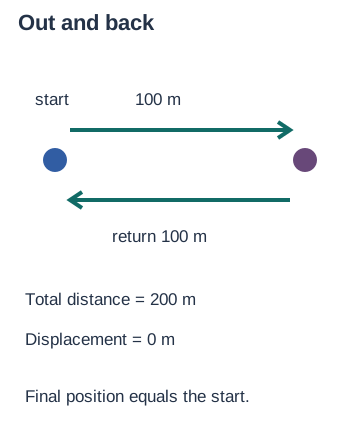
For a straight journey 100 m east followed by 100 m west, distance is 200 m and displacement is 0 m. For 100 m east then 40 m west, distance is 140 m and displacement is 60 m east. The same route data produce different quantities.
Choose a reference direction before using positive and negative signs. East might be positive, but that is a convention you state. A negative displacement then means west; it does not mean a negative path length.
2. Calculate average speed from totals
Average speed = total distance ÷ total elapsed time. Include stops when the question asks about the whole journey. If a traveller covers 120 m in 20 s and then rests for 10 s, the whole-interval average speed is 120 ÷ 30 = 4 m/s.
Do not automatically average two listed speeds. For equal time intervals, their arithmetic mean works. For equal distances, it generally does not because the slower leg takes longer. Start with the distance and time for each stage.
Keep units consistent. Convert minutes to seconds if the answer is needed in metres per second. To convert km/h to m/s, multiply by 5/18, since 1 km is 1000 m and 1 hour is 3600 s. Write units at each stage.
3. Include direction in average velocity
Average velocity = displacement ÷ elapsed time. A displacement of 60 m east in 20 s gives 3 m/s east. If the final position equals the starting position, average velocity is zero even if the object moved throughout.
Instantaneous velocity describes motion at a particular instant, while an average summarises an interval. A zero average velocity does not mean the object was stationary every moment. Similarly, an average speed does not prove uniform motion.
Speed is the magnitude of instantaneous velocity. A car turning at constant speed changes its velocity because its direction changes. This distinction becomes essential when discussing acceleration.
4. Use the change in velocity, including its sign
For one-dimensional motion over an interval, average acceleration is (final velocity − initial velocity) ÷ time. Use u for the initial velocity and v for the final velocity if the notation is supplied. The unit is m/s², meaning a change of metres per second each second.
If velocity changes from 4 m/s to 16 m/s in 3 s, average acceleration is (16 − 4) ÷ 3 = 4 m/s². If it changes from 16 to 4 in the chosen positive direction over the same time, the acceleration is −4 m/s².
Negative acceleration does not always mean slowing down. If an object is moving in the negative direction and its velocity becomes more negative, its speed increases. State direction and compare the magnitude of velocity before describing speeding up or slowing down.
5. Read the axes before using gradient or area
On a distance–time graph, gradient gives speed for the relevant segment. On a displacement–time graph, gradient gives velocity. A horizontal segment means no change in the plotted position quantity during that interval.
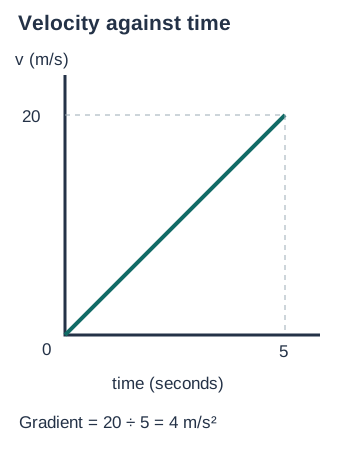
On a velocity–time graph, gradient gives acceleration and signed area gives displacement. If velocity is negative, the area below the time axis contributes negative displacement. Total distance requires adding the magnitudes of the travelled contributions.
For a straight line rising from 0 to 20 m/s over 5 s, gradient is 4 m/s². The triangular area is one half × 5 × 20 = 50 m. This interpretation assumes the graph really shows velocity against time, not distance against time.
6. Solve a motion question in a fixed order
First draw a simple route or timeline. List distances, directions, stops and times. Next identify the quantity requested: speed, velocity, acceleration or displacement. Only then choose the relationship and substitute consistent units.
Check the answer against the story. A return journey should have zero net displacement if the start and end coincide. An average speed cannot be negative. A velocity answer may need a direction even when its numerical magnitude is correct.
Keep the assumptions visible. Constant acceleration permits familiar straight-line velocity–time reasoning, but an arbitrary real trip may have changing acceleration. Do not apply a formula requiring uniform acceleration merely because the question contains u, v and t.
5 worked examples with reasoning
1. Travel 100 m east and 100 m west in 40 s. Find both averages.
- Total distance = 200 m; displacement = 0 m.
- Average speed = 200 ÷ 40 = 5 m/s.
- Average velocity = 0 ÷ 40 = 0 m/s.
2. Cover 120 m in 20 s, then rest 10 s. Find whole-interval average speed.
- The total time is 30 s.
- The total distance remains 120 m.
- Average speed = 4 m/s.
3. Convert 36 km/h to m/s.
- Multiply by 1000/3600 or 5/18.
- 36 × 5/18 = 10.
- The speed is 10 m/s.
4. Velocity changes from 5 to 17 m/s in 4 s in one direction.
- Change = 17 − 5 = 12 m/s.
- Average acceleration = 12 ÷ 4.
- Answer: 3 m/s².
5. Read the triangular velocity–time graph from 0 to 20 m/s in 5 s.
- Gradient = 20 ÷ 5 = 4 m/s².
- Area = 1/2 × 5 × 20 = 50 m.
- Acceleration is constant and displacement is 50 m for this graph.
Save the guide or print the practice
Download to save or share
Complete guide with answers (PDF) · Worksheet without answers (PDF) · Worksheet and answer key (PDF)
Try each task before opening its answer. Give an example or reason, not only a label.
14 practice questions with explanations
Try each task before opening its answer. Give an example or reason, not only a label.
Write an answer and your reason before opening the explanation. Check the reasoning as well as the final answer.
- Distance
Go 30 m east then 10 m west. Find distance.
Answer and reasoning
40 m.
Add the path lengths.
- Displacement
Go 30 m east then 10 m west. Find displacement.
Answer and reasoning
20 m east.
Subtract opposing changes in position.
- Speed
Cover 150 m in 30 s. Find average speed.
Answer and reasoning
5 m/s.
150 ÷ 30 = 5.
- Stop
Cover 150 m in 30 s then stop 20 s. Find whole-interval average speed.
Answer and reasoning
3 m/s.
Use total time 50 s.
- Velocity
Return to the start after 60 s. What is average velocity?
Answer and reasoning
0 m/s.
Net displacement is zero.
- Conversion
Convert 72 km/h to m/s.
Answer and reasoning
20 m/s.
72 × 5/18 = 20.
- Acceleration
Change from 2 to 14 m/s in 4 s. Find average acceleration.
Answer and reasoning
3 m/s².
(14 − 2) ÷ 4 = 3.
- Sign
Velocity changes from 12 to 4 m/s in 2 s along the positive direction. Find average acceleration.
Answer and reasoning
−4 m/s².
(4 − 12) ÷ 2 = −4.
- Direction
Can constant speed involve acceleration?
Answer and reasoning
Yes.
Changing direction changes velocity.
- Average
Does zero average velocity prove no movement occurred?
Answer and reasoning
No.
An out-and-back journey can have zero displacement.
- Graph
What does a velocity–time gradient represent?
Answer and reasoning
Acceleration.
It is change in velocity per time.
- Graph
What does signed area under a velocity–time graph represent?
Answer and reasoning
Displacement.
Negative areas contribute negative change in position.
- Units
Can average speed be negative?
Answer and reasoning
No.
Distance and elapsed time are non-negative quantities.
- Method
Why not simply average two speeds for equal-distance legs?
Answer and reasoning
The times differ.
Calculate total distance divided by total time.
Use the ideas without looking at the notes
Make an out-and-back route with unequal distances and a stop. Calculate total distance, displacement, average speed and average velocity, keeping directions and elapsed time explicit.
Common questions
How do speed and velocity differ?
Velocity includes direction; speed is its instantaneous magnitude or, for average speed, total distance per time.
Can average velocity be zero while average speed is positive?
Yes, for a journey returning to its start.
Does negative acceleration always mean slowing?
No. Compare its direction with the velocity.
What is m/s²?
A change in velocity of metres per second for each second.
Why must graph axes be checked?
Gradient and area mean different things for different plotted quantities.
Connect your learning
Ask about guided Science learning if your child needs help explaining these ideas.
About this guide
Original explanations, examples, diagrams and practice by BananaLearn. The grade label indicates the intended learning level; this is not an official textbook extract or exam paper.