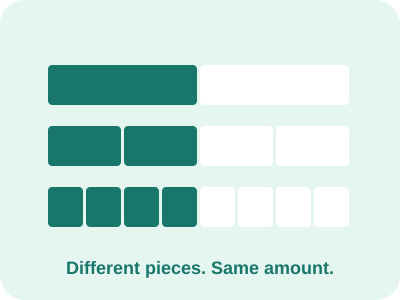
See the idea
Before you start
Divide an amount into equal groups and understand the numerator and denominator. Begin with totals that divide exactly, then extend to quantities that can be split.
Words used in this guide
- Unit fraction
- A fraction with numerator 1, such as 1/7.
- Of
- In this calculation, it means multiplication: 3/5 of 20 is (3/5) × 20.
- Quantity
- The measured or counted amount to which the fraction applies.
Why the method works
The denominator tells you how many equal shares make the whole amount. Dividing finds one share. The numerator tells you how many shares to take. For 4/7 of 35, one seventh is 5, so four sevenths is 20. Multiplying by the numerator before dividing can give the same result, but finding one share first often makes the meaning easier to see.
The denominator tells you how to split
For 2/5 of 30, first find one fifth: 30 ÷ 5 = 6. Each fifth contains six.
The numerator tells you how many parts
Take two of those fifths: 6 × 2 = 12. So 2/5 of 30 = 12. Multiplying 30 by 2/5 gives the same result.
Check the size of the answer
A positive fraction less than 1 gives a smaller amount than the starting quantity. An improper fraction can give a larger amount: 3/2 of 10 = 15.
Worked examples, step by step
Example 1: Find 3/8 of 32.
- One eighth of 32 is 32 ÷ 8 = 4.
- Three eighths is 3 × 4 = 12.
Example 2: Find 5/6 of 42.
- One sixth is 42 ÷ 6 = 7. Five sixths means five groups of seven.
- 5 × 7 = 35.
- Check with the missing share: one sixth is 7 and 35 + 7 = 42.
Example 3: A 10-metre cord is cut to 3/4 of its original length. Find the new length.
- One quarter of 10 is 2.5 metres. Three quarters is 3 × 2.5.
- The new length is 7.5 metres.
- A fractional answer makes sense because a length can be divided. Do not round to a whole metre unless asked.
Example 4: Three fifths of a collection is 18 cards. How many cards are in the whole collection?
- If three shares total 18, one share is 18 ÷ 3 = 6.
- Five shares make the whole: 5 × 6 = 30 cards.
- This reverses the usual problem. Dividing 18 by 5 would split the wrong amount.
Common mistakes and how to repair them
“Divide by the numerator.”
For 3/8 of 24, the eight equal shares are 3 each. Taking three gives 9. Dividing by 3 first does not identify an eighth.
“Any fraction of an amount must be smaller.”
A positive fraction below 1 makes it smaller. But 5/4 of 20 = 25, because five quarter-sized shares exceed the four shares in one whole.
Check your understanding
Choose an answer for each question. You can check again after reading the explanation.
Worked answers
What is 2/3 of 18? 12. One third is 6; two thirds is 12.
What is 3/4 of 28? 21. 28 ÷ 4 × 3 = 21.
Practise independently
Work these out on paper. Include a diagram or a sentence where the question asks you to explain. Open each solution after making an attempt.
3. Find 4/9 of 63.
Show the reasoning
63 ÷ 9 × 4 = 28.
4. Find 7/10 of 50.
Show the reasoning
50 ÷ 10 × 7 = 35.
5. Find 3/2 of 18.
Show the reasoning
18 ÷ 2 × 3 = 27. The fraction is greater than 1.
6. Two thirds of a length is 14 cm. Find the full length.
Show the reasoning
One third is 7 cm, so the full length is 21 cm.
If a method still feels uncertain, revisit the closest worked example, then try a fresh problem. A correct answer copied from a solution tells you less than an explanation you can give independently.
Learn it → Try it → Explain it
Put the idea into play
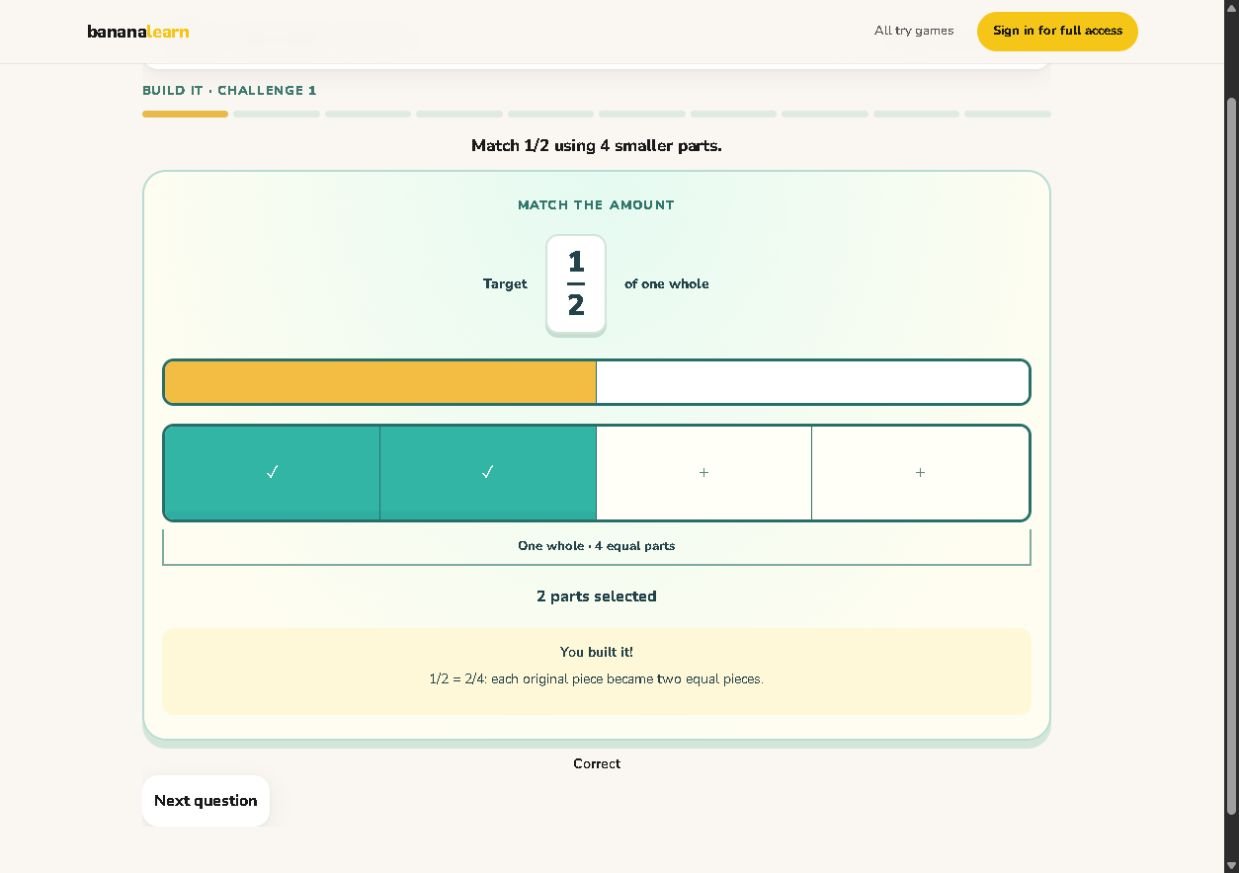
Build and compare fractions with pictures you can change.
Start with “Same amount” to strengthen fraction equivalence before returning to this guide. Simplifying and operations modes require sign-in.
Try Fraction Visuals →Free guest play has question, level and time limits. Sign in to continue or save progress. A game score is not a mastery assessment.
Questions students and parents ask
What if the division is not a whole number?
Keep a fraction or decimal if the context allows splitting. Half of 9 metres is 4.5 metres. Half of nine indivisible tickets needs a different practical interpretation.
Can I multiply first?
Yes: (a/b) × N = (a × N)/b for non-zero b. Choose the order that is convenient and explain the equal shares.
How can I estimate?
Compare the fraction with 1/2 and 1. Three quarters of a positive amount must lie between half and all of that amount.
Help at home: Draw the whole before finding a share
Draw a bar for 24 objects and divide it into six equal boxes. Ask for one sixth, then five sixths. Label the total above the entire bar.
If your child confuses the whole with the selected amount, ask them to point to all 24 objects before shading any.
Reverse the task: tell them two sixths is 8 and ask for the total. A correct explanation shows they can reason beyond a memorised procedure.
Keep the conversation focused on the reasoning you can hear or see. One short activity cannot establish lasting mastery or diagnose a learning difficulty.
My child can shade fractions but struggles with word problems
For “3/4 of 20 counters”, the whole is the collection of 20. Share it into four equal groups of five. Take three groups: 5 + 5 + 5 = 15. The denominator tells you how many equal groups make the whole; the numerator tells you how many groups to take.
Ask your child to circle the whole quantity before calculating. Compare “3/4 of 20” with “3/4 of a collection is 15; how many are in the whole collection?” In the second problem, three groups total 15, so one group is five and four groups total 20. The same numbers require different reasoning.
For a fresh check, find 2/3 of 18 with objects, then explain why 12 is reasonable. If sharing into three groups is hard, practise that step before adding more fraction notation.
Helping your child with fractions? Start with this parent guide →
Would a teacher help with the next step?
Bring one example your child found difficult to a free 50-minute session. Tell us their grade, curriculum and time zone when you enquire.
Request a free session