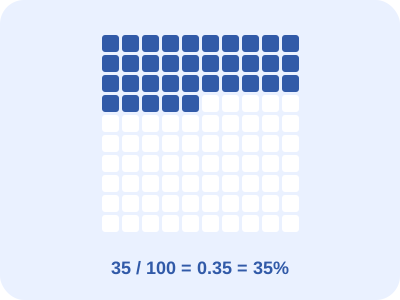
See the idea
Before you start
Understand equivalent fractions, decimal place value and division. Keep track of the whole: 50% of a small group and 50% of a large group represent the same proportion but different counts.
Words used in this guide
- Percent
- Per hundred. 35% means 35/100.
- Terminating decimal
- A decimal with a finite number of decimal places.
- Recurring decimal
- A decimal with a repeating digit or block that continues indefinitely.
Why the method works
Fractions, decimals and percentages are different representations of numbers. Hundredths give an easy bridge: 7/20 = 35/100 = 0.35 = 35%. When a denominator cannot be scaled to 100 using a whole-number multiplier, divide the numerator by the denominator. Keep recurring values exact when possible; a rounded decimal is an approximation, not a new exact name for the fraction.
Percent means out of one hundred
25% means 25/100. Simplify 25/100 by dividing both numbers by 25 to get 1/4. This is why 25% of a quantity is one quarter of that quantity.
Convert a decimal to a percentage
Multiply the decimal by 100 and write the percent sign: 0.6 = 60%. The value represented is unchanged because percent itself means hundredths.
Some conversions repeat
1/3 = 0.333… = 33.333…%. It is approximately 33.3%, not exactly 33%. Keep the original fraction when an exact answer is needed.
Worked examples, step by step
Example 1: Write 3/5 as a decimal and a percentage.
- 3/5 = 6/10 = 0.6.
- 0.6 = 60/100 = 60%.
Example 2: Convert 7/8 to a decimal and percentage.
- Divide 7 by 8 to obtain 0.875. You can also rename the fraction as 875/1000.
- Multiply the decimal value by 100 to express it as a percentage: 87.5%.
- This is less than 100%, matching the fact that 7/8 is less than one.
Example 3: Convert 0.45 and 12.5% to simplest fractions.
- 0.45 = 45/100 = 9/20. The last digit names hundredths.
- 12.5% = 12.5/100 = 125/1000 = 1/8.
- Do not interpret 12.5% as 12.5 wholes. The percent sign divides the written number by 100.
Example 4: A learner answers 16 of 20 questions correctly. Express the share three ways.
- Write 16/20 and simplify to 4/5.
- 4/5 = 0.8 = 80%.
- The share incorrect is 4/20 = 1/5 = 20%. Correct and incorrect shares sum to 100%.
Common mistakes and how to repair them
“0.6% equals 0.6.”
0.6% = 0.006. By contrast, 0.6 = 60%. Say “per hundred” when the percent sign appears.
“1/3 = 0.33 exactly.”
1/3 = 0.333… with the 3 repeating. To two decimal places, 1/3 ≈ 0.33. Similarly, its exact percentage is 33 1/3%.
Check your understanding
Choose an answer for each question. You can check again after reading the explanation.
Worked answers
Which percentage equals 3/4? 75%. 3/4 = 75/100.
Which decimal equals 20%? 0.2. 20/100 = 0.20 = 0.2.
Practise independently
Work these out on paper. Include a diagram or a sentence where the question asks you to explain. Open each solution after making an attempt.
3. Write 3/20 as a decimal and percentage.
Show the reasoning
3/20 = 15/100 = 0.15 = 15%.
4. Write 0.72 as a simplest fraction and percentage.
Show the reasoning
72/100 = 18/25, and 72%.
5. Convert 125% to a decimal and mixed number.
Show the reasoning
1.25 = 1 1/4. A percentage can exceed 100%.
6. Order 0.4, 3/8 and 42% from smallest to largest.
Show the reasoning
3/8 = 0.375, 0.4 = 0.400 and 42% = 0.420. Thus 3/8 < 0.4 < 42%.
If a method still feels uncertain, revisit the closest worked example, then try a fresh problem. A correct answer copied from a solution tells you less than an explanation you can give independently.
Learn it → Try it → Explain it
Put the idea into play
Build and compare fractions with pictures you can change.
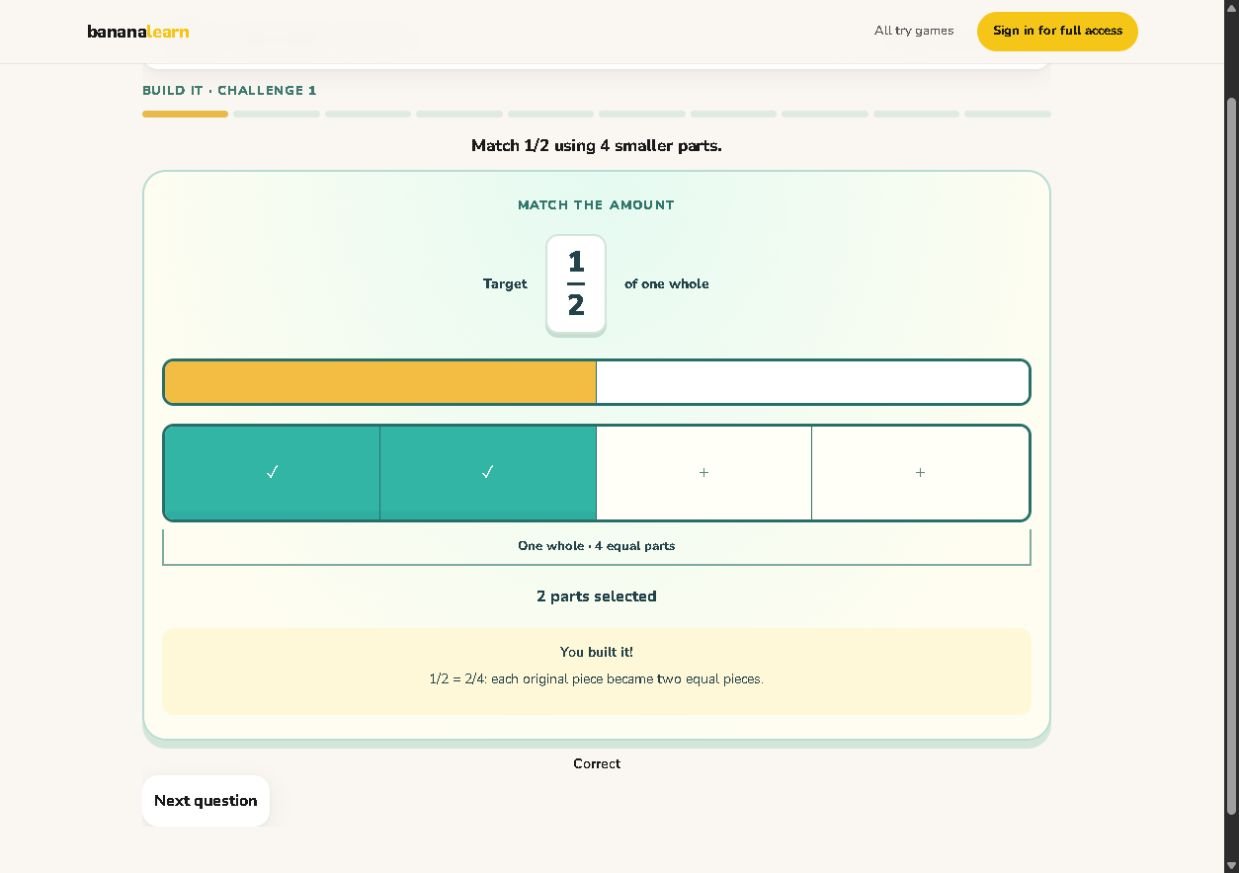
Choose “Same amount” and build an equivalent fraction. Explain why the shaded amounts match.
Try Fraction Visuals →Free guest play has question, level and time limits. Sign in to continue or save progress. A game score is not a mastery assessment.
Questions students and parents ask
Can a percentage be above 100?
Yes. 150% means one and a half times the reference whole. The context must make clear what that whole is.
Which fractions terminate as decimals?
A fraction in simplest form has a terminating decimal if its denominator has no prime factors other than 2 and 5.
Which form should I use?
Choose the form that makes the task clear: fractions for exact equal parts, decimals for place-value calculations and percentages for comparisons per hundred.
Help at home: Match three representations
Make cards for 1/2, 0.5 and 50%; repeat with 1/4 and 3/4. Ask your child to match them and explain using a hundred square.
Then introduce 0.05 and 5%. Ask why they do not belong in the 1/2 group. This catches a common factor-of-ten confusion.
Use a fresh fraction such as 7/10. Ask the child to produce the other two forms without relying on memorised card positions.
Keep the conversation focused on the reasoning you can hear or see. One short activity cannot establish lasting mastery or diagnose a learning difficulty.
Would a teacher help with the next step?
Bring one example your child found difficult to a free 50-minute session. Tell us their grade, curriculum and time zone when you enquire.
Request a free session