What does it mean?
A price tells what an item costs. The amount paid tells what the customer gives. If the payment exceeds the cost, change is the part returned. With a ₹275 item paid for using ₹500, the price and change together must rebuild ₹500.
An amount paid is split into total cost and change. Add item prices to find the cost, then subtract it from the payment. These examples use whole Indian rupees (₹).
Learning goal: Represent local-currency amounts and solve totals and simple change using the learner's verified school/local currency conventions. The grade is a suggested starting point; school sequences vary. Use the first worked example to check readiness, and Number sense and multiplication if an earlier idea needs revisiting.
See the idea
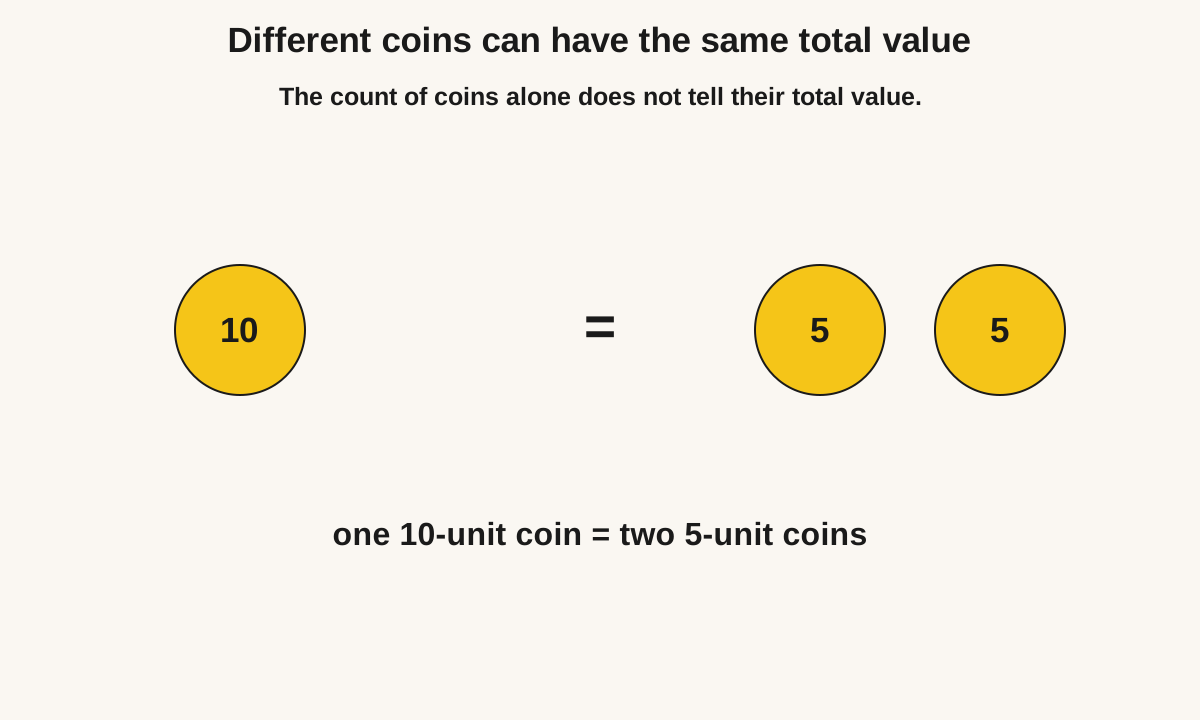
Read each diagram with its labels, then follow the worked examples. Practice questions include their own measurements and information.

Enlarge diagram to read the labels
Swipe across the enlarged diagram to read every label.
Enlarge diagram to read the labels
Swipe across the enlarged diagram to read every label.
Choose a method and explain why it works
For several items, add their prices first. Compare that total with the payment, then subtract total cost from amount paid. A useful alternative is to count up from the cost to the payment. All examples here use whole rupees, so there is no need to mix rupees and paise in one calculation.
Key rule and when to use it
Total cost = sum of prices. Change = payment − total cost when the payment covers the cost. Amounts must use the same currency unit.
Worked examples, step by step
Example 1: An item costs ₹275 and ₹500 is paid. Find the change.
- Change is payment minus cost.
- ₹500 − ₹275 = ₹225.
- Check: ₹275 + ₹225 = ₹500.
Answer: ₹225
Example 2: Two items cost ₹125 and ₹240. Find their total cost.
- Both prices use rupees.
- 125 + 240 = 365.
- The total cost is ₹365.
Answer: ₹365
Example 3: A notebook costs ₹135 and a pen costs ₹48. You pay ₹200. Find the change.
- Total cost = 135 + 48 = ₹183.
- Change = 200 − 183 = ₹17.
- Check: cost ₹183 + change ₹17 = payment ₹200.
Common mistakes and important boundaries
Do not add price and payment to find change. If the payment is smaller than the cost, the subtraction describes a shortfall, not money owed back to the customer. If a question uses paise, convert to one unit before combining amounts: ₹1 is 100 paise.
A point to explain
The learner may mix currency units or treat change as addition.
Compare an uncertain attempt with the closest worked example. Look at the meaning of each operation, unit and label before repeating the arithmetic.
Money and Change Word Problems — practice
Work on paper first. Open each answer afterwards and compare the reasoning. Print the questions with or without the separate answer key; no account is required.
Name: ____________________ Date: __________
Two prices are 125 rupees and 240 rupees. What operation finds the total cost?
Show answer
addition
An item costs 275 rupees and 500 are paid. What does 'change' mean?
Show answer
the amount returned after paying more than the price
125 + 240 = __ rupees.
Show answer
365
500 - 275 = __ rupees.
Show answer
225
Three items cost 120, 85 and 200 rupees. Find the total.
Show answer
405
Why should the same rupee be used for every amount in one calculation?
Show answer
The amounts must refer to the same unit before they can be combined or compared.
A learner pays 500 for an item costing 320 and says the change is 820. What operation error was made?
Show answer
They added instead of subtracting; the change is 180.
A price is 460 rupees. You pay 700. What change is due?
Show answer
240
Money and Change Word Problems — answer key
addition
the amount returned after paying more than the price
365
225
405
The amounts must refer to the same unit before they can be combined or compared.
They added instead of subtracting; the change is 180.
240
Questions students and parents ask
What if the payment is less than the cost?
There is no positive change. For a ₹460 cost and ₹400 payment, another ₹60 is needed. Do not describe that shortfall as money returned.
Can I check change by counting up?
Yes. From ₹183 to ₹190 is ₹7, and from ₹190 to ₹200 is ₹10. The total returned is ₹17.
Is this a complete set of textbook exercise solutions?
No. This guide adapts BananaLearn’s own teaching examples and practice. It is not official NCERT material or a promise of the exact chapter sequence in a particular board, country or textbook edition.
What if the examples are still difficult?
Revisit Number sense and multiplication. Try the first example with its model, then attempt one fresh question independently. A correct copied answer is not evidence that the method can be used without support.
Help at home
Make a pretend shop using clearly labelled whole-rupee prices. Ask the child to check that cost plus change equals the amount handed over.
Keep one example of the learner’s own working. A repeated difficulty across fresh questions can guide a discussion with their teacher; one short practice sheet does not establish a diagnosis or a full mastery profile.
Connect this idea to the next skill
About this guide
Based on BananaLearn’s Grade 3 course lesson “Local Money”. The explanations have been adapted for independent reading; course diagrams are reused where they fit the idea, and missing classroom givens are made explicit in questions.
Need another way to understand it?
Bring one question your child found difficult to a free 50-minute session. Tell us their grade, curriculum and time zone so we can discuss a suitable next step.
Request a free session