
Start with the key idea
Help a fifth grader identify the unknown quantity, represent equal groups or parts and check whether the answer fits the story. This guide draws on Common Core Grade 5 topic areas as one reference; state standards, school sequences and adopted curricula can differ.
1. Start from the assignment, not a generic grade label
Ask what the teacher has introduced and whether a diagram, equation or particular written method is expected. A child may understand the story but be unsure how the school wants the reasoning recorded. Clarify that before replacing the method.
Common Core Grade 5 includes fraction operations, decimal and whole-number work, and volume, with particular limits on fraction division. This page uses those areas to choose examples, not to claim that every US school follows the same sequence.
Treat a topic that has not been taught differently from a mistake in familiar work. If the assignment seems much harder than recent lessons, save the child’s attempt and ask the teacher which prerequisite or model to revisit.
2. Restate the question with its unit
Have the child complete a sentence such as “I need to find how many bags” or “I need the amount in each bag”. These sound similar but describe different unknowns. The unit of the answer helps select a representation.
For twenty-four counters divided among six children, the unknown is counters per child. For twenty-four counters packed six per bag, the unknown is bags. Both use 24 ÷ 6, but the model and answer label differ.
Avoid a keyword-only rule. “Each” may appear in a multiplication or division story, depending on what is unknown. Encourage the child to draw the known total, group size and number of groups before deciding how to calculate.
3. Explain fraction multiplication as a part of an amount
Three quarters of twelve feet means divide twelve feet into four equal lengths and take three. Each quarter is three feet, so the selected length is nine feet. The fraction acts on the stated whole quantity.
For two thirds of three quarters of a cup, partition the three-quarter-cup amount into three equal parts and take two. Each part is one quarter cup, giving one half cup. The answer is smaller than three quarters because only part of that amount was selected.
Multiplication does not always make a positive quantity larger. A factor below one scales it down; a factor above one scales it up. A sketch and a size prediction are useful before applying a fraction algorithm.
4. Model the limited fraction-division cases clearly
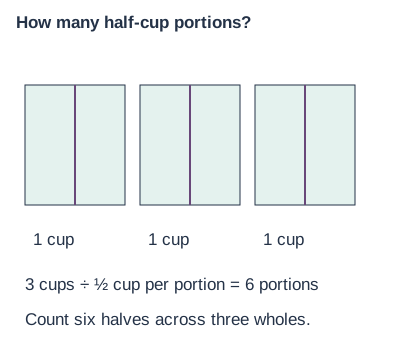
Three cups divided into half-cup portions asks how many halves fit into three wholes. There are two halves per cup, so six portions. The quotient counts portions; it is not a cup amount.
If one half of a pizza is shared equally among three children, the question asks for each share. Divide the half into three equal parts: each child gets one sixth of the original pizza. The two division stories have different unknowns and different units.
The Common Core Grade 5 fraction-division scope includes unit fractions divided by whole numbers and whole numbers divided by unit fractions. General fraction-by-fraction division is not required in that standard. Follow the school’s scope rather than rushing to a general rule without a model.
5. Build volume from layers
A box four cubes long and two cubes wide holds eight unit cubes in one layer. With three identical layers, it holds 24 cubes. This explains volume as length times width times height for a rectangular prism.

Keep volume separate from surface area. Filling a box with cubes is a cubic-unit question; covering its faces is a square-unit question. A child may multiply three numbers correctly but still attach square units, showing the quantity needs another look.
For a shape made of two non-overlapping rectangular prisms, find each volume and add. Do not count an overlapping region twice. Ask the child to show where every part of the total sits in the drawing.
6. Check the result and the level of help
Ask for a prediction before the calculation and a check afterwards. A four-dollar item bought three times should cost about twelve dollars; an answer near one dollar would conflict with the story. For division, multiply back using the quantity represented by the quotient.
After one supported attempt, offer a fresh problem with the same structure. Change the context as well as the numbers occasionally so the child must recognise the relationship. Avoid judging understanding from a copied correction immediately after seeing the answer.
When progress stalls, note whether the child needs help with vocabulary, the model, a calculation fact or recording the steps. Share that evidence with the teacher. The goal is a more independent next attempt, not a parent-produced finished worksheet.
5 worked examples with reasoning
1. Four notebooks cost $2.75 each. Find the total.
- Think four equal groups of $2.75.
- 4 × 2 = 8 dollars and 4 × 0.75 = 3 dollars.
- Total = $11.00; it is slightly below four times three dollars.
2. Find 3/4 of 12 feet.
- One quarter is 12 ÷ 4 = 3 feet.
- Three quarters are 3 × 3 = 9 feet.
- The result is less than the original twelve feet.
3. Two cups are divided into quarter-cup portions. Find the number of portions.
- One cup contains four quarter-cup portions.
- Two cups contain eight portions.
- Check: eight times one quarter cup equals two cups.
4. One third of a cake is shared equally by two children. What fraction of the whole cake does each get?
- Divide the one-third part into two equal pieces.
- Each is 1/6 of the original cake.
- Check: two shares of one sixth combine to one third.
5. A rectangular prism is 5 units long, 3 units wide and 2 units high. Find its volume.
- One layer contains 5 × 3 = 15 unit cubes.
- Two layers contain 30 unit cubes.
- Volume = 30 cubic units.
Save the guide or print the practice
Download to save or share
Complete guide with answers (PDF) · Worksheet without answers (PDF) · Worksheet and answer key (PDF)
Try each task before opening its answer. Give an example or reason, not only a label.
14 practice questions with explanations
Try each task before opening its answer. Give an example or reason, not only a label.
Write an answer and your reason before opening the explanation. Check the reasoning as well as the final answer.
- Meaning
24 counters are shared equally among 6 children. What unit should the answer use?
Answer and reasoning
Counters per child.
The question asks for each share.
- Meaning
24 counters go into bags of 6. What unit should the answer use?
Answer and reasoning
Bags.
The question asks for the number of groups.
- Money
Three pens cost $1.80 each. Find the total.
Answer and reasoning
$5.40.
Three equal groups of 1.80.
- Decimal
Calculate 4.5 + 0.75.
Answer and reasoning
5.25.
Align tenths and hundredths.
- Fraction
Find 2/3 of 15 feet.
Answer and reasoning
10 feet.
15 ÷ 3 × 2.
- Fraction
Calculate 1/2 + 1/3.
Answer and reasoning
5/6.
Use sixths as equal-sized parts.
- Scaling
Is 3/4 of a positive amount larger or smaller than the whole amount?
Answer and reasoning
Smaller.
The scale factor is less than one.
- Portions
How many half-cup portions fit into 4 cups?
Answer and reasoning
8 portions.
Two halves per cup.
- Sharing
One quarter of a cake is shared equally among 3 children. Fraction of the whole cake per child?
Answer and reasoning
1/12.
Split each quarter into three equal parts.
- Volume
Find volume of a rectangular prism 4 cm by 3 cm by 2 cm.
Answer and reasoning
24 cm³.
Three dimensions count unit-cube layers.
- Volume
Two non-overlapping rectangular prisms have volumes 12 and 18 cubic units. Combined volume?
Answer and reasoning
30 cubic units.
Add non-overlapping volumes.
- Unit
Does volume use square units or cubic units?
Answer and reasoning
Cubic units.
It measures filled three-dimensional space.
- Check
A child gets 2 portions from 3 cups in half-cup portions. What check shows a problem?
Answer and reasoning
Two half-cup portions use only one cup.
The proposed answer does not account for all three cups.
- Support
What should follow a parent’s worked demonstration?
Answer and reasoning
A fresh independent attempt with a similar structure.
It checks whether the child can apply the idea.
Use the ideas without looking at the notes
Name the unknown and its unit, model the relationship, calculate and check. Let one supported example lead to a fresh independent attempt.
Common questions
Does every US school use Common Core?
No. State standards and local curricula vary; use the school’s assigned scope.
Should I teach “invert and multiply” immediately?
First make the grouping or sharing meaning clear, especially for the limited cases expected at this stage.
Can division give a larger number?
Yes. Dividing three cups into half-cup portions gives six portions; the quotient counts a different unit.
Is a correct number enough?
Ask for the unit and a reason so it is clear which quantity was found.
When should I contact the teacher?
When the same specific difficulty persists or the assignment’s method and scope are unclear. Include the child’s working.
Connect your learning
Ask about guided Maths learning if your child needs help explaining these ideas.
About this guide
Original explanations, examples, diagrams and practice by BananaLearn. The grade label indicates the intended learning level; this is not an official textbook extract or exam paper.