
Start with the key idea
Use the child’s current school task to identify one concept, ask for an explanation and practise a fresh example. Confirm the school’s textbook edition and sequence; this is a home-support routine, not an official CBSE syllabus or a claim that every overseas school teaches topics in the same order.
1. Start with the actual school requirement
Ask the child to show the question, the teacher’s example and any instruction about working. Note the grade, textbook title and edition, chapter and current topic. Overseas CBSE schools can have their own schedules and classroom routines; a generic online worksheet may not match this week’s need.
Separate a missing idea from unfamiliar presentation. A child may know multiplication but not recognise that a story asks for equal groups. Another may understand the relationship but make an arithmetic error. Ask “What is happening in this problem?” before selecting more exercises.
Keep one small folder of representative work: an independent attempt, the support given and a later fresh attempt. The aim is to make progress visible, not to collect every mark. Share a few well-chosen examples with the teacher if the same difficulty keeps returning.
2. Ask for meaning before a faster method
Use a drawing, objects or a number line when it clarifies the idea. For 1/2 + 1/3, divide the same-sized whole into sixths: one half is three sixths and one third is two sixths. Together they make five sixths. Adding denominators would change the size of the pieces instead of combining equal units.
Let the learner describe the model in their own words. Then connect the model to the written calculation: 1/2 + 1/3 = 3/6 + 2/6 = 5/6. If the explanation is unclear, stay with the model before asking for speed.
A parent does not have to invent a new method. Use the school’s example and ask the teacher about a method you do not recognise. A reliable explanation that the child can use is more valuable than several shortcuts offered at once.
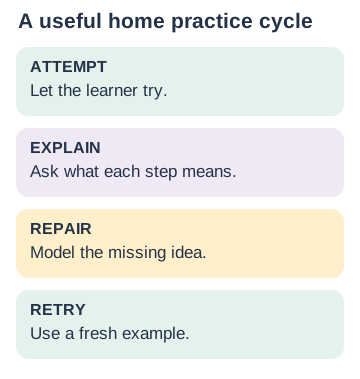
3. Use a short attempt–explain–repair–retry cycle
Choose a manageable task with a clear stopping point. First let the child attempt it. Next ask for the reasoning. If a step is missing, model only the necessary part. Finally offer a new task that uses the same idea with different numbers or wording.

For example, a learner who aligns 4.5 + 0.27 incorrectly can write 4.50 + 0.27 and identify tenths and hundredths. The answer is 4.77. A fresh check such as 2.8 + 0.16 = 2.96 helps show whether the alignment now makes sense.
The routine can be brief, but its duration should fit the child and task. Stop after a useful attempt rather than extending practice solely to meet a fixed daily target. If fatigue or frustration is getting in the way, plan a later return and discuss workload where necessary.
4. Keep examples familiar without changing the mathematics
Everyday examples can use the family’s local context: shopping, a bus journey or measuring a desk. Keep units and currency explicit. If three identical notebooks cost 7 currency units each, the total is 21 units; the multiplication relationship does not depend on which country the shop is in.
For a school question in rupees, answer in rupees unless a conversion is requested. Do not insert an exchange rate into an arithmetic problem unnecessarily. For measurement, write the unit beside every quantity: 1.5 metres equals 150 centimetres.
Language can also vary. Maths and math refer to the same subject; a different spelling is not a different concept. Ask the child to connect the vocabulary used at school with an example. If a term is unclear, clarify it before concluding that the mathematical understanding is missing.
5. Give feedback that names an action
Replace “be careful” with a check that can detect the actual error. For decimal addition, align place values. For an equation, substitute the proposed value into the original equation. For a word problem, write an answer sentence that identifies the requested quantity.
If a child answers 3x + 2 = 14 with x = 4, substitution gives 3 × 4 + 2 = 14. This confirms the answer for that equation. If the value was copied, ask for a fresh equation before treating the method as independent.
Record the level of support honestly. “Solved after a place-value reminder” is useful information; it is not a failure. Use a later task to see whether the reminder is still needed, and avoid comparing the child with another learner’s pace.
6. Make teacher conversations specific
Bring the exact task, the child’s explanation and what happened after a small hint. A message such as “She adds equal denominators but changes the denominator when the pieces differ” gives a teacher something concrete to respond to. Ask which representation and next task the teacher recommends.
When tutoring is being considered, share the school materials and current need first. Confirm subject, grade, curriculum and timetable fit before purchasing. A general claim to teach international students does not establish coverage of a particular school course or examination.
Review progress through independent explanations and fresh applications, alongside school feedback. Homework completion, attendance and correct answers are useful observations, but none alone proves that the child can use the idea in a new situation.
Our one-task maths support record
Choose one representative task. The record should show the learning step and the help given rather than only whether the final answer was correct.
School book/edition and current task: ____________________
What the learner tried independently: ____________________
What each number or unit means: ____________________
Explanation or hint offered: ____________________
Fresh example and response: ____________________
Question for the teacher if difficulty persists: ____________________
Save the full guide to keep this record with the explanations. The separate worksheet contains the practice and decision questions; use its answer version to check your reasoning.
5 worked examples with reasoning
1. Explain 1/2 + 1/3.
- Use equal-sized wholes and divide them into sixths.
- Write 3/6 + 2/6 = 5/6.
- Check that the total is between one half and one whole.
2. Repair 4.5 + 0.27.
- Write 4.50 + 0.27 with decimal points aligned.
- Add to get 4.77.
- Ask which column represents hundredths.
3. Three notebooks cost 7 units each.
- Identify three equal groups of seven.
- Compute 3 × 7 = 21.
- Write 21 currency units, using the currency named in the question.
4. Check x = 4 in 3x + 2 = 14.
- Replace x with 4.
- Compute 12 + 2 = 14.
- Use a different equation if the original answer came from a model.
5. Prepare a useful teacher message.
- Attach the original attempt and question.
- Explain the hint given and the fresh response.
- Ask for the next suitable example rather than requesting a complete reteaching plan.
Save the guide or print the practice
Download to save or share
Complete guide with answers (PDF) · Worksheet without answers (PDF) · Worksheet and answer key (PDF)
Try each situation before reading the suggested response. Give a reason and adapt the decision to the learner and school requirements.
14 practice questions with explanations
Try each situation before reading the suggested response. Give a reason and adapt the decision to the learner and school requirements.
Write an answer and your reason before opening the explanation. Check the reasoning as well as the final answer.
- School
Which book detail matters before choosing chapter practice?
Answer and reasoning
The current title and edition used by the school.
Chapter numbering and sequence can vary.
- Fractions
Find 1/2 + 1/4.
Answer and reasoning
3/4.
One half is two quarters.
- Meaning
Why not add denominators in 1/2 + 1/3?
Answer and reasoning
They describe different piece sizes.
Convert to equal-sized parts before combining.
- Decimals
Find 2.8 + 0.16.
Answer and reasoning
2.96.
Write 2.80 + 0.16.
- Units
Convert 1.5 m to cm.
Answer and reasoning
150 cm.
Multiply metres by 100.
- Context
Four tickets cost 6 units each. What is the total?
Answer and reasoning
24 units.
Four equal groups of six.
- Equation
Check y = 5 in 2y + 1 = 11.
Answer and reasoning
2 × 5 + 1 = 11, so it works.
Substitute into the original equation.
- Observation
What should a parent ask before giving the operation in a story?
Answer and reasoning
What is happening, and what quantity is being found?
This reveals the learner’s interpretation.
- Support
Does success after a hint mean the task was independent?
Answer and reasoning
No.
Record the hint and later check a fresh example.
- Language
Are math and maths different subjects?
Answer and reasoning
No.
They are different forms of the same subject name.
- Currency
Should a rupee question be converted to local currency automatically?
Answer and reasoning
No.
Keep the requested units unless conversion is part of the task.
- Feedback
Make “be careful with decimals” actionable.
Answer and reasoning
Name the place-value columns before adding.
The check matches the error.
- Teacher
What evidence makes a message useful?
Answer and reasoning
The task, original attempt, explanation and support given.
It helps distinguish the source of difficulty.
- Transfer
What should follow a correct copied solution?
Answer and reasoning
A new suitable problem with an explanation.
Copying alone does not establish independent use.
Use the ideas without looking at the notes
Record the school task, independent attempt, explanation, support and fresh check. Keep units visible. Ask the teacher about persistent patterns. Confirm any tutor’s fit with the exact course before making a commitment.
Common questions
Must parents know every CBSE method?
No. Use the school’s example and ask for clarification where needed.
Is this a current CBSE syllabus?
No. Confirm the school’s current books, syllabus and sequence.
Should practice always be timed?
Not when the immediate goal is understanding. Use timing only when it serves the task and is appropriate for the learner.
How can we tell whether extra support helps?
Look for clearer independent explanations and success on fresh suitable tasks, alongside teacher feedback.
Connect your learning
Ask about one-to-one learning support if your child needs help explaining these ideas.
About this guide
Original explanations, examples, diagrams and practice by BananaLearn. The grade label indicates the intended learning level; this is not an official textbook extract or exam paper.