Maths · Algebra 2 / Precalculus · prerequisites: equations and graphs
Inverse Functions: Worked Examples, Graphs & Domain Checks
A machine doubles your number, then adds 5. It returns 19. To recover your number, do you halve first or subtract first? The order is the whole idea behind an inverse function.
Original BananaLearn guide · 7 November 2026
On a phone, swipe across the illustration to read every label.

What is an inverse function?
An inverse function recovers the original input from its output. If f sends 7 to 19, its inverse sends 19 back to 7. We write f⁻¹(19)=7 and say “f inverse of nineteen”. The superscript −1 is part of this notation; it does not tell you to calculate the reciprocal 1/f(19).
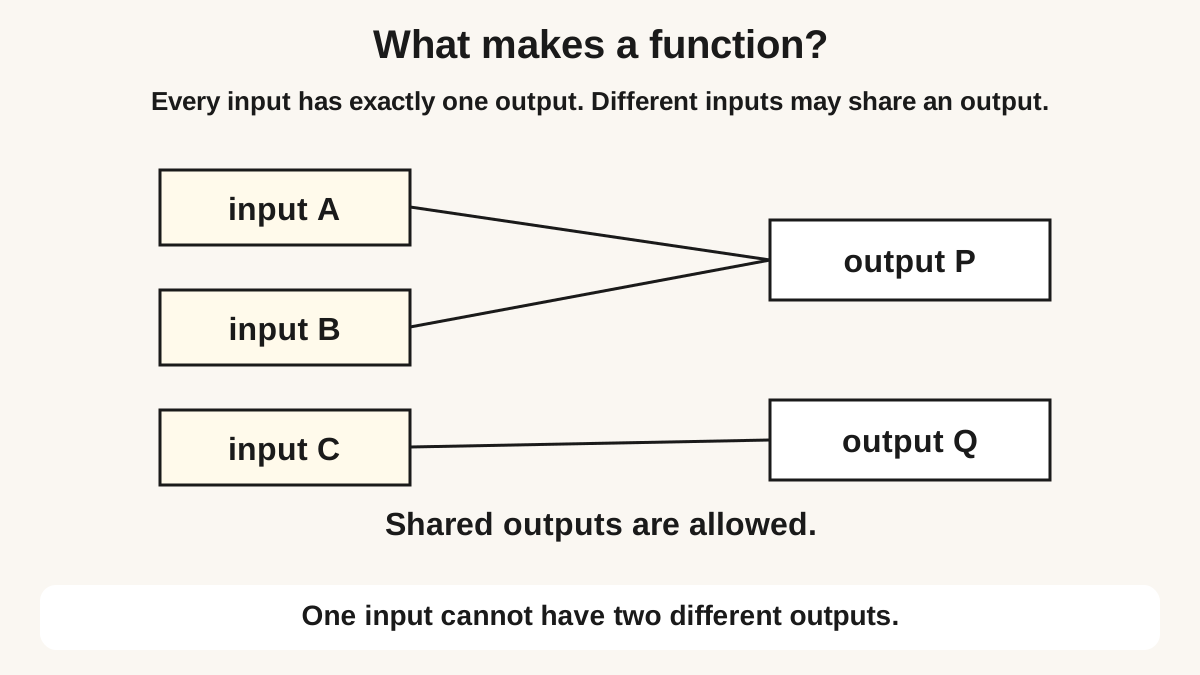
A function gives each allowed input exactly one output. For the reverse rule to be a function too, each output must come from exactly one input. That extra condition is called one-to-one. A function can be perfectly valid without having an inverse function on its full domain. This guide treats inverses on the original function’s range; when a codomain is specified, an inverse to that entire codomain also needs every codomain value to be reached.
Start by reversing a two-step machine
Take f(x)=2x+5. Input 7 becomes 14 after multiplying by 2, then 19 after adding 5. Starting with 19, subtract 5 to recover 14, then divide by 2 to recover 7. Thus f⁻¹(x)=(x−5)/2. The last forward operation is the first operation to undo.
Halving 19 first and then subtracting 5 gives 4.5. Putting 4.5 through the original rule gives 14, not 19. This quick numerical check catches a reversed-order mistake before you rely on a symbolic answer. The inverse formula works for every real input here because doubling and adding a constant never merge two distinct inputs.
Find the inverse algebraically, one line at a time
For f(x)=4x−7, write y=4x−7. Exchange the input and output names: x=4y−7. Add 7 to both sides: x+7=4y. Divide by 4: y=(x+7)/4. Rename this rule f⁻¹(x)=(x+7)/4. Swapping the letters expresses a reversal of the ordered pairs; solving the resulting equation is still necessary.
For g(x)=(x+6)/3, solve y=(x+6)/3 for x: 3y=x+6, then x=3y−6. Its inverse is g⁻¹(x)=3x−6. At x=4 the forward rule gives 10/3; the inverse returns 3×(10/3)−6=4. Keep brackets around an entire numerator when typing a formula.
On a phone, swipe across the illustration to read every label.
Use a table to check whether reversal is possible
Suppose the only allowed inputs are 1, 3 and 5, and their outputs are 8, 12 and 16. Reverse the pairs to get inverse inputs 8, 12 and 16 with outputs 1, 3 and 5. On these stated finite sets, each inverse input has exactly one output. You do not need a formula to describe this inverse.
Now change the last output from 16 to 12. The forward pairs (1,8), (3,12), (5,12) still describe a function. Reversing them gives both (12,3) and (12,5), so the reverse relation is not a function. A short table from an infinite-domain rule only checks those listed values: it cannot prove that no other repeated output exists.
Domain and range exchange jobs
The domain is the set of allowed inputs; the range is the set of outputs actually produced. For an invertible function, the range becomes the inverse’s domain, and the original domain becomes its range. A correct inverse answer therefore includes its allowed inputs, especially for roots, fractions and restricted graphs.
Consider a fictional delivery model C(n)=30+12n, where n is a non-negative whole number of parcels. Its range is {30,42,54,…}. The algebraic reverse is n=(C−30)/12, but the contextual inverse accepts only those listed charges. A charge of 48 would give 1.5 parcels, outside this model. Do not silently replace a discrete real-world domain with all real numbers.
Why x squared needs a restricted domain
For f(x)=x² on all real numbers, both −3 and 3 produce 9. The output 9 cannot identify which input was used, so f has no inverse function on that domain. Writing f⁻¹(x)=±√x would give two outputs for a positive input and would not repair the problem.
Restrict the original function to x≥0. Every non-negative output now comes from one non-negative input, and the inverse is √x with domain x≥0. Alternatively, restricting the original to x≤0 gives inverse −√x, again with domain x≥0 but with non-positive outputs. These are inverses of two different restricted functions; choose the branch required by the original domain.
A shifted quadratic: retain the chosen branch
Let h(x)=(x−2)²+1 with original domain x≥2. Its smallest output is 1. Swap the roles in x=(y−2)²+1, giving x−1=(y−2)². Because the original inputs were at least 2, choose y−2≥0 and obtain h⁻¹(x)=2+√(x−1). Its domain is x≥1 and its range is y≥2.
Check h(5)=10 and h⁻¹(10)=2+√9=5. If the original domain had instead been x≤2, the inverse would be 2−√(x−1). The same algebraic square creates two possible branches, but the stated domain selects one. A graph or a simple input-output check makes that selection visible.
Graphs: reflection and the horizontal line test
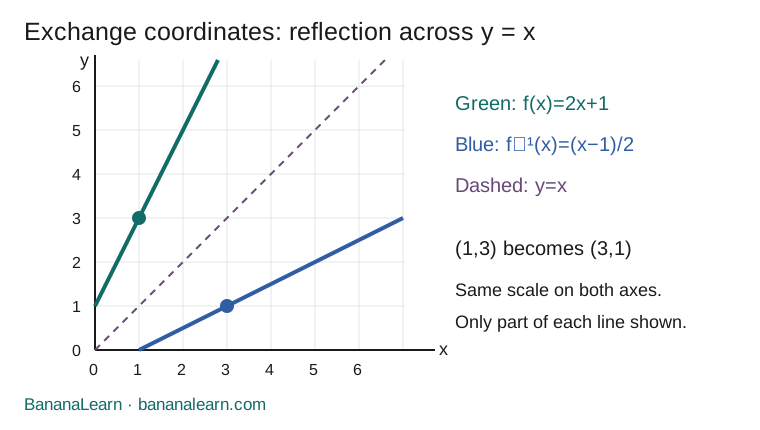
Every forward graph point (a,b) becomes (b,a) on the inverse graph. This exchanges horizontal and vertical coordinates and reflects the graph across y=x when both axes use the same scale. For f(x)=2x+1, the point (1,3) corresponds to (3,1) on f⁻¹(x)=(x−1)/2. Points on y=x remain fixed.
A horizontal line crossing the original graph at two points finds two inputs with the same output. After reflection, those would become two outputs for one inverse input. Therefore an invertible function must meet each horizontal line at most once. The vertical line test checks whether the original relation is a function; the horizontal line test checks whether that function is one-to-one. A graph window cannot establish behavior beyond what is shown unless the rule is known.
Check both compositions and their domains
For f(x)=2x+5 and g(x)=(x−5)/2, g(f(x))=[(2x+5)−5]/2=x. In the other order, f(g(x))=2[(x−5)/2]+5=x. Both calculations recover the input for all real values in this example. A single successful numerical pair is useful for catching errors but does not prove the identity for every input.
Domains matter even when simplification looks familiar. If f(x)=x² on non-negative inputs and g(x)=√x, then g(f(x))=√(x²)=x on x≥0. On all real numbers √(x²)=|x|, not always x. For example, starting at −4 gives 4 after the round trip. This is why the restriction is part of the answer, not an optional note.
A rational example: record the excluded values
Let r(x)=3/(x−2), with x≠2. Its output can never equal zero. Solve y=3/(x−2): y(x−2)=3, x−2=3/y, and x=2+3/y. Therefore r⁻¹(x)=2+3/x, with x≠0. The inverse range excludes 2, matching the original domain.
For a numerical check, r(5)=1 and r⁻¹(1)=5. In r(r⁻¹(x)), the subtraction in the denominator gives 3/x, so the result is x when x≠0. Do not include the excluded input during cancellation. This example also shows that a reciprocal-looking formula can still have a very different inverse.
A useful way to help at home
Ask the learner to show a forward journey, identify any merged outputs and state the allowed inputs before finding a formula. If the calculation goes wrong, return to one concrete value and reverse its operations. If the issue is notation, compare f⁻¹(9) with 1/f(9) using a rule where the two answers are visibly different.
Students who can undo a linear rule but struggle with quadratics usually need work on domain and function meaning rather than more of the same rearrangement exercises. Follow the prerequisite links below, then try the mixed questions independently. This is a topic guide for Algebra 2/Precalculus learning; it is not a claim that every Grade 9–12 board includes every example.
Inverse-function checking sheet
Copy this record into a notebook. Fill each blank using your own example or the activity above.
On a phone, swipe across a wide table to see every column.
| Before solving | Your record |
|---|---|
| Original rule and domain | f(x)=___; x belongs to ___ |
| One-to-one check | Repeated output? ___; reason ___ |
| Reverse rule | f⁻¹(x)=___ |
| Inverse domain and range | Domain ___; range ___ |
| Two-way verification | f(f⁻¹(x))=___; f⁻¹(f(x))=___ |
14 questions with explained answers
Try each question first. Open the explanation to check your reasoning. These are original BananaLearn questions, not official exam questions.
If f(6)=17 and f is invertible, what is f⁻¹(17)?
Check answer and reasoning
6
The inverse recovers the input that produced 17.Find the inverse of f(x)=5x−4 on the real numbers.
Check answer and reasoning
f⁻¹(x)=(x+4)/5
Add 4, then divide by 5. Substitution in either order returns x.Find the inverse of g(x)=(x−3)/4.
Check answer and reasoning
g⁻¹(x)=4x+3
Undo division by 4 before undoing subtraction of 3.For f(x)=2x+5, compare f⁻¹(9) and 1/f(9).
Check answer and reasoning
2 and 1/23
The inverse gives (9−5)/2=2; the reciprocal gives 1/(18+5).Do the finite pairs (0,7), (2,9), (4,9) have an inverse function on their range?
Check answer and reasoning
No
Both 2 and 4 produce 9, so the reversed input 9 would have two outputs.The finite function maps −2→5, 0→8 and 3→11. Give its inverse pairs.
Check answer and reasoning
(5,−2), (8,0), (11,3)
Reverse each pair. The three original outputs are distinct.Can f(x)=x² on all real numbers have an inverse function?
Check answer and reasoning
No
For instance, −2 and 2 both produce 4. Restricting the domain would define a different function.Find the inverse of f(x)=x² with domain x≤0.
Check answer and reasoning
f⁻¹(x)=−√x, with domain x≥0
The non-positive branch recovers the original allowed inputs.For h(x)=(x+1)² with domain x≥−1, find h⁻¹ and its domain.
Check answer and reasoning
h⁻¹(x)=√x−1, domain x≥0
The original range is non-negative, and the original restriction selects the positive square-root branch before subtracting 1.A point (−2,7) is on an invertible function’s graph. Which point is on its inverse graph?
Check answer and reasoning
(7,−2)
Exchange coordinates; do not change their signs.Find the inverse of r(x)=4/(x+1), x≠−1.
Check answer and reasoning
r⁻¹(x)=4/x−1, x≠0
The original range excludes zero; reversing the fraction and the shift gives this rule.Is √(x²)=x for every real x?
Check answer and reasoning
No; it equals |x|
At x=−3 the square root is 3. The identity equals x only for non-negative x.A parcel model charges C(n)=20+8n for non-negative whole-number n. Is 32 an allowed inverse input?
Check answer and reasoning
No
(32−20)/8=1.5, so 32 is not in the discrete range {20,28,36,…}.A learner claims 3x−5 and (x−5)/3 are inverses. Disprove it with one input.
Check answer and reasoning
Starting at 0 gives −5, then −10/3 rather than 0
One failed round trip disproves the claim. The correct inverse is (x+5)/3.
Choose your next learning step
- Start with inputs, outputs and function tables
- Check straight-line graphs and their scales
- Algebra 2 support: functions, quadratics and logarithms
- Precalculus support: connect algebra with graphs
Explore BananaLearn games, learning resources and tutoring. Maths is our priority; English and Science tutoring are also available. Share your current schoolwork when checking teaching fit.
Sources and scope
Explanations, activities, diagrams and practice are original BananaLearn work. Class labels suggest a learning level; school sequences and current textbook editions can differ. Sources checked 7 November 2026.
How we prepare guides · Report a correction
Share the complete guide: https://bananalearn.com/learn/inverse-functions-domain-range-examples.html