
Start with the key idea
Use this guide to identify your NCERT maths book, find official materials and organise chapter practice. NCERT lists Ganita Prakash for Class 6, and its ePathshala entry identifies Chapter 2 as Lines and Angles. This page does not present an unverified complete current contents list. The original readiness questions below support selected number and geometry skills; they are not copied textbook exercises.
1. Record the book identity before searching
Write the exact title, class, language, part if printed, publisher and edition or reprint information from your own copy. A shop listing or search result may use an old cover image, so the inside publication page is more useful than the thumbnail.
An edition and a reprint are not automatically the same thing. A later printing can retain an earlier edition, while a revised edition may change content or numbering. Record both dates when they are present rather than assuming the newest year means a different syllabus.
Add the school’s assignment wording and page number to this record. A question number without a chapter title is fragile: several books can all contain an Exercise 2.1. If a source disagrees with your book, ask which edition it covers before deciding that your child has the wrong answer.
2. Use the official book as the reference point
Start from NCERT’s textbook portal or ePathshala. Select class, subject, language and book, then compare the displayed chapter title with the contents in the school copy. Official access helps establish what the book actually says; an answer website is a separate teaching resource.
The official entries checked for this guide confirm the Class 6 title Ganita Prakash and the ePathshala chapter Lines and Angles. A complete current Class 6 contents map has not been verified here, so this guide deliberately avoids presenting a guessed ten-chapter list as authoritative.
Keep the official book link alongside your school’s topic list. A school may teach topics in a different order, set extra practice or use another approved text. Matching the book does not establish the date of a school test or guarantee which questions will appear.
3. Turn the contents page into a useful learning record
For each chapter in your actual book, create one row with its title, the main skill, one independent example, a difficulty and the next action. Copy only the titles needed for your own record; you do not need to rewrite whole pages of notes.
For Lines and Angles, a useful check might be identifying the vertex, naming an angle and distinguishing an acute angle from a right angle. Record what the child can explain rather than ticking the chapter because the pages were read.
Use three practical statuses: not studied, practising and ready to revisit later. A child who has not been taught a topic needs instruction, not an error label. A child who solves one familiar question correctly still benefits from a fresh example after a gap.
4. Connect number facts to a model
If twenty-four counters form four equal rows, each row has six. This shows 4 × 6 = 24 and makes both four and six factors of twenty-four. A factor divides the number exactly; a multiple is produced by multiplying the number by a whole number.

A plausible mistake is to list 48 as a factor of 24 because it appears in the twenty-four times table. It is a multiple, not a factor. Check the direction: 24 ÷ 48 is not a whole-number quotient, but 48 ÷ 24 is.
Use this distinction when a question asks for grouping or repeated totals. The story “split 24 into equal groups” suggests factors, while “continue totals of 24, 48, 72” suggests multiples. Read what is being organised before choosing a list.
5. Read an angle as a turn, not a long arm
An angle is formed by two rays sharing a vertex. In angle AOB, O is the vertex because it is the middle letter. Extending either ray does not increase the angle; the opening between the directions is what matters.
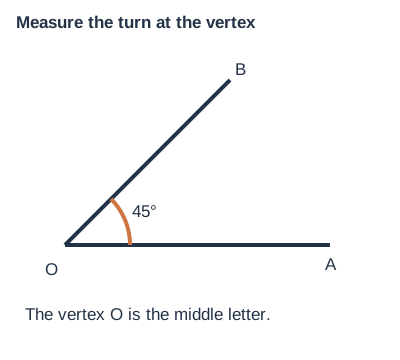
A 45° angle is acute because it is smaller than 90°. A right angle is exactly 90°, and an obtuse angle lies between 90° and 180°. Use the numerical measure when it is given rather than estimating from a sketch that may not be drawn to scale.
To measure with a protractor, place its centre on the vertex and align its baseline with one ray. Read from zero on that ray’s side. Choosing the other scale can turn a genuine 45° measurement into 135°, so compare the result with the visible opening.
6. Use a short chapter routine that reveals understanding
Begin with one worked example, cover it and try a different question of the same type. Ask the learner to name the quantity being found, show the method and explain one check. This provides more information than copying five solved examples.
When stuck, separate reading, representation and calculation. For a rectangle question, draw and label the sides before multiplying. For a number pattern, write the change between terms. Teach the specific missing step rather than repeating the entire chapter immediately.
Finish by recording one next action: practise factor pairs, align the protractor or reread a definition. Return to a fresh question after a short gap. This record gives a parent or tutor a concrete starting point without pretending that a fourteen-question worksheet measures the whole course.
5 worked examples with reasoning
1. Find all positive factors of 18.
- Pair divisors: 1 × 18, 2 × 9, 3 × 6.
- The factors are 1, 2, 3, 6, 9, 18.
- Each divides eighteen with no remainder.
2. Continue 5, 9, 13, 17 by two terms.
- Each step adds four.
- The next terms are 21 and 25.
- The stated continuation follows that rule; a short list alone does not prove a unique possible rule.
3. Classify an angle measuring 120°.
- Compare with 90° and 180°.
- It lies between them, so it is obtuse.
- The length of the drawn rays does not alter this classification.
4. Find the perimeter of a rectangle 7 cm long and 4 cm wide.
- Add all four sides: 7 + 4 + 7 + 4.
- The perimeter is 22 cm.
- This measures the boundary, not the area.
5. A book and a website show different topics for Chapter 2. What should you check?
- Match exact book title, class, language and part.
- Compare the publication details and contents with the school assignment.
- Use the matching edition; do not change the homework topic just to match a search result.
Save the guide or print the practice
Download to save or share
Complete guide with answers (PDF) · Worksheet without answers (PDF) · Worksheet and answer key (PDF)
Try each task before opening its answer. Give an example or reason, not only a label.
14 practice questions with explanations
Try each task before opening its answer. Give an example or reason, not only a label.
Write an answer and your reason before opening the explanation. Check the reasoning as well as the final answer.
- Book
What extra information makes “Exercise 2.1” easier to identify?
Answer and reasoning
Book title, class, language, part, edition and chapter title.
A number alone can occur in many books.
- Book
Does a later reprint year always mean new chapter numbering?
Answer and reasoning
No.
Check the edition and actual contents.
- Factors
List the positive factors of 12.
Answer and reasoning
1, 2, 3, 4, 6, 12.
Pair numbers whose product is twelve.
- Multiples
Write the first four positive multiples of 7.
Answer and reasoning
7, 14, 21, 28.
Multiply seven by one, two, three and four.
- Reason
Is 30 a factor or a multiple of 15?
Answer and reasoning
A multiple.
30 = 2 × 15.
- Pattern
Continue 2, 6, 10, 14 using the same difference.
Answer and reasoning
18, 22.
Add four each time.
- Angle
What is the vertex of angle PQR?
Answer and reasoning
Q.
The middle letter names the vertex.
- Angle
Classify an angle of 35°.
Answer and reasoning
Acute.
It is between zero and ninety degrees.
- Angle
Classify an angle of 90°.
Answer and reasoning
Right angle.
It equals ninety degrees.
- Angle
Do longer rays change a 60° angle to a larger angle?
Answer and reasoning
No.
The directions, not the ray lengths, determine the angle.
- Boundary
Find the perimeter of a square with side 6 cm.
Answer and reasoning
24 cm.
Four equal sides give 4 × 6.
- Area
Find the area of a rectangle 8 cm by 3 cm.
Answer and reasoning
24 cm².
Multiply length by width.
- Planning
A topic has not been taught yet. Should it be recorded as a failed topic?
Answer and reasoning
No; mark it not studied.
It needs teaching before an independent check.
- Review
After copying a solution, what provides a better check of learning?
Answer and reasoning
A fresh independent question with an explanation.
Copying alone does not show method selection.
Use the ideas without looking at the notes
Book record: title; class; language; part; edition; reprint; school-assigned chapter. Chapter record: independent attempt; difficulty; next action; date to revisit.
Common questions
Is this the complete NCERT Class 6 contents list?
No. It explains edition checking and selected original practice. Use the contents of your official school-matched book for the full list.
Are these NCERT exercise solutions?
No. The examples and questions are original BananaLearn practice.
Where should I obtain the textbook?
Use NCERT’s textbook portal or ePathshala and match the school-prescribed book.
Can chapter numbers differ between editions?
Yes. Check the actual title and contents before relying on a numbered search result.
Should every child start with the same chapter?
Follow the school sequence and use prerequisite checks to decide what support is needed.
Connect your learning
Ask about guided Maths learning if your child needs help explaining these ideas.
About this guide
Original explanations, examples, diagrams and practice by BananaLearn. The grade label indicates the intended learning level; this is not an official textbook extract or exam paper.