
Start with the key idea
This guide maps the eight chapters in the verified Ganita Prakash Grade 7 Part I contents, with original study suggestions and readiness practice. The official file records first edition April 2025 and reprint January 2026, for 2026–27. It does not establish the complete scope of every school course or an unverified Part II.
1. Match Grade 7, the part and the printing
Check that the book is Grade 7 Ganita Prakash and compare its part and contents with the official file linked below. The verified Part I has eight chapters. Do not assume an older Class 7 textbook or a different part uses the same numbered exercises.
Record the publication details inside the book rather than relying on a cover photograph. Keep the school topic list beside this guide, since teaching order and supplementary tasks can differ. A chapter guide supports planning; it does not replace a teacher’s instructions.
Before looking for an answer, copy the full question and any diagram labels onto your working page. If a solution uses different numbers, a different figure or a different chapter title, first check the source match. Do not force that solution onto the task in front of you.
| Part I chapter | Verified title | Your study status |
|---|---|---|
| 1 | Large Numbers Around Us | Not studied / practising / revisit later |
| 2 | Arithmetic Expressions | Not studied / practising / revisit later |
| 3 | A Peek Beyond the Point | Not studied / practising / revisit later |
| 4 | Expressions using Letter-Numbers | Not studied / practising / revisit later |
| 5 | Parallel and Intersecting Lines | Not studied / practising / revisit later |
| 6 | Number Play | Not studied / practising / revisit later |
| 7 | A Tale of Three Intersecting Lines | Not studied / practising / revisit later |
| 8 | Working with Fractions | Not studied / practising / revisit later |
2. Connect large numbers, expressions and decimals
The first three Part I titles are Large Numbers Around Us, Arithmetic Expressions and A Peek Beyond the Point. A useful original study route is to connect place value, operation order and decimal size rather than treating them as unrelated tricks.
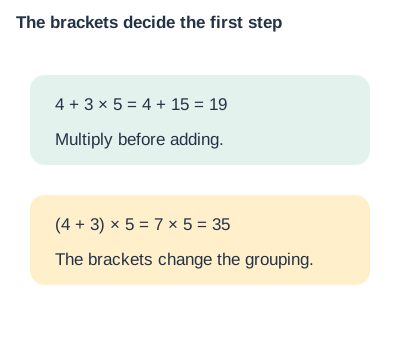
For 4 + 3 × 5, multiplication gives fifteen before addition gives nineteen. For (4 + 3) × 5, the bracketed sum becomes seven before multiplication gives thirty-five. Simply calculating from left to right would ignore the structure of the first expression.
When comparing 0.7 and 0.65, rewrite 0.7 as 0.70. Seventy hundredths exceed sixty-five hundredths. Extra printed digits do not guarantee a larger decimal. Use a number line or place-value chart when the comparison feels surprising.
3. Give letter expressions a meaning
Expressions using Letter-Numbers is the fourth title in the verified contents. To study algebra meaningfully, decide what the letter represents and what each operation does. A repeated charge of ₹6 per item plus one ₹10 delivery fee can be modelled as 6 n + 10.
For four items, substitute n = 4 to obtain ₹34. The expression is not 6(n + 10), because that would multiply the delivery fee as though it applied inside every group. A short sentence identifying the fixed and changing parts prevents the error.
Keep expressions and equations distinct. An expression such as 6 n + 10 names a quantity. An equation such as 6 n + 10 = 34 states an equality that can be solved. Practise translating both directions: story to symbols and symbols back to a story.
4. Link line relationships to triangle reasoning
The geometry titles are Parallel and Intersecting Lines and A Tale of Three Intersecting Lines, with Number Play between them in the contents. A sensible study sequence is to name the relationships before using a numerical angle rule.
If two straight lines intersect, vertically opposite angles are equal. Adjacent angles on a straight line add to 180°. For parallel lines cut by a transversal, name the specific corresponding or alternate angle relationship; the parallel condition matters.
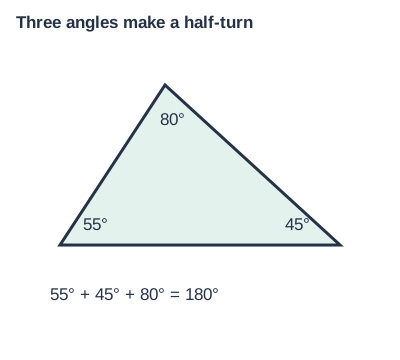
A triangle with angles 55° and 45° has third angle 80°, because the interior angles total 180°. Do not subtract only one given angle or use 360°, which belongs to a full turn. Write the relationship first so the arithmetic has a reason.
5. Use number play and fractions to explain a rule
Number Play and Working with Fractions invite more than answer production. For an original parity check, adding two odd numbers gives an even number: each odd number has a paired part plus one extra, and the two extras make another pair.
For fractions, identify whether the task is combining, comparing or finding a part of a quantity. In 2/3 + 1/6, change two thirds to four sixths, then add to obtain five sixths. Adding denominators would change the unit rather than combine equal-sized parts.
Ask for a size check as well. The sum must exceed two thirds but remain below one whole. A claimed answer such as three ninths is smaller than the first addend, exposing a problem even before every step is checked. This habit transfers across many questions.
6. Build a chapter-by-chapter practice record
Use the verified title list below to match the part, then add your own evidence column. Record one independently completed question, a remaining uncertainty and a date for a fresh attempt. A completed notebook exercise is useful work but not the same as independent recall.
Choose the next task from the error: place-value model for a decimal confusion, a story for an expression error or a marked diagram for an angle relationship. Avoid restarting an entire chapter when one prerequisite needs attention.
The worksheet below samples selected skills and includes explained answers. It is not a replica of NCERT exercises or a full Part I test. Mark unfamiliar topics as not studied, and use the results to guide teaching rather than to label the learner.
5 worked examples with reasoning
1. Evaluate 6 + 2 × 8.
- Multiply first: 2 × 8 = 16.
- Add six to get 22.
- Left-to-right addition first would incorrectly give 64.
2. Compare 0.56 and 0.6.
- Write 0.6 as 0.60.
- Sixty hundredths exceed fifty-six hundredths.
- Therefore 0.6 is greater.
3. A service charges ₹8 per item plus a fixed ₹12 fee. Write the cost for n items and find the cost for five.
- The variable part is 8 n; add twelve once.
- Cost = 8 n + 12; for n = 5 it is ₹52.
- The fixed charge does not multiply by the item count.
4. A triangle has angles 47° and 63°. Find the third.
- The three interior angles sum to 180°.
- Third angle = 180 − 47 − 63 = 70°.
- Check 47 + 63 + 70 = 180.
5. Calculate 3/4 + 1/8.
- Convert three quarters to six eighths.
- Add to get 7/8.
- The answer is greater than three quarters but less than one.
Save the guide or print the practice
Download to save or share
Complete guide with answers (PDF) · Worksheet without answers (PDF) · Worksheet and answer key (PDF)
Try each task before opening its answer. Give an example or reason, not only a label.
14 practice questions with explanations
Try each task before opening its answer. Give an example or reason, not only a label.
Write an answer and your reason before opening the explanation. Check the reasoning as well as the final answer.
- Place value
Write 3,04,050 in words using the Indian grouping system.
Answer and reasoning
Three lakh four thousand fifty.
Separate lakh, thousand and units groups.
- Order
Calculate 5 + 4 × 3.
Answer and reasoning
17.
Multiply twelve, then add five.
- Brackets
Calculate (5 + 4) × 3.
Answer and reasoning
27.
Add inside the brackets first.
- Decimal
Which is greater: 0.9 or 0.85?
Answer and reasoning
0.9.
Compare 0.90 with 0.85.
- Decimal
Calculate 2.4 + 0.37.
Answer and reasoning
2.77.
Align tenths and hundredths.
- Letters
Evaluate 3 n + 2 when n = 5.
Answer and reasoning
17.
Substitute five for n.
- Story
Write the cost of n ₹7 pens plus one ₹9 delivery fee.
Answer and reasoning
7 n + 9 rupees.
The fee is added once.
- Angles
Two adjacent angles form a straight line. One is 68°. Find the other.
Answer and reasoning
112°.
180 − 68.
- Angles
Two lines intersect and one angle is 75°. Find its vertically opposite angle.
Answer and reasoning
75°.
Vertically opposite angles are equal.
- Triangle
A triangle has angles 50° and 60°. Find the third.
Answer and reasoning
70°.
180 − 50 − 60.
- Parity
Is the sum of two odd integers odd or even? Explain.
Answer and reasoning
Even.
The two unpaired units form one pair.
- Fraction
Calculate 1/2 + 1/3.
Answer and reasoning
5/6.
Three sixths plus two sixths.
- Fraction
Find 2/3 of 27 counters.
Answer and reasoning
18 counters.
One third is nine; two thirds are eighteen.
- Edition
Does this Part I guide verify every chapter in another part?
Answer and reasoning
No.
Match that part against its own official contents.
Use the ideas without looking at the notes
Use a row per chapter: exact title; one independent example; current difficulty; next practice task; revisit date.
Common questions
Which part is mapped here?
The eight-chapter Grade 7 Part I contents in the official linked file.
Is this a full solution book?
No. It provides original examples, readiness tasks and a study route.
What if my contents differ?
Check class, part, language and publication details, then follow your school-matched book.
Must I study chapters in this order?
Use the school’s sequence and revisit prerequisites when needed.
How should the worksheet be used?
Try independently, examine reasons for errors and choose a focused follow-up.
Connect your learning
Ask about guided Maths learning if your child needs help explaining these ideas.
About this guide
Original explanations, examples, diagrams and practice by BananaLearn. The grade label indicates the intended learning level; this is not an official textbook extract or exam paper.