
Start with the key idea
Choose a format by matching it to a specific learning need. One-to-one tuition can allow flexible pacing and close feedback; a well-matched small group can offer shared explanations, discussion and practice with others. Neither format guarantees better results. Check group matching, actual learner participation, feedback and a fresh independent task before deciding.
What the two formats actually mean
One-to-one means one learner works with one tutor during the session. Small-group tuition means several learners share the teaching. Providers use the word “small” differently, so ask for the maximum number of pupils and what happens when attendance changes. A large webinar is a different experience from an interactive group.
A timetable tells you the scheduled lesson length, not how much individual feedback each learner receives. In a group, useful teaching can happen while a peer explains, but only if the task and explanation are relevant and the other children engage with them. Do not divide minutes by headcount and call the result exact teaching time.
Ask whether the group is fixed, changes from week to week, or mixes school curricula. None of these facts alone decides quality. They help you work out how closely tasks can match the child’s current knowledge and school requirements.
Start with the learning need, not the format label
Write the concern as a task: “explain which operation a word problem requires”, “support a reading inference with evidence” or “balance a simple chemical equation”. A broad goal such as confidence or better marks needs a more observable learning target alongside it.
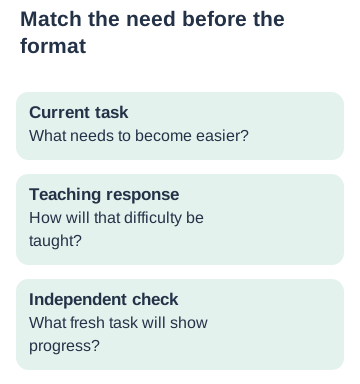
A child with a specific prerequisite gap may benefit from concentrated explanation and flexible pacing. A group of learners with the same gap may also be suitable if the tutor can see each person’s work and respond. Ask what happens when one learner needs an earlier step while others are ready to move on.
A learner who already understands the basics may need discussion, varied applications or feedback on reasoning. A group can offer contrasting approaches; one-to-one can offer these through carefully chosen examples too. The teaching activity matters more than the label.
Check participation and feedback in each option
In a one-to-one lesson, watch whether the child attempts and explains, rather than watching the tutor solve every problem. The format creates an opportunity for individual attention; it does not prove that the opportunity is used well.
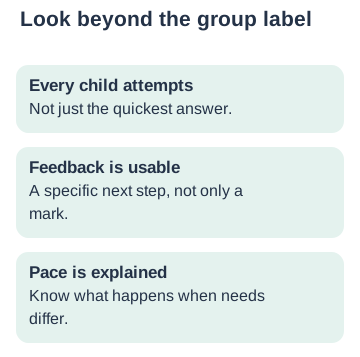
In a group, ask how every pupil answers. Mini-whiteboards, short written responses or an individual attempt before discussion can reveal more than asking “Does everyone understand?” A single confident child answering for everyone leaves other learners’ understanding unknown.
Ask how corrections work. Useful feedback identifies a next step the learner can act on. A shared answer key can check a final result, but it may not explain why a child selected the wrong method. Find out whether the tutor can inspect the reasoning as well as the answer.
Compare the formats through three learning situations
Maths: one learner knows 6 × 7 but cannot represent six equal groups; another understands groups but needs fact practice. A common worksheet may not address both difficulties. Ask for an example of how each will receive an appropriate next task.
English: three children compare which sentence best supports an inference. A group may make the disagreement useful if every child first chooses and explains. If one learner needs help reading the passage itself, that access need must also be addressed rather than mistaken for weak reasoning.
Science: learners predict whether a bulb lights in several circuit sketches, then justify their choices. Peer explanations can expose misunderstandings. The tutor still needs an individual check afterwards to see whether each child can recognise a complete path.
What research can and cannot settle for your family
The Education Endowment Foundation reviews evidence for both individual and small-group tuition, largely in school contexts. Its one-to-one summary reports mixed results in direct comparisons with small groups. That supports checking implementation rather than assuming one format always wins.
These research summaries do not measure BananaLearn, your child or a particular commercial package. Average effects across studies are not promised marks, a personal forecast or a reason to buy a set number of lessons. Ask how the provider will define and check progress for your actual learner.
Use the research as a set of questions: is the help targeted, connected to school learning and checked over time? Then inspect the provider’s real lesson plan and a suitable trial. That gives more relevant evidence than simply quoting an average result.
Check the arrangements that change the decision
Compare the total cost for a defined period, the length and number of sessions, and what is included. In a group, ask what happens after a missed lesson, whether catch-up support is included and whether another pupil’s pace controls the sequence. In individual tuition, check cancellation and rescheduling terms too.
Consider the child’s ability to hear, see, write and ask questions in the actual setting. Online versus in-person is a separate choice from individual versus group. Do not assume every group is in a classroom or every individual lesson is online.
An affordable format that the child can attend consistently may fit better than an impressive package that clashes with school and rest. Before increasing time or cost, name the learning need that the added provision is meant to address. Avoid treating a larger purchase as evidence of better support.
Use a simple decision and review process
First name the learning goal and check what the school already provides. Next observe or ask for the actual learning activities in each option. Record task match, participation, feedback, child comfort and practical terms separately. “Unknown” is a useful finding when information is missing.
Choose the option with the clearest fit, then agree a review point. Keep a small starting task and a later fresh task so you can discuss independent work and the help still needed. A short initial observation is enough to choose a next step, not to declare permanent mastery.
Change the arrangement if the evidence shows a mismatch: a different group level, a focused individual sequence, or revised goals may help. This is a teaching decision rather than a judgement of the child’s ability. The printable comparison below keeps the questions in one place.
3 worked examples with reasoning
1. A group follows the same textbook but the child cannot follow its explanations.
- Identify the exact earlier step causing difficulty.
- Ask how the tutor would address that prerequisite without leaving the learner behind.
- Compare the response with an individual option; textbook matching alone is insufficient.
2. The child gets every group answer right after hearing classmates.
- Ask for an individual response before discussion or a fresh task afterwards.
- Record the reasoning and any support.
- Do not interpret copied correct responses as independent understanding.
3. The individual tutor gives almost no time for the child to try.
- Ask for a learner attempt and feedback cycle.
- Observe whether the teaching changes.
- Individual attention is valuable only when the child can use the opportunity to learn.
Save the guide or print the practice
Download to save or share
Complete guide with answers (PDF) · Worksheet without answers (PDF) · Worksheet and answer key (PDF)
Use these situations to practise making a decision. The model responses are examples, not a score or a diagnosis of your child.
8 decision tasks with model responses
Use these situations to practise making a decision. The model responses are examples, not a score or a diagnosis of your child.
Write an answer and your reason before opening the explanation. Check the reasoning as well as the final answer.
- Match
Two children are in Grade 6. Does that establish a useful tutoring group?
Answer and reasoning
No; compare their goals and current understanding.
Grade is broad and does not identify a specific learning need.
- Participation
One pupil answers every question. What should you ask?
Answer and reasoning
How will each learner attempt and explain?
Hearing a correct answer does not reveal every child’s understanding.
- Format
Can small-group tuition be online?
Answer and reasoning
Yes.
Delivery location and group size are separate choices.
- Feedback
A worksheet is marked wrong without comments. What is missing?
Answer and reasoning
A usable next step or explanation of the difficulty.
A mark alone may not help the child change their approach.
- Evidence
Can a research average predict your child’s marks?
Answer and reasoning
No.
Study averages are not individual forecasts or provider guarantees.
- Time
Should a 60-minute group lesson be described as exactly 15 minutes of learning per child in a group of four?
Answer and reasoning
No.
Shared explanation and peer discussion can contribute; individual feedback still needs checking.
- Review
What makes a later progress task more informative than repeating the same question?
Answer and reasoning
A fresh matched task can test use beyond memorising the old answer.
Keep difficulty and support conditions comparable.
- Decision
Name one reason to clarify before buying.
Answer and reasoning
Example: nobody can explain how groups are matched.
Missing information should not be treated as a positive rating.
Your printable decision record
Format comparison sheet: Learning goal ___ Option A and group size ___ Option B and group size ___ Task match ___ Child attempts ___ Feedback example ___ School connection ___ Cost and terms ___ Child view ___ Questions still open ___ Review task and date ___.
Record evidence or “unknown” in each field. There is no automatic winning total.
Common questions
Is one-to-one always better?
No. It can offer flexible pacing and close feedback, but suitability depends on the learner and the teaching. A well-matched group may also work well.
How many pupils should a small group have?
Ask for the actual maximum and how each pupil participates. This guide does not set a universal size that guarantees quality.
What if my child is shy?
Ask how the tutor supports comfortable participation and observe the child’s experience. Do not assume shyness alone determines the best format.
Can we combine formats?
Possibly, when each serves a distinct goal and the workload is manageable. Avoid paying twice for repeated content without a clear purpose.
Should we change if marks do not rise immediately?
Review work samples, goals and support before drawing a conclusion. One short-term mark is not enough to judge the whole arrangement.
Connect your learning
Ask about one-to-one learning support if you would like to discuss your child’s learning needs.
About this guide
Original explanations, examples, diagrams and practice by BananaLearn. This parent guide offers practical decision tools, not an assessment or a guarantee of learning outcomes. Monetary examples, where included, are hypothetical.