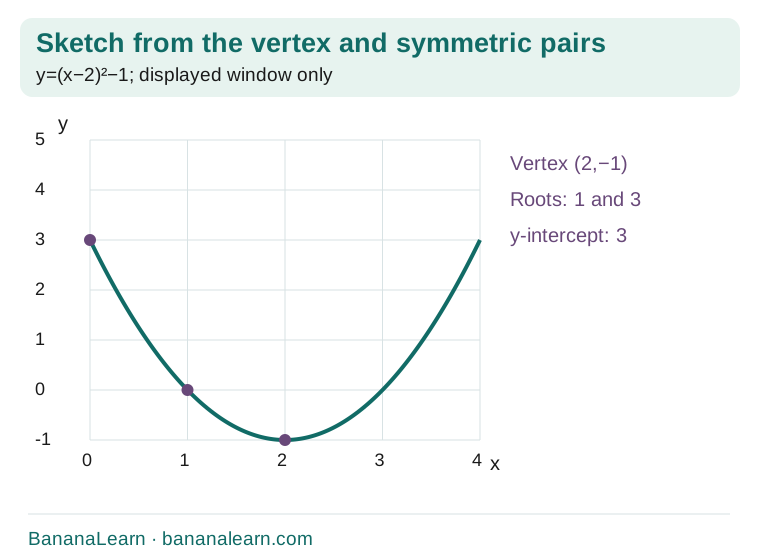
1. Sketch y=x²−4x+3.
- Factorise to (x−1)(x−3): roots 1 and 3.
- Complete the square to (x−2)²−1: vertex (2,−1).
- The y-intercept is (0,3); (4,3) is its symmetric partner. Open upward.
Maths · Algebra / Precalculus · suggested level; school sequences vary
Two different x-values can land at the same height on a parabola. Find its centre of symmetry first, and the rest of the sketch becomes easier to check.
Start here
For y=a(x−h)²+k, the vertex is (h,k) and the axis is x=h. Use intercepts and symmetric point pairs to check the graph.
Original BananaLearn guide · 7 November 2026
On a narrow screen, swipe the diagram or open it full size.
A quadratic has a non-zero squared term: y=ax²+bx+c with a≠0. Its graph is a parabola. Positive a gives an upward opening; negative a gives a downward opening. The graph is not two straight lines meeting at a corner.
The vertex is the turning point. An upward-opening parabola has a minimum there; a downward-opening one has a maximum. Naming the direction helps you catch a sketch that contradicts the equation.
In y=a(x−h)²+k, the squared part is zero at x=h. Therefore the vertex is (h,k). For y=2(x−3)²−4, use (3,−4), not (−3,−4). The axis of symmetry is the vertical line x=3.
Points equally far to the left and right of h have the same square and therefore the same y-value. This gives an efficient table and a strong visual check.
Set x=0, because every point on the y-axis has x-coordinate zero. For y=x²−4x+3, the y-intercept is (0,3). In general form it is (0,c).
The number c is not automatically the vertex height. A parabola can meet the y-axis well above or below its turning point. Keep the roles of intercept and vertex separate.

On a narrow screen, swipe the diagram or open it full size.
Set y=0 and solve the quadratic. The graph may cross twice, touch once or never meet the x-axis over the real numbers. For y=(x−1)(x−3), the intercepts are (1,0) and (3,0).
For y=(x−2)²+5, a square is non-negative, so y is always at least 5. There are no real x-intercepts. Do not force two crossings onto every quadratic sketch.
Expanded form makes the y-intercept clear. Factorised form makes roots clear when factorisation is available. Vertex form makes the turning point clear. They are three descriptions of one function, not three unrelated formulas.
Complete the square in x²−4x+3: (x−2)²−1. The vertex is (2,−1), midway between roots 1 and 3. Expanding the vertex form returns the original expression.
For y=(x−2)²−1, choose x=0,1,2,3,4. The y-values are 3,0,−1,0,3. Plot the vertex and the two symmetric pairs. Draw a smooth curve through them rather than connecting points with a zigzag.
Label both axis scales and the equation. A sketch is qualitative unless accurate plotting is required; it should still put crossings and the vertex on the correct sides of each axis.
For this upward parabola, every y≥−1 occurs and no smaller value occurs. Its range is y≥−1. A horizontal line y=3 meets it at x=0 and x=4, so the equation (x−2)²−1=3 has two solutions.
A restricted x-domain changes the displayed graph and may change the range. State any restriction before treating a sketch as a complete description.
Check opening direction, vertex, axis, y-intercept, real roots and one symmetric pair. If these disagree, revisit the equation before improving the artwork. The coefficient a changes vertical scale as well as opening direction.
For parent support, ask “which part of the formula tells you that?” A child who can connect each feature to the equation is learning more than a memorised sequence of plotting steps.
See the reasoning
Try, explain, check
Try each task before opening its explanation. These are original BananaLearn questions, not official exam or past-paper questions. Where several answers can work, the explanation gives the criteria.
(5,3)
The square vanishes at x=5.
x=−2
The centre is where x+2=0.
Down
The squared-term coefficient is negative.
x=−2 and x=2
Set x²=4.
(0,−6)
Substitute x=0.
y≥2
The square is non-negative and a is positive.
9 at x=4
Subtracting a square cannot increase 9.
5
Both are 2 units from x=3.
None
Its minimum is 1.
One distinct root, −6
The curve touches the axis at its vertex.
(x+3)²−4
Expand to check x²+6x+9−4.
No
They coincide only when the vertex lies on x=0.
Copy these headings and fill them for one worked task, then for a fresh attempt. Use your own evidence rather than copying the model answer.
Explore BananaLearn’s games, learning features and one-to-one tutoring. Maths is our priority; English and Science tutoring are also available. Bring a recent example of schoolwork when checking teaching fit.
Original BananaLearn explanations, examples, illustrations and practice. Source facts checked 7 November 2026. Suggested levels are learning guides, not a claim that every board or textbook uses the same sequence.
How we prepare guides · Report a correction
Share the complete guide: https://bananalearn.com/learn/quadratic-graphs-vertex-intercepts.html