
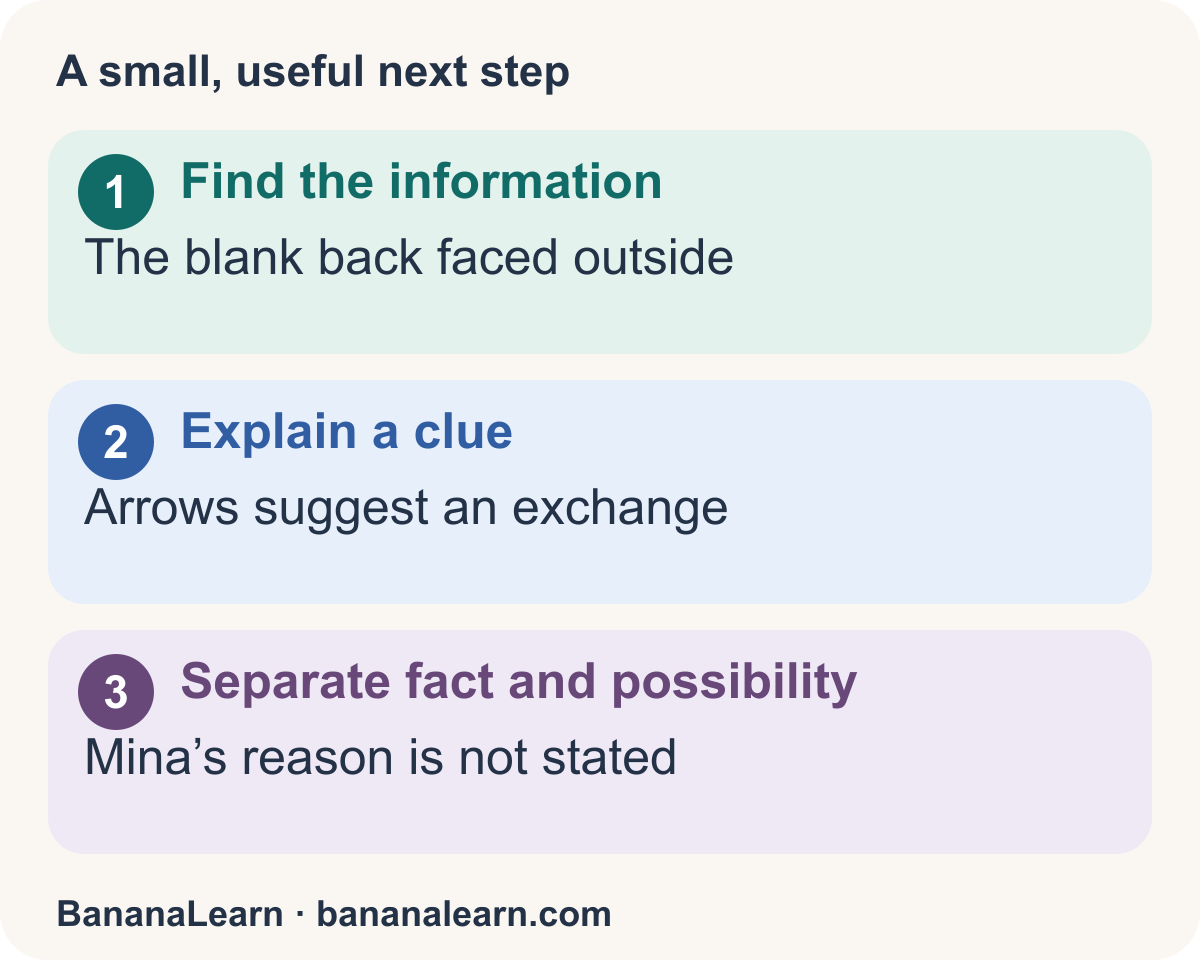
Read the story once before choosing questions
Share the original story below. Read it aloud if the printed words are beyond your child’s current independent reading level; say that you are exploring understanding of a heard story. If they read it themselves, allow time to reread. This is a family activity, not a standardised assessment.
The sign in the window
Ravi made a sign for the school book swap: “Bring one book. Choose one book.” He chose the classroom window beside the playground. At lunchtime, no one brought a book.
“Maybe nobody wants to swap,” he said. Leena stood outside the window. “I can only see the blank back,” she called.
Ravi turned the sign around. Then he added a drawing of two books with arrows between them. The next morning, three classmates arrived carrying books. Mina had brought two. Ravi pointed to the first line, and she put one back in her bag.
By break time, Ravi’s adventure story had a new owner. He chose a book about the Moon and left the sign in the window.
Invite a brief retelling before choosing two or three questions. There is no need to complete the whole set in one sitting. Younger children can point, draw or answer aloud. Older readers can write an answer with a supporting detail.
Seven questions, with answers and reasons
- What was the rule for the swap? Bring one book and choose one book. The opening sign states both parts; bringing a book alone does not explain the whole rule.
- Why could Leena not read the sign outside? The blank back faced her. Ravi had put the written side where people outside could not read it.
- What does “swap” mean here? Exchange one book for another. It does not mean buy a new book; the story does not mention money.
- Why might Ravi have added the drawing? It could help people understand that books would be exchanged. This is an inference supported by the two books and arrows. The narrator does not state Ravi’s exact thought.
- How do we know Mina followed the one-book rule? After Ravi pointed to the first line, she returned one of her two books to her bag. That action supports the answer.
- Did turning the sign guarantee that classmates would come? No. They came after the sign changed, but the story cannot prove that every future swap would attract visitors or identify every reason they came.
- Would you choose the Moon book or the adventure story? Either choice is possible. Explain your preference; there is no single correct personal answer.
Questions 1–3 mostly use information stated in the text and word meaning. Questions 4–6 ask the reader to reason from evidence and recognise its limits. Question 7 invites a preference. Treating all seven as exact-answer recall would miss those differences.
Respond to an answer without supplying it immediately
Child: “Mina was greedy.”
Adult: “Which action made you think that? What did she do after Ravi pointed to the sign?”
Closer answer: “She brought two books, then put one back. Maybe she did not notice the rule.”
The closer answer separates the observed action from a possible explanation. “Maybe” matters because the story does not reveal Mina’s reason. An adult can model that distinction without insisting on the exact wording in our answer list.
If the child says “I don’t know”, return to the relevant sentence together. Check the meaning of a word, reread the event or offer two possible answers and ask which fits. Avoid a string of rapid questions. If listening to the passage helps but independent reading remains hard, describe that difference to the teacher.
Use these question types with a different text
| Purpose | Reusable question | What to look for |
|---|---|---|
| Recall | What happened just before this? | An accurate event, not a guessed sequence. |
| Vocabulary | What does this word mean here? | A meaning that fits the sentence. |
| Inference | What might explain that action? | A plausible idea tied to a detail. |
| Information text | Which detail supports that statement? | Relevant evidence from the passage or diagram. |
| Response | What would you like to ask next? | The child’s own curiosity. |
Do not force a feelings question onto a passage about how a machine works, or demand a single motive when a story leaves it uncertain. Match the question to what is actually available.
Decide what to practise next
If events are confused, retell three main moments in order. If vocabulary blocks meaning, explain the word in the sentence and revisit the passage. If an inference has no evidence, ask for one supporting detail. Choose one next step instead of writing a general judgement about the child’s comprehension.
For persistent difficulty, use the reading-fluency and understanding guide and bring a concrete example to school. For turning an oral answer into writing, try our talk, draw, write sequence. The printable sheet below is for practising the same discussion with another passage.
Further reading: Scholastic: questions during story time. The scenarios, examples and resources here are original BananaLearn materials.
Story discussion and evidence sheet
Use with the story in the linked guide or another short passage. Choose a few questions; accept spoken answers and write notes only if useful.
A completed example
Question type: Why add arrows?
Our answer: To help explain the swap
Detail from the text: Two books with arrows between them
Certain or possible?: Possible explanation, not stated thought
Opens a separate sheet with the completed example and writing space. Save it as a PDF or print it using your browser. No account is required.
Questions parents ask
Should the book stay open?
Yes, returning to the text is useful for checking evidence. Closing the book tests memory as well as comprehension and is not necessary for this activity.
What if an answer is different from yours?
Check whether it fits the text and the kind of question. An inference can have more than one defensible answer; an unsupported guess should be explored rather than marked right automatically.
Should every answer be written?
No. Oral answers, pointing and drawing can help you discuss meaning. Practise written answers separately when that is the learning goal or the school task.
Would a teacher help with the next step?
BananaLearn offers 1-on-1 Maths, English and Science tutoring. Tell us your child’s grade, curriculum and what they are finding difficult so we can discuss a suitable fit.
Ask about a free 50-minute session