
Start with the key idea
Choose a workable learner routine first, then confirm the exact date and local time for both people. Record the named time zones, daylight-saving arrangements, lesson length and cancellation terms. Review teaching fit separately from scheduling convenience.
1. Start with the learner’s real day
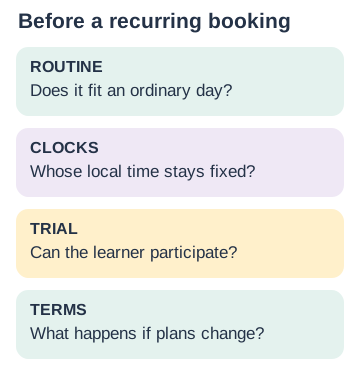
Map the school finish, travel, meals, homework, activities and usual wind-down before choosing a lesson. Leave transition time rather than placing tutoring at the exact moment the child arrives home. Ask the learner when they can participate and check that the proposed pattern is realistic for the family.
Compare two or three possible windows instead of filling every available gap. A shorter workable block may be more useful than a longer slot during a rushed evening, but confirm what lesson lengths the provider actually offers. Do not assume a displayed hourly rate describes the length of one class.
Treat availability as a constraint, not as proof of teaching quality. A tutor with a perfect time slot still needs suitable subject knowledge, an appropriate teaching approach and a clear feedback process. If the learner is repeatedly too tired to explain or attempt work, revisit the schedule rather than simply increasing reminders.
2. Write one appointment so it cannot be misread
An appointment should state the date, learner location and local time, tutor location and local time, duration and meeting link. Use a named zone such as Asia/Kolkata or a clear city rather than an ambiguous abbreviation. A calendar invitation can display each participant’s local time, but both people should verify the first occurrence.

For a simple fixed-offset example, 6:00 pm in India is 4:30 pm in Dubai on the same date: India is one hour and thirty minutes ahead. The two displayed times must describe one moment, not two separate appointments. If the session lasts fifty minutes, the planned end is 6:50 pm in India and 5:20 pm in Dubai.
For locations that change clocks seasonally, avoid reusing a fixed offset all year. Confirm the actual appointment date in a calendar or reliable time-zone tool. Cities within the same country can have different clocks, so country names alone are not enough for Australia or the United States.
3. Decide which local clock a recurring lesson follows
Ask a precise question: “If our clocks change, will the lesson stay at the same time for the child?” A recurring slot can follow the learner’s local time or the tutor’s local time. Either can work when everyone understands the consequence, but leaving the rule unstated invites missed sessions.
For example, a family may need tutoring to remain after a fixed school activity. If the tutor keeps their own local time when the family’s clock changes, the lesson may move relative to that activity. Check future occurrences around the change, not only the first invitation.
Put the agreed rule in writing and ask how changes will be communicated. Recheck after travel, a school timetable change or a change of device time-zone settings. An automatic calendar conversion helps with display; it does not negotiate a new slot or confirm that the tutor is available.
4. Use a trial to test the whole setup
Before a trial, confirm the device, microphone, camera policy, writing method and access link. A larger screen may make a diagram easier to see, but the learner also needs a way to attempt work and show reasoning. Test this with a short real task rather than relying only on a connection check.
During the lesson, notice whether the learner gets thinking time, whether the tutor checks an explanation and whether a new question follows a model. Afterwards, ask what the next teaching step would be. A smooth video call is not the same as a useful lesson.
Check whether the selected time works on an ordinary school day. A holiday trial at midday may not reveal how a weekday evening will feel. If the schedule will differ after the trial, discuss that difference explicitly before committing to a package.
5. Clarify what happens when plans change
Ask about rescheduling notice, missed lessons, tutor absence, public holidays, connection failures and package validity. Record the provider’s actual terms without assuming that a reasonable request will always be granted. If a lesson is described as fifty minutes, compare package prices using fifty-minute classes rather than calling them full hours.
For travel, identify whether the child will join from a different time zone and whether the environment is suitable. Update the appointment with the actual location and date. Do not rely on remembering the old home-time conversion while the device is set to a new local clock.
Keep a simple communication route for corrections. A confirmed revised invitation is clearer than several messages saying “same time tomorrow”. If the local time changes, state both the old and new slot and ask for confirmation before treating the change as agreed.
6. Review consistency and learning together
After a small run of lessons, review punctuality, energy, participation and the learning work. Repeated missed starts may reflect an unsuitable schedule; repeated passive sessions may require a teaching conversation. Record the issue accurately so the response fits it.
Use one independent example to review learning: can the child explain a method or complete a fresh suitable task? Also ask whether the lesson timing leaves enough room for school, rest and other responsibilities. A timetable that can only work through constant rushing is unlikely to be a good long-term fit.
Before changing providers, separate schedule problems from teaching problems and discuss possible adjustments. Before increasing frequency, check that the current lessons are usable and that extra sessions have a clear purpose. Availability and volume alone do not establish educational value.
Our unambiguous lesson booking
Read the two local times back as one appointment. Confirm the actual date and recurring-clock rule with the tutor; a calendar display alone does not establish agreement.
Exact date: ____________________
Learner city/zone and local start–end: ____________________
Tutor city/zone and local start–end: ____________________
Recurring slot follows whose local clock? ____________________:
Clock-change or travel dates to recheck: ____________________
Meeting/access details stored privately: checked / pending
Duration, rescheduling notice and agreed contact: ____________________
Save the full guide to keep this record with the explanations. The separate worksheet contains the practice and decision questions; use its answer version to check your reasoning.
5 worked examples with reasoning
1. Convert an India–Dubai lesson at 6:00 pm India time.
- India is 1 hour 30 minutes ahead of Dubai.
- Subtract that difference: 4:30 pm Dubai time.
- Write the date, duration and both local times on the appointment.
2. A fifty-minute lesson begins at 6:00 pm in India.
- Add fifty minutes to find 6:50 pm.
- The corresponding Dubai end is 5:20 pm.
- Do not label the session as a full purchased hour.
3. A weekly invitation crosses a seasonal clock change.
- Check the local times on a date after the change.
- Ask which participant’s clock the recurring slot follows.
- Confirm availability before accepting the revised pattern.
4. A trial is successful at midday during a holiday.
- Identify the proposed term-time slot.
- Check school travel, meals and the learner’s energy at that time.
- Trial or discuss the real schedule before buying a long package.
5. A family travels while keeping the same tutor.
- Record the new location and dates.
- Check each appointment in the new local time.
- Confirm a suitable workspace and any changes with the tutor.
Save the guide or print the practice
Download to save or share
Complete guide with answers (PDF) · Worksheet without answers (PDF) · Worksheet and answer key (PDF)
Try each situation before reading the suggested response. Give a reason and adapt the decision to the learner and school requirements.
14 practice questions with explanations
Try each situation before reading the suggested response. Give a reason and adapt the decision to the learner and school requirements.
Write an answer and your reason before opening the explanation. Check the reasoning as well as the final answer.
- Appointment
What is missing from “Tuesday at 6”?
Answer and reasoning
Date, local time zone, duration and meeting details.
The phrase does not identify one unambiguous appointment.
- Conversion
What is 7:00 pm India time in Dubai?
Answer and reasoning
5:30 pm on the same date.
Subtract one hour thirty minutes.
- Duration
A fifty-minute class starts at 5:30 pm. When does it end?
Answer and reasoning
6:20 pm.
Thirty minutes reaches six, then twenty more.
- Location
Is “Australian time” precise enough?
Answer and reasoning
No.
Use the city or named time zone.
- Season
Can one UK–India offset be assumed for every month?
Answer and reasoning
No.
Check the exact date and seasonal clock arrangements.
- Recurrence
Which rule must be agreed for recurring sessions?
Answer and reasoning
Whether the slot follows the learner’s or tutor’s local clock.
A clock change can affect the other participant’s displayed time.
- Calendar
Does automatic conversion guarantee tutor availability?
Answer and reasoning
No.
Display and agreement are different matters.
- Routine
Why allow time after school travel?
Answer and reasoning
The learner may need a practical transition before participating.
The available clock slot is not the whole routine.
- Trial
What should a trial include besides a connection check?
Answer and reasoning
A real learner attempt and feedback.
Teaching fit needs observable work.
- Terms
Name two rescheduling details to ask about.
Answer and reasoning
For example, notice required and treatment of missed lessons.
Use the provider’s actual policy.
- Travel
What should change when a learner travels?
Answer and reasoning
Confirm the location, date and local appointment time.
Old offsets may no longer describe the situation.
- Value
Does an ideal time slot prove a tutor is suitable?
Answer and reasoning
No.
Check subject fit and teaching separately.
- Review
What evidence suggests the routine needs revisiting?
Answer and reasoning
For example, repeated rushed starts or inability to participate at that time.
Discuss the observed pattern rather than blame.
- Action
Rewrite “same time tomorrow” clearly.
Answer and reasoning
For example: 12 November, 6:00–6:50 pm Asia/Kolkata, with the confirmed link.
A dated zone-specific appointment is less ambiguous.
Use the ideas without looking at the notes
Write the date, both locations, both local start and end times and the agreed recurring-clock rule. Check the real school-day routine, a learner attempt in the trial and the written rescheduling terms. Recheck after travel or seasonal clock changes.
Common questions
Should we choose the tutor’s most convenient time?
Only if it also works for the learner’s routine and the teaching fit is right.
Can a calendar handle all time-zone issues?
It can convert displayed times, but recurrence rules and availability still need agreement.
Does every country change clocks?
No. Check the actual locations and dates rather than assuming one rule.
How should we compare packages?
Use the actual number and duration of classes and the written terms, alongside teaching suitability.
Connect your learning
Ask about one-to-one learning support if your child needs help explaining these ideas.
About this guide
Original explanations, examples, diagrams and practice by BananaLearn. The grade label indicates the intended learning level; this is not an official textbook extract or exam paper.