
Start with the key idea
An arithmetic progression has a constant difference d between consecutive terms. Its nth term is a + (n − 1)d. The sum of the first n terms is n[2 a + (n − 1)d]/2, or n(a + last)/2. In word problems, distinguish a single term from an accumulated total.
1. Check for a constant difference
The sequence 6, 10, 14, 18 is arithmetic because each term increases by 4. Subtract each term from the next to check the difference. The difference may be positive, negative or zero.
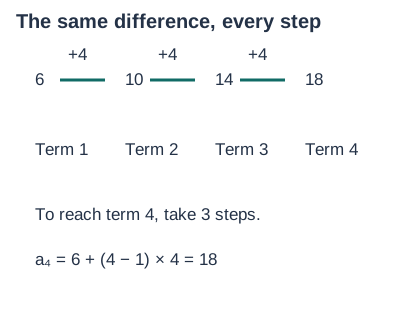
A sequence that doubles, such as 3, 6, 12, 24, is not arithmetic. It has a constant multiplier, but the differences are 3, 6 and 12. A steadily growing story is not automatically an arithmetic progression.
Look for the same amount added each time: three extra seats per row or five more rupees saved each day. When a percentage is applied to a changing amount, the increases usually change, so an AP model may not fit.
2. Count the steps from the first term
The first term is a. To reach the second, add d once; to reach the third, add d twice. Therefore the nth term is a + (n − 1)d. The subtraction of one counts the gaps rather than the listed terms.
For seats 12, 15, 18, …, a = 12 and d = 3. Row 10 has 12 + 9 × 3 = 39 seats. Using 12 + 10 × 3 gives row 11, because it takes one step too many.
Write the index meaning explicitly. If day 1 is the first deposit, day 10 uses nine increases. If a story instead describes an initial balance at day 0, translate its timing before choosing a. The formula does not decide the story’s starting label.
3. Find how many terms meet a condition
To find which term of 5, 9, 13, … equals 49, solve 49 = 5 + (n − 1)4. Subtract 5, divide by 4 and add 1 to obtain n = 12.
A term index must be a positive integer. Testing 50 gives n = 12.25, so 50 is not a term of this sequence. Do not round the index and claim an exact match; the twelfth and thirteenth terms are 49 and 53.
For an inequality such as reaching at least 50, the interpretation changes: choose the first permitted term not below 50, which is the thirteenth term, 53. Exact membership and crossing a threshold are different questions.
4. Pair the ends to understand the sum formula
Write 2 + 4 + 6 + 8 + 10 once forwards and once backwards. Each vertical pair totals 12, and there are five pairs. Twice the required sum is 5 × 12 = 60, so the sum is 30.
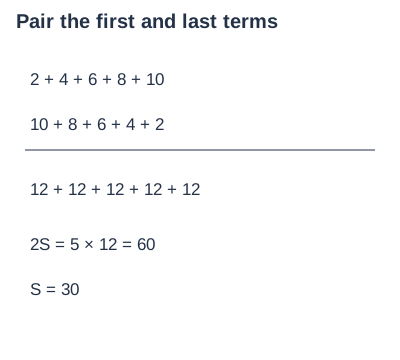
This gives S = n(a + last)/2. Replacing the last term with a + (n − 1)d yields S = n[2 a + (n − 1)d]/2. The factor one half appears because the pairing counted the original sum twice.
The formula works for an odd number of terms too. Pairing the forward and reversed lists still creates n equal sums. You are not required to split the original list into disjoint pairs before using the argument.
5. Separate a final amount from a total saved
A learner saves ₹10 on day 1 and ₹5 more each following day. The deposit on day 7 is 10 + 6 × 5 = ₹40. This is only that day’s deposit, not the money saved over the whole week.
Total savings for seven days are 7(10 + 40)/2 = ₹175. Label each calculation: seventh deposit, then sum of seven deposits. If the question asks for a running balance, a sum is likely needed; if it asks for a particular day’s deposit, use a term.
Check the total against bounds. Seven deposits each between ₹10 and ₹40 must total between ₹70 and ₹280. The average deposit is ₹25, so seven times ₹25 gives ₹175, an independent interpretation of the formula.
6. Respect whole-number and physical limits
For 30, 27, 24, …, d = −3. The tenth term is 30 + 9(−3) = 3 and the eleventh is 0. Algebra can continue to negative terms, but a story about remaining objects may need to stop at zero.
A real-world sequence may be arithmetic only over a stated range. A seating pattern might stop after twenty rows; savings may stop after a fortnight. Do not extend a model indefinitely without the problem allowing it.
In the final answer, give the requested object and unit: twelve terms, thirty-nine seats or ₹175 total savings. Recalculate the first few terms when a negative difference or uncertain starting day makes the formula difficult to interpret.
5 worked examples with reasoning
1. An auditorium has 20 seats in its first row and two extra seats per row. Find seats in row 15.
- a = 20, d = 2 and n = 15.
- a₁₅ = 20 + 14 × 2 = 48.
- There are 48 seats in row 15; fourteen gaps separate rows 1 and 15.
2. An auditorium has 20 seats in its first row and two extra seats in each following row. Find the total seats in the first 15 rows.
- First term 20, last term 48, count 15.
- S₁₅ = 15(20 + 48)/2 = 510.
- The total is 510 seats, not 48.
3. Which term of 7, 12, 17, … is 82?
- 82 = 7 + (n − 1)5.
- 75 = 5(n − 1), so n − 1 = 15.
- 82 is the sixteenth term.
4. Is 84 a term of the arithmetic progression 7, 12, 17, …? Explain.
- 84 = 7 + (n − 1)5 gives n = 16.4.
- A term number must be a positive integer.
- No: neighbouring terms are 82 and 87.
5. A tank contains 100 litres and loses 8 litres each minute. How much remains after 6 minutes, assuming the rate stays constant?
- The initial amount is at minute 0, not minute 1.
- Subtract six losses: 100 − 6 × 8 = 52.
- 52 litres remain. If listed as an AP starting with 100, this is its seventh listed term.
Save the guide or print the practice
Download to save or share
Complete guide with answers (PDF) · Worksheet without answers (PDF) · Worksheet and answer key (PDF)
Try each task before opening its answer. Give an example or reason, not only a label.
14 practice questions with explanations
Try each task before opening its answer. Give an example or reason, not only a label.
Write an answer and your reason before opening the explanation. Check the reasoning as well as the final answer.
- Identify
Is 4, 9, 14, 19 an AP? State d.
Answer and reasoning
Yes; d = 5.
Every consecutive difference is five.
- Identify
Is 2, 4, 8, 16 an AP?
Answer and reasoning
No.
Differences are 2, 4 and 8.
- Term
Find term 8 when a = 3 and d = 4.
Answer and reasoning
31.
3 + 7 × 4 = 31.
- Term
Find term 6 of 25, 22, 19, … .
Answer and reasoning
10.
25 + 5(−3) = 10.
- Count
Which term of 2, 5, 8, … is 29?
Answer and reasoning
The tenth.
29 = 2 + 3(n − 1).
- Membership
Is 30 a term of the arithmetic progression 2, 5, 8, …? Explain.
Answer and reasoning
No.
The index is not an integer.
- Sum
Find the sum of 1 through 10.
Answer and reasoning
55.
10(1 + 10)/2.
- Sum
Find the sum of the first five terms of 4, 7, 10, … .
Answer and reasoning
50.
Last term 16; 5(4 + 16)/2.
- Zero
Can an AP have d = 0?
Answer and reasoning
Yes.
Every term then equals the first term.
- Interpret
Does a₁₂ mean the total of twelve terms?
Answer and reasoning
No.
It means the twelfth term; S₁₂ is the sum.
- Story
Save ₹20 on day 1, then ₹2 more per day. Find day 5’s deposit.
Answer and reasoning
₹28.
20 + 4 × 2.
- Story
Save ₹20 on day 1 and ₹2 more each following day. Find the total saved over the first five days.
Answer and reasoning
₹120.
5(20 + 28)/2.
- Timing
An initial height is 10 cm at week 0, increasing 3 cm weekly. Height after four weeks?
Answer and reasoning
22 cm.
Four increases: 10 + 4 × 3.
- Reason
Why does the nth-term formula use n − 1?
Answer and reasoning
There are n − 1 gaps from term 1 to term n.
Count the increases, not the terms.
Use the ideas without looking at the notes
Name a, d and the meaning of n. Decide whether the unknown is one term, a number of terms or a total, then check the story’s starting point and limits.
Common questions
Can the common difference be negative?
Yes; a decreasing arithmetic progression has a negative difference.
When should I use a sum?
When the question asks for an accumulated total across several terms.
Can a term number be 4.5?
Not for an ordinary sequence indexed by positive integers. An exact term test must give a whole-number index.
Does the sum formula work for an odd count?
Yes. The forward-and-reversed-list argument works for any positive integer count.
Why does a day-zero story need care?
Its initial amount comes before the first elapsed interval. Count actual changes before assigning the index.
Connect your learning
Ask about guided Maths learning if your child needs help explaining these ideas.
About this guide
Original explanations, examples, diagrams and practice by BananaLearn. The grade label indicates the intended learning level; this is not an official textbook extract or exam paper.