
Start with the key idea
Reading comprehension means understanding what a passage says and using its clues to answer questions. Some answers are stated directly; others need a small, sensible inference supported by the words.
1. Read the original story: The Missing Green Shoots
On Monday, Mina and her grandfather planted beans in two short rows beside the garden path. Mina pushed a wooden label into the soil. “Now we will remember what is here,” she said. Her grandfather gave her a small watering can. “Keep the soil damp, but do not flood it.”

Every morning Mina hurried outside before breakfast. She watered only when the soil felt dry on top. For three days she saw no green shoots. On Thursday, she frowned at the bare patch. “Perhaps the beans have disappeared,” she said. Grandfather smiled. “Some changes happen where we cannot see them.”
That afternoon a windy shower knocked the label flat. Mina put it upright again and pressed the soil around it. She did not dig up the beans. Instead, she drew the empty patch in her notebook and wrote the date.
On Saturday, two tiny green hooks pushed through the soil. Mina called her grandfather, but she did not pull the shoots straight. “They will unfold as they grow,” he explained. Mina drew a second picture beside the first. This time she added two green lines. “My notebook can show changes even when they are slow,” she said. Then she put the watering can down and went inside for breakfast.
2. Find answers that are written directly
A literal question asks about a detail the story gives. Who planted the beans? Mina and her grandfather. Where were the rows? Beside the garden path. Find the sentence first, then answer the exact question. If you are asked where, a character’s name will not answer it.
You do not always need to copy a whole sentence. “Beside the garden path” is enough for a short location question unless your teacher asks for a full sentence. Copy names accurately and include the detail that distinguishes the answer.
Check the day carefully. The planting happened on Monday, the shower and notebook drawing on Thursday, and the first visible shoots on Saturday. A question about visible shoots is different from one about planting. Rereading is a useful reading strategy, not a sign that you have failed.
3. Make a small inference and show the clue
An inference joins a story clue with sensible understanding. Mina hurries outside each morning, so it is reasonable to say she is eager to see the beans grow. The story does not say she is training for a race, so that would be an invention.
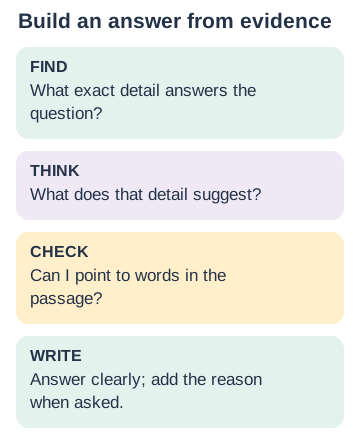
Use the frame “I think ___ because the passage says ___.” It keeps your answer close to evidence. Different feeling words may work: eager, excited or impatient can be reasonable when supported by the right detail. The explanation matters more than guessing one secret word.
Mina leaves the beans in the soil even when she sees no shoots. This suggests she follows her grandfather’s advice and learns to wait. It does not prove that she never feels impatient again. Keep the conclusion as small as the evidence allows.
4. Put events in order and explain why
Sequence questions ask what happened first, next and later. Make a short timeline with actions rather than rewriting every sentence: planted beans; checked the patch; replaced the fallen label; drew the empty patch; saw shoots; drew them. Days can help, but the order of sentences is also useful.
Cause questions ask why something happened. The label fell because of the windy shower. Mina put it upright so the planting place would stay labelled. These are related details, but they answer different questions.
Do not add a cause merely because it sounds possible. The story does not say an animal stole the beans. “No shoots were visible yet” is an observation; “the beans disappeared” is Mina’s worry, not a fact confirmed by the narrator. Reading carefully means separating what a character thinks from what the story establishes.
5. Work out words using the surrounding sentence
The instruction “keep the soil damp, but do not flood it” contrasts two amounts of water. Damp means slightly wet, while flooded would mean too much water covering or soaking the area. The contrast helps even if damp is a new word.
A green hook in this story is a curved young shoot, not a metal tool. Use the garden setting and the next sentence about unfolding to choose the intended meaning. One word can have different meanings in different contexts.
When explaining a word, replace it in the sentence and check whether the sentence still makes sense. Avoid giving a dictionary meaning that does not fit the passage. For younger readers, say the sentence aloud and discuss the clue before writing an answer.
6. Choose a main idea and check your answer
A main idea covers the important events, not just one small object. “Mina owns a watering can” is true but too narrow. “Mina learns to observe and wait as her beans begin to grow” connects the problem, actions and ending.
A good title should also fit the whole story. “Waiting for the First Shoots” would work because waiting and growth drive the events. “The Lost Dog” would not fit even if it sounded exciting.
Before opening an answer, underline the relevant passage words or write a short note beside the question. After checking, explain why an answer works. For an open question, another answer can be acceptable when it uses accurate evidence. The purpose is thoughtful reading, not memorising a single wording.
5 worked examples with reasoning
1. Where did Mina and her grandfather plant the beans?
- Find the opening sentence.
- It names two rows beside the garden path.
- Answer: Beside the garden path.
2. Why might Mina be described as eager?
- The story says she hurried outside every morning.
- Repeated checking suggests she wants to see growth.
- Answer: She is eager because she keeps checking for shoots.
3. Did the beans definitely disappear on Thursday?
- Mina says perhaps they disappeared.
- That is her worry, not a confirmed event.
- Answer: No; the story only says no shoots were visible yet.
4. What does damp mean here?
- Compare damp with do not flood it.
- The soil needs some water, not too much.
- Answer: Slightly wet.
5. Choose a main idea: a label fell, or Mina learns to notice slow growth.
- The label is one event.
- Waiting, observing and new shoots connect the whole story.
- The broader main idea is Mina learning to notice slow growth.
Save the guide or print the practice
Download to save or share
Complete guide with answers (PDF) · Worksheet without answers (PDF) · Worksheet and answer key (PDF)
Try each task before opening its answer. Give an example or reason, not only a label.
14 practice questions with explanations
Try each task before opening its answer. Give an example or reason, not only a label.
Write an answer and your reason before opening the explanation. Check the reasoning as well as the final answer.
- Find
Who helped Mina plant the beans?
Answer and reasoning
Her grandfather.
The first sentence names both people.
- Find
On which day did they plant the beans?
Answer and reasoning
Monday.
It is stated at the start.
- Find
Where did they plant the rows?
Answer and reasoning
Beside the garden path.
Use the location in the opening.
- Find
What did Mina use to water the soil?
Answer and reasoning
A small watering can.
Her grandfather gave it to her.
- Sequence
On which day did the first shoots become visible?
Answer and reasoning
Saturday.
The final paragraph gives the day.
- Cause
What knocked the label flat?
Answer and reasoning
A windy shower.
The Thursday paragraph states the cause.
- Action
What did Mina do after the label fell?
Answer and reasoning
She put it upright and pressed the soil around it.
She repaired the label’s position.
- Check
Did Mina dig up the beans?
Answer and reasoning
No.
The passage explicitly says she did not.
- Inference
Give one clue that Mina wanted to see growth quickly.
Answer and reasoning
She hurried outside every morning.
This supports eagerness or impatience.
- Word
What does damp mean in the watering instruction?
Answer and reasoning
Slightly wet.
The contrast with flooding explains the amount.
- Word
What are the green hooks?
Answer and reasoning
Curved young shoots.
They push through soil and later unfold.
- Compare
How did the second notebook picture differ?
Answer and reasoning
It included two green lines for the shoots.
The first showed the empty patch.
- Main idea
Give a suitable alternative title.
Answer and reasoning
For example, Waiting for the First Shoots.
It matches the story’s central events.
- Evidence
Why is “an animal stole the beans” a weak answer?
Answer and reasoning
The passage gives no evidence for it.
A possible idea is not automatically a supported inference.
Use the ideas without looking at the notes
Retell the story in four sentences: the planting, the wait, Mina’s careful observation and the first shoots. Then choose one feeling word and support it with a passage detail.
Common questions
Must every answer copy the passage exactly?
No. Use your own clear words unless exact quotation is requested.
Can two different feeling words be correct?
Yes, if both fit the evidence and are explained.
Should I reread the passage?
Yes. Rereading helps you check details and avoid guesses.
Can a picture supply an answer missing from the story?
Only if the task asks you to use the picture. These questions use the written passage.
What makes an inference different from a guess?
An inference is supported by clues in the text.
Connect your learning
Ask about guided English learning if your child needs help explaining these ideas.
About this guide
Original explanations, examples, diagrams and practice by BananaLearn. The grade label indicates the intended learning level; this is not an official textbook extract or exam paper.