
Start with the key idea
A summary is a shorter account of a text’s main ideas or events, written accurately in your own words. Keep the central meaning, leave out minor detail and do not add opinions or facts that the source does not support.
1. Read the original passage: A Shelf That Worked
Class 5 wanted to start a book-sharing shelf outside its classroom. At first, the children planned to collect as many books as possible. They painted a wooden box blue and tied a yellow ribbon around its handle. By Friday, the box was full, but several books had torn pages and some were too difficult for younger readers.
Their teacher asked the class to find out what readers needed before collecting more. The children spoke to pupils in Classes 3 and 4. Many wanted short stories with clear print, and a few asked for books about animals. The class sorted the collection, repaired loose covers with adult help and set aside books with missing pages.
They then made simple labels: short stories, animal books and longer reads. A small notebook recorded which book had been borrowed and when it was returned. Instead of competing to bring the most books, children looked for suitable books in good condition.
Two weeks later, more pupils were using the shelf. The class had fewer books in the box than on the first Friday, but readers could find useful books more easily. The children decided to ask for feedback again before the next collection.
2. Find the central problem and change
Read the whole passage once before shortening it. Here the main issue is not the colour of the box. The class collected many books, but some were unsuitable or damaged. The important change is that the children asked readers what they needed, organised suitable books and made the shelf more useful.
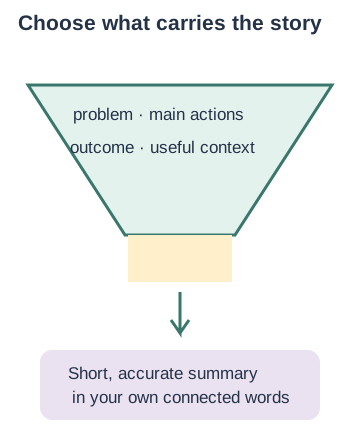
For a story-like passage, ask who is involved, what problem or goal matters, what key action changes the situation and what happens in the end. For an information passage, look for the main topic and the most important facts explaining it. The same planning questions will not fit every text perfectly.
Write short notes first. Notes such as unsuitable books, ask readers, sort and label, more useful shelf are enough to guide you. They are planning material, not yet a finished summary.
3. Choose essential detail and leave out decoration
An essential detail helps a reader understand the main meaning. The request for short, clear books explains how the class changed its collection. The yellow ribbon does not explain that change, so it can usually be left out. A detail is not unimportant in every context; it is less important for this particular summary.
Do not remove a key contrast. The shelf became more useful even though it held fewer books. Keeping that contrast explains what the children learned about quality and suitability. A summary that says only “the class collected more books” would reverse the passage’s point.
Combine related details where possible. Sorting, repairing and labelling can become “they improved and organised the collection” if the word limit is tight. Keep enough precision that the reader still understands the action.
4. Write connected sentences in your own words
Model summary: Class 5 created a book-sharing shelf but found that some donated books were damaged or unsuitable. After asking younger readers what they needed, the class improved and organised the collection and recorded borrowing. More pupils used the shelf even though it contained fewer books, so the class planned to seek feedback again.
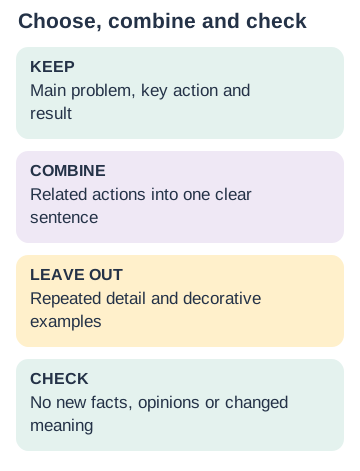
The model keeps the problem, response and result. It leaves out the box colour, ribbon and exact Friday because those details are not needed to explain the main change. It uses connected sentences rather than a string of unrelated keywords.
Writing in your own words does not mean replacing every ordinary word with a longer synonym. Necessary words such as books and readers can remain. Change sentence structure naturally, combine related points and preserve the source’s meaning. Do not turn a simple passage into complicated language.
5. Check accuracy before counting words
Compare every summary sentence with the source. “All the books were damaged” is too strong: only some had problems. “The class sold the books” is invented. “No one used the shelf” conflicts with the ending. Small words such as some, more and fewer can carry important meaning.
Then check length against the task’s instruction. There is no single universal number of sentences or fixed fraction of the original that every summary must use. A teacher may give a word limit; if so, aim to include the essentials within it. Do not remove meaning just to hit an arbitrary number.
Read your draft aloud. If one sentence has several loosely connected ideas, divide it or use a clear linking word such as after or although. A shorter text still needs readable grammar and logical order.
6. Keep summary, retelling and opinion separate
A retelling may include many events and descriptive details in order. A summary selects only the central points. A review or response can include your opinion, but a straightforward summary should not add “I think this was an amazing idea” unless the task specifically asks for evaluation.
For practice, explain why you kept each sentence. If it cannot be connected to the main problem, action or result, reconsider it. Ask a partner who has not read the source whether the summary makes sense; then check their understanding against the original passage.
Use the same method for a science paragraph or a short news-style report: read completely, identify the main meaning, select evidence, write clearly and verify. Do not summarise from the title alone, because the title may omit an important limitation or change.
5 worked examples with reasoning
1. Should the yellow ribbon appear in a short summary?
- Ask whether it explains the central problem or result.
- It decorates the box but does not explain the improvement.
- Usually leave it out.
2. Repair: The class solved the problem by collecting more books.
- The source says the improved shelf held fewer books.
- Suitability and organisation were the key changes.
- Write: The class improved and organised the collection after asking readers what they needed.
3. Combine sorting, repairing covers and adding labels.
- These actions all improve the collection.
- Use a phrase that retains that shared function.
- For example: They improved and organised the books.
4. Should “I wish my class did this” go in the summary?
- It is the writer’s personal response.
- The task asks for the source’s main meaning.
- Leave the opinion for a separate response.
5. Why keep “even though it contained fewer books”?
- It captures the contrast between quantity and usefulness.
- The result is not simply a larger collection.
- The contrast explains the lesson of the passage.
Save the guide or print the practice
Download to save or share
Complete guide with answers (PDF) · Worksheet without answers (PDF) · Worksheet and answer key (PDF)
Try each task before opening its answer. Give an example or reason, not only a label.
14 practice questions with explanations
Try each task before opening its answer. Give an example or reason, not only a label.
Write an answer and your reason before opening the explanation. Check the reasoning as well as the final answer.
- Purpose
What is a summary meant to preserve?
Answer and reasoning
The source’s main meaning.
Shortening must not change the central point.
- Problem
What was wrong with the first collection?
Answer and reasoning
Some books were damaged or unsuitable.
Do not change some into all.
- Action
Who did the class ask about reading needs?
Answer and reasoning
Pupils in Classes 3 and 4.
The feedback came from younger readers.
- Keep
Which is more useful in a summary: ribbon colour or reader feedback?
Answer and reasoning
Reader feedback.
It explains the change in approach.
- Result
Did the improved shelf contain more books?
Answer and reasoning
No, it contained fewer.
It became more useful despite that.
- Combine
Combine “They sorted books. They added labels.”
Answer and reasoning
For example: They organised and labelled the books.
The new sentence preserves both actions.
- Correct
Repair: Every donated book had missing pages.
Answer and reasoning
Some books had problems, including missing pages.
The original does not say every book.
- Opinion
Is “This is the best idea ever” part of an objective summary?
Answer and reasoning
No.
It adds unsupported personal judgement.
- Accuracy
Can you say the class sold the unsuitable books?
Answer and reasoning
No.
The source does not give that information.
- Words
Must every word be replaced with a synonym?
Answer and reasoning
No.
Natural paraphrasing preserves meaning and key terms.
- Length
Is every summary exactly three sentences?
Answer and reasoning
No.
Follow the particular task and source.
- Order
Why should the problem usually come before the solution?
Answer and reasoning
It helps the reader understand why the action was needed.
Logical connections matter.
- Ending
What did the class plan to do again?
Answer and reasoning
Seek feedback before the next collection.
This shows the new approach continuing.
- Review
What should you check before submitting?
Answer and reasoning
Accuracy, key ideas, clarity and the requested length.
All four contribute to a useful summary.
Use the ideas without looking at the notes
Write your own summary of A Shelf That Worked without looking at the model. Underline the problem, action and result in different colours, then check that you have not added an opinion or changed a quantity.
Common questions
Can a summary use words from the source?
Yes. Necessary terms can remain, while phrasing and structure should be your own.
Should I include every example?
Usually not. Keep examples only when essential to the main meaning.
Can two summaries both be good?
Yes. They may phrase and combine ideas differently while preserving the essentials.
Is a summary the same as an opinion?
No. A summary reports the source’s meaning; opinion evaluates or responds to it.
What if no word limit is given?
Write a clearly shorter version that retains the central ideas without unnecessary detail.
Connect your learning
Ask about guided English learning if your child needs help explaining these ideas.
About this guide
Original explanations, examples, diagrams and practice by BananaLearn. The grade label indicates the intended learning level; this is not an official textbook extract or exam paper.