
Start with the key idea
An adjective describes a noun or pronoun: a quiet room; the room is quiet. An adverb can modify a verb, an adjective or another adverb: speak quietly, very quiet, quite slowly. Many adverbs end in -ly, but that ending is not a reliable test on its own.
1. Find what the adjective describes
“A narrow path” uses narrow to describe the noun path. “The path is narrow” gives the same description after the verb is. An adjective does not have to sit directly before its noun.
Read “The tired puppy slept”. Tired describes the puppy. It does not tell how the sleeping happened. To explain your choice, name both words: tired is an adjective describing puppy. This is more useful than memorising tired on a list.
Descriptions can tell size, colour, shape, condition or other qualities: a round stone, a purple kite, a difficult puzzle. Choose a detail that helps your reader understand the scene. Several adjectives are not automatically better than one precise adjective.
2. Find the action or description the adverb modifies
“The child spoke quietly” uses quietly to tell how the child spoke. “We leave tomorrow” uses tomorrow to tell when. “She often reads” uses often to tell how frequently. Adverbs do more than describe how an action happens.

In “a very quiet room”, very strengthens the adjective quiet. In “walk quite slowly”, quite modifies the adverb slowly. At this level, start with the word directly affected and draw a small arrow towards it.
Not every word after a verb is an adverb. In “She opened the box”, box is a noun naming the thing opened. Ask what job the word is doing, not simply where it appears in the sentence.
3. Use endings as clues, then check the sentence
Many manner adverbs are formed by adding -ly: quiet becomes quietly and careful becomes carefully. Some spellings change: happy becomes happily. These patterns help you make a word, but they do not identify every word correctly.
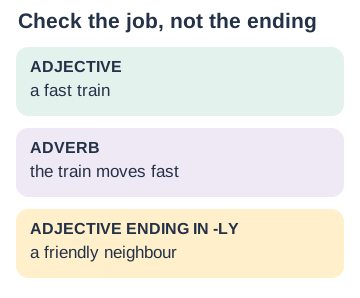
Friendly, lovely and lonely usually work as adjectives: a friendly neighbour, a lovely day, a lonely traveller. Fast can be an adjective or an adverb without changing its spelling. “A fast runner runs fast” shows both uses.
Hard and hardly have different meanings. “She works hard” means she puts in effort. “She hardly works” means she does very little work. Adding -ly can create a different meaning, so read the completed sentence aloud and check what it says.
4. After looks or feels, decide what is being described
“The soup smells delicious” describes the soup. Delicious is an adjective after the linking use of smells. “The dog smells the bag carefully” describes how the dog investigates; carefully modifies the action. The same verb can work differently in different sentences.
“The child looks happy” describes the child. “The child looks carefully at the map” tells how the child looks. A rule such as “always use an adverb after a verb” would make the first sentence wrong.
For familiar school examples, use good for a quality and well for doing an action competently: “a good singer”, “She sings well”. Well can also be an adjective meaning healthy, as in “I feel well”. Introduce that exception when the context calls for it.
5. Add a detail that actually helps the reader
Compare “The dog moved” with “The dog limped”. Limped already gives a particular kind of movement. You may not need “moved slowly and awkwardly” if one accurate verb fits. Use adjectives and adverbs to add useful information, not to make every sentence longer.
“The red folder is beside the blue folder” uses colour to identify the right object. “The wonderful, amazing folder” gives praise but may not help someone find it. Ask what the reader needs to know.
Try one revision at a time. Begin with “A child opened a box”. Add an adjective to identify the box, then an adverb if the way it was opened matters: “A child carefully opened the fragile box”. Check that fragile describes box and carefully describes opened.
6. Explain a choice with an arrow
Underline the possible describing word. Draw an arrow to the word it modifies. If it describes a noun or pronoun, label it adjective. If it modifies a verb, adjective or adverb, label it adverb. Use the sentence as evidence.
Some words need more advanced analysis than a beginner exercise should demand. Start with unambiguous examples and supply context. Do not force every word in a sentence into these two groups; nouns, verbs, pronouns and other word classes still have their own jobs.
Finish by writing two sentences with fast: one describing a thing and one describing an action. Explain the two arrows. A new sentence shows more understanding than repeating the same word list.
5 worked examples with reasoning
1. Identify quiet and quietly: “The quiet child spoke quietly.”
- Quiet describes child, a noun: adjective.
- Quietly modifies spoke, a verb: adverb.
- The words are related, but their jobs differ.
2. Explain very in “The water is very cold.”
- Cold describes water.
- Very strengthens cold rather than naming the water.
- Very is an adverb modifying an adjective.
3. Choose: “The flowers smell sweet / sweetly.”
- The sentence describes the flowers’ smell.
- Sweet is the adjective describing the flowers.
- Write The flowers smell sweet.
4. Why is friendly an adjective in “a friendly dog”?
- It describes the noun dog.
- The -ly ending alone does not decide the word class.
- The sentence gives the evidence for the label.
5. Explain the difference between “worked hard” and “hardly worked”.
- Worked hard means put in effort.
- Hardly worked means did very little work.
- Both hard and hardly can be adverbs, but they are not interchangeable.
Save the guide or print the practice
Download to save or share
Complete guide with answers (PDF) · Worksheet without answers (PDF) · Worksheet and answer key (PDF)
Try each task before opening its answer. Give an example or reason, not only a label.
16 practice questions with explanations
Try each task before opening its answer. Give an example or reason, not only a label.
Write an answer and your reason before opening the explanation. Check the reasoning as well as the final answer.
- Identify
In “a blue cup”, what does blue describe?
Answer and reasoning
Cup; blue is an adjective.
Cup is the noun being described.
- Identify
In “The cup is blue”, is blue still an adjective?
Answer and reasoning
Yes.
It describes cup after the linking verb is.
- Action
Classify slowly in “The snail moved slowly.”
Answer and reasoning
Adverb.
It modifies moved.
- Time
Classify tomorrow in “We leave tomorrow.”
Answer and reasoning
Adverb.
It tells when we leave.
- Degree
What does very modify in “very small”?
Answer and reasoning
The adjective small.
Very is an adverb of degree.
- Ending
Classify friendly in “a friendly teacher”.
Answer and reasoning
Adjective.
It describes teacher despite ending in -ly.
- Same word
Classify fast in “a fast bicycle”.
Answer and reasoning
Adjective.
It describes bicycle.
- Same word
Classify fast in “The cyclist rides fast.”
Answer and reasoning
Adverb.
It modifies rides.
- Choose
The baby looks happy / happily. Choose the form describing the baby.
Answer and reasoning
Happy.
The adjective describes the baby after looks.
- Choose
The baby smiled happy / happily.
Answer and reasoning
Happily.
It describes how the baby smiled.
- Meaning
Does “hardly tried” mean tried with great effort?
Answer and reasoning
No.
It means made very little attempt.
- Choose
Complete: She plays the flute good / well.
Answer and reasoning
Well.
It describes the quality of the playing.
- Spelling
Make a manner adverb from careful.
Answer and reasoning
Carefully.
Add -ly to careful.
- Spelling
Make a manner adverb from happy.
Answer and reasoning
Happily.
The y changes to i before -ly.
- Write
Add an adjective and an adverb to “The child opened the box.”
Answer and reasoning
For example: The child carefully opened the red box.
Carefully modifies opened; red describes box.
- Explain
Why is position alone an unreliable test?
Answer and reasoning
An adjective can follow a linking verb, and other word classes can follow action verbs.
Name the word being modified and its job.
Use the ideas without looking at the notes
Write a two-sentence scene. Circle two adjectives and underline one adverb. Draw an arrow from each to the word it modifies. Remove any description that adds no useful meaning.
Common questions
Do all adverbs end in -ly?
No. Fast, often and tomorrow can be adverbs.
Are all -ly words adverbs?
No. Friendly and lovely commonly work as adjectives.
Can an adjective come after a verb?
Yes. In The soup is hot, hot describes soup after is.
Can an adverb describe an adjective?
Yes. Very modifies quiet in very quiet.
Should every sentence contain an adverb?
No. Add one when it supplies useful meaning. A precise verb may already say what you need.
Connect your learning
Ask about guided English learning if your child needs help explaining these ideas.
About this guide
Original explanations, examples, diagrams and practice by BananaLearn. The grade label indicates the intended learning level; this is not an official textbook extract or exam paper.