Science · Suggested Grade 5
Dissolving vs Melting: Class 5 Explanations & Investigation
Sugar seems to disappear in water, while ice turns into liquid water. The two changes look similar from a distance, but different things are happening.
Original explanations and practice by BananaLearn · Published 1 November 2026
On a small screen, swipe across the illustration to read every label.
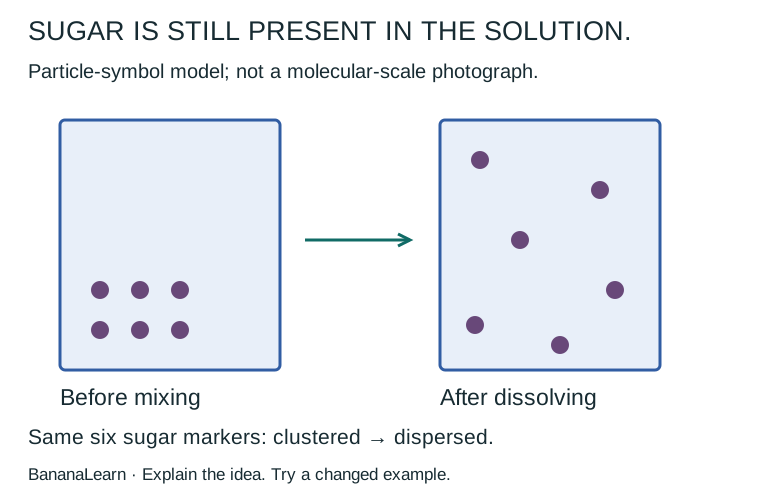
Name the change, not just its appearance
Melting is a change of state from solid to liquid. Ice melting produces liquid water; no separate solvent is needed. Dissolving happens when a solute mixes with a solvent to form a solution. Sugar can dissolve in water while both materials remain present.
A clear appearance does not prove that a substance has vanished or that a liquid is pure. This guide uses sugar and room-temperature water as an introductory model. Not every substance dissolves in water, and not every dissolving process is described adequately by the same simple particle picture.
Follow the materials in each example
In an ice cube, water particles change their arrangement and movement as melting occurs. The material is still water. In sugar dissolving, sugar becomes dispersed through the water at a scale too small to see as individual grains. The solution contains both sugar and water.
Do not draw dissolved sugar as a pile of tiny visible grains at the bottom. A remaining pile may mean undissolved material is still present. Our diagram uses coloured symbols as a model of distribution, not a photograph of molecules or a scale drawing.
Heating is not the definition of dissolving
Sugar can dissolve in water at room temperature. Stirring and smaller grains can change how quickly it dissolves under comparable conditions, but they do not turn dissolving into melting. Warm water often helps sugar dissolve faster, yet heating is neither a required definition nor proof of the process.
Melting also needs the right temperature and energy conditions; a solid is not said to melt merely because it has been added to a liquid. If ice is added to water, it may melt, but this is still a state change of water rather than the same example as sugar forming a solution.
A safe comparison you can explain
Use two clear unbreakable cups, room-temperature water, a small amount of food sugar and a spoon, with adult supervision appropriate to the child. Observe the sugar before mixing, stir gently and record whether visible grains remain. Separately observe a small ice cube melting in a cup. Do not taste either sample.
Keep the purpose narrow: identify the materials and observed change. No flame, boiling, chemical mixing or drinking-water test is required. Clean up spills promptly. This activity cannot certify that an unknown clear liquid is safe to drink, and unknown substances should not be used.
What happens to mass?
In a closed system with nothing entering or leaving, the total mass stays the same during these changes. If 100 g of water and 5 g of sugar are combined without loss, the contents have total mass 105 g. A container’s mass must be included or subtracted consistently.
A lower reading in an open setup might reflect evaporation, spillage, sugar left on the spoon or measurement error. Do not conclude that dissolved material lost its mass. The everyday phrase disappeared describes what the eyes see, not what a balance should show under controlled conditions.
Can the change be reversed?
Liquid water can freeze again under suitable conditions. Dissolved sugar can, in principle, be recovered by removing water under suitable conditions; that does not mean an ordinary filter will remove it. A classroom paper filter typically separates undissolved larger particles, not dissolved sugar.
Do not heat sugar solutions at home for this guide. Recovery is discussed conceptually rather than prescribed as an unsupervised procedure. Reversible does not mean effortless, and it does not guarantee every real-world mixture can be returned to its original form without complications.
Use evidence words carefully
A strong explanation states: The grains are no longer visible, and the model is that sugar is dispersed through the water. It avoids Sugar became water or Sugar melted because both statements confuse the material or process. When evidence is limited, name what was observed separately from the explanation.
Use the comparison record to list starting materials, ending materials and whether a solvent is involved. Parents can ask Where is the sugar now? or Does clear mean pure? A useful next step is comparing a soluble material with an insoluble one using known safe classroom materials and no tasting.
Compare the material trail
Copy the record into a notebook or use it to organise your own answer. Blank spaces are for your work.
| Example | Starting materials | Ending materials | Solvent involved? |
|---|---|---|---|
| Ice melts | Solid water | Liquid water | No separate solvent |
| Sugar dissolves | Sugar + water | Sugar solution | Water |
| Your explanation | ___ | ___ | ___ |
10 questions with explained answers
Try the questions before opening the answers. Explain the reason, then try a changed example to check your understanding.
Ice becomes liquid water. Name the change.
Show answer and explanation
Melting
Water changes from solid to liquid.Sugar mixes uniformly into water. Name the process.
Show answer and explanation
Dissolving
A solute forms a solution with a solvent.Does sugar turn into water when it dissolves?
Show answer and explanation
No
Both sugar and water remain in the solution.Must water be hot for sugar to dissolve?
Show answer and explanation
No
It can dissolve at room temperature.100 g water plus 5 g sugar, no loss: contents mass?
Show answer and explanation
105 g
Masses add in the stated closed comparison.Does clear mean pure or safe to drink?
Show answer and explanation
No
Appearance cannot establish composition or safety.Will ordinary paper filtration usually remove dissolved sugar?
Show answer and explanation
No
The sugar is dispersed at a scale that passes through the ordinary filter.Does stirring make dissolving the same as melting?
Show answer and explanation
No
Changing the rate does not change the definition.A pile remains at the bottom. Is all the material dissolved?
Show answer and explanation
No
Visible remaining solid shows at least some is undissolved.Should you taste an experimental or unknown sample?
Show answer and explanation
No
This activity uses observation and explanation, not tasting.
Keep the ideas connected
For help with a school-learning difficulty, bring one attempted question to a discussion about tutoring and curriculum fit. Maths is our priority; English and Science tutoring are also available.
Sources, scope and sharing
The examples, diagrams and practice are original BananaLearn work. Grade labels suggest a learning level; teaching sequences and school requirements can differ. Official sources below support the stated facts and resource links. These activities are independent resources, not official exam questions or endorsed campaign materials.
How we prepare learning guides · Report a correction
Share this guide: https://bananalearn.com/learn/class-5-dissolving-melting-differences.html