
Start with the key idea
To separate a mixture, identify its components and a useful difference in their properties, such as particle size, solubility, settling behaviour, magnetism or volatility. Then choose a method that uses that difference. State which material is retained, which passes through or leaves, and whether the method recovers every component.
1. Say what you want to recover
A mixture contains more than one substance or material together. In a bowl of rice and small stones, you may want the rice. In salty water, you might want the salt, the water or both. The goal changes which method is appropriate.
Name the components and describe the relevant difference. “Use a filter because it separates things” is incomplete. “Use a suitable filter to retain undissolved sand particles while the liquid passes through” names both the property and the outcome.
Separation need not change a component into a new substance. Dissolving salt in water does not mean that the salt has ceased to exist. A mixture that looks uniform can still have more than one component.
2. Use size when the particles are suitable
Handpicking can remove a small number of clearly visible stones from rice. It becomes slow or impractical when pieces are tiny, similar-looking or very numerous. A method can be scientifically possible without being the best practical choice.

Sieving uses a mesh to let smaller particles pass while larger ones remain. The mesh openings must fall between useful particle sizes. A sieve that is too coarse lets both materials through; one that is too fine may retain both.
Filtration uses a suitable porous barrier to retain undissolved particles from a fluid. In a simple sand-and-water model, sand remains as residue and water passes as filtrate. The result depends on particle and pore sizes; extremely fine particles may need another treatment.
3. Settling and pouring are different steps
If suitable heavier insoluble particles settle at the bottom of a liquid, that settling is sedimentation. Carefully pouring off the upper liquid is decantation. The sediment may remain wet, and fine suspended material can remain in the poured liquid.
Do not assume every solid settles quickly. Some pieces float, and very fine particles can remain suspended for a long time. Name the supplied material or observation rather than applying “solids sink” to every case.
Decantation is often a preliminary step rather than complete purification. In a paper example with muddy water, allowing sediment to settle and pouring off clearer liquid may remove much of the visible material. It does not establish that the water is safe to drink.
4. A dissolved solid passes through an ordinary filter
Salt dissolved in water is distributed through the solution on a scale much smaller than the openings of ordinary filter paper. The solution passes through; the salt is not trapped as grains because the original visible grains have dissolved.
Evaporating water from a salt solution can leave the salt behind. If the water vapour escapes, this process recovers the salt but does not collect the water. Do not claim that evaporation alone gives separate usable samples of both components.
To recover water as well, a suitable distillation setup evaporates water and then condenses the vapour into a separate container. That is a useful extension, not an instruction to improvise heating equipment at home. These examples are paper tasks; adults or trained teachers handle laboratory heating.
5. Combine methods for sand, salt and water
Suppose a mixture contains sand and salt dissolved in water. Filter first. The sand remains on the filter, while the salt solution passes through. Label the residue and filtrate so you can follow all three components.
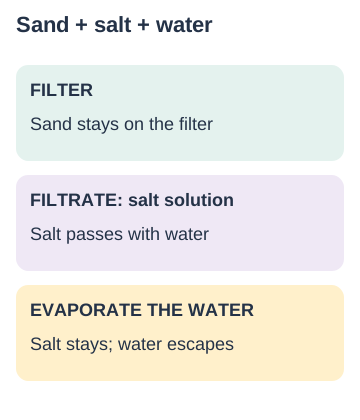
Then evaporate the water from the filtrate if the aim is to recover salt. Water is transferred to the surroundings as vapour, and salt remains. If the task asks for collected water too, evaporation alone is not enough; a suitable condensation-and-collection stage is needed.
If the starting mixture contains dry sand and salt, add enough water to dissolve the salt before filtering. Sand remains undissolved in this simple model. The extra water is part of the procedure and must be accounted for in the final separation.
6. Magnetism and moving air use other differences
A magnet can separate iron pieces from a mixture with non-magnetic sand in a suitable classroom model. Not every metal is strongly attracted to an ordinary magnet. Aluminium and copper are useful counterexamples to the incorrect rule “all metals are magnetic”.
Winnowing uses differences in how moving air carries components, commonly lighter husk and heavier grain in a suitable agricultural mixture. It is not a general method for any two powders. Size, shape, mass and air conditions affect how particles move.
For magnetic separation, choose a paper prediction or a teacher-controlled demonstration. Do not handle sharp metal filings casually. For winnowing, discuss a supplied diagram or observation rather than blowing dust near someone’s eyes or face.
7. Explain success and the remaining limits
For each method, write three lines: difference used, material recovered here, material still mixed or lost. This prevents a correct method name from hiding an incomplete explanation. For salt water filtered through paper, the key conclusion is that the dissolved salt remains in the filtrate.
Compare results with the intended goal. Clear-looking water is not necessarily pure water, and pure-looking material is not automatically safe for drinking or eating. Dissolved substances and microorganisms may not be visible. This guide does not provide a drinking-water treatment procedure.
After an error, change one condition and predict again. What if the sieve holes were wider? What if the solid were dissolved instead of suspended? What if both materials were attracted to the magnet? A good method depends on a useful difference between components.
5 worked examples with reasoning
1. Choose a method for a few clearly visible stones in a bowl of rice.
- Handpicking uses the visible difference between pieces.
- It is practical because there are only a few stones and they can be distinguished.
- For many tiny similar particles, this method may be unsuitable.
2. A sieve retains both components. What should be checked?
- Compare the particle sizes with the mesh openings.
- The openings may be too small to let the intended smaller particles pass.
- A successful sieve needs a useful size difference and a suitable mesh.
3. Why does filtering salt water not produce salt-free water?
- The salt is dissolved rather than present as large undissolved grains.
- It passes through ordinary filter paper with the water.
- The filtrate remains salt solution.
4. Separate sand and dissolved salt from water when only the solids must be recovered.
- Filter: sand is the residue and salt solution is the filtrate.
- Evaporate water from the filtrate using suitable supervised equipment.
- Salt remains. The evaporated water is not collected in this procedure.
5. A learner says a magnet will separate copper from sand. Evaluate the plan.
- Copper is not strongly attracted to an ordinary magnet.
- The proposed useful difference is absent in this example.
- Choose another suitable property if one is supplied; do not promise magnetic separation.
Save the guide or print the practice
Download to save or share
Complete guide with answers (PDF) · Worksheet without answers (PDF) · Worksheet and answer key (PDF)
Try each task before opening its answer. Give an example or reason, not only a label.
16 practice questions with explanations
Try each task before opening its answer. Give an example or reason, not only a label.
Write an answer and your reason before opening the explanation. Check the reasoning as well as the final answer.
- Choose
Which method is practical for a few visible stones mixed with rice?
Answer and reasoning
Handpicking.
The pieces are distinguishable and few enough to remove individually.
- Size
What property does a suitable sieve use?
Answer and reasoning
A difference in particle sizes.
Some particles pass through its mesh while larger ones remain.
- Vocabulary
What is retained on a filter called?
Answer and reasoning
Residue.
It is the material held back by the filter.
- Vocabulary
What is the liquid that passes through a filter called?
Answer and reasoning
Filtrate.
It may still contain dissolved substances.
- Dissolved
Does ordinary filter paper retain dissolved salt?
Answer and reasoning
No.
The dissolved salt passes through with the liquid.
- Recovery
Which component is recovered by evaporating a salt solution without collecting vapour?
Answer and reasoning
Salt.
Water leaves as vapour rather than being collected.
- Sequence
What passes through the filter when sand and dissolved salt are in water?
Answer and reasoning
Salt solution.
Sand is retained; dissolved salt remains with the water.
- Sequence
Why add water first to a dry sand-and-salt mixture in the described method?
Answer and reasoning
To dissolve the salt selectively.
The sand remains undissolved, allowing subsequent filtration.
- Settling
Name the process when suitable suspended particles settle.
Answer and reasoning
Sedimentation.
Settling is distinct from pouring off the upper liquid.
- Pouring
What is carefully pouring off the upper liquid called?
Answer and reasoning
Decantation.
Some fine particles or dissolved substances may remain in it.
- Magnet
Will an ordinary magnet reliably remove aluminium pieces from sand?
Answer and reasoning
No.
Aluminium is not strongly attracted in this ordinary classroom test.
- Limit
Does clear-looking filtered water have to be safe to drink?
Answer and reasoning
No.
Dissolved substances and microorganisms may remain; appearance does not establish safety.
- Evaluate
If both materials pass through a sieve, give one possible reason.
Answer and reasoning
The openings are too large for the intended separation.
Mesh size must be suitable for the particle-size difference.
- Goal
What extra stage is needed to collect evaporated water in distillation?
Answer and reasoning
Condensation and collection in a separate container.
Evaporation alone lets vapour escape.
- Reason
Why is “use a filter because it separates” an incomplete explanation?
Answer and reasoning
It does not identify the useful property or where each component goes.
Name the undissolved particles retained and the filtrate that passes.
- Create
Write a method-choice statement for iron pieces and non-magnetic sand.
Answer and reasoning
Use a magnet to attract the iron while the non-magnetic sand remains.
The useful difference is magnetic attraction, under the supplied conditions.
Use the ideas without looking at the notes
Make a three-column decision table: mixture and goal; useful property difference; method and limitation. Include one dissolved-solid example and one undissolved-solid example. Explain why their filtration results differ.
Common questions
Is filtration the same as evaporation?
No. Filtration uses a suitable porous barrier; evaporation transfers liquid into vapour and may leave a dissolved solid.
Does filtration remove every impurity?
No. Ordinary filtration does not remove dissolved salt and does not by itself establish drinking-water safety.
Are sedimentation and decantation identical?
No. Sedimentation is settling; decantation is pouring off the upper liquid.
Can a magnet separate every metal from sand?
No. The metal must respond sufficiently to the magnet under the conditions used.
Why may a mixture need several methods?
Different components may differ in different properties. Sand, salt and water need a sequence if both solids are to be recovered.
Connect your learning
Ask about guided Science learning if your child needs help explaining these ideas.
About this guide
Original explanations, examples, diagrams and practice by BananaLearn. The grade label indicates the intended learning level; this is not an official textbook extract or exam paper.