Science · Suggested Grade 6–8
World Toilet Day 2026: School Reading & Sanitation Activity
A toilet can be present and still be unusable. A broken lock, no water or an inaccessible entrance changes whether a student can use it safely.
Original explanations and practice by BananaLearn · Published 1 November 2026
On a small screen, swipe across the illustration to read every label.
Date, theme and the limits of this school resource
World Toilet Day is observed on 19 November. UN-Water states the 2026 theme is sanitation and gender equality. This independent BananaLearn lesson connects that confirmed observance with practical reading and design reasoning for suggested Classes 6–8. It is not an official campaign pack and does not claim that searches are already rising.
Use 25–35 minutes, paper and pencils. The aim is to distinguish a facility’s existence from usable access and to justify a design priority. No child needs to describe their body, home facilities, health or personal experience. Use the invented cases below instead of collecting private information.
Read: the door on the school plan
Original fictional passage: The club’s drawing showed four toilet doors beside a corridor. “We have four, so everyone is provided for,” said Arun. Meera added a note: two doors had broken locks. One doorway had a step that stopped a wheelchair user entering. The handwashing tap was shown, but the plan gave no arrangement for keeping it supplied.
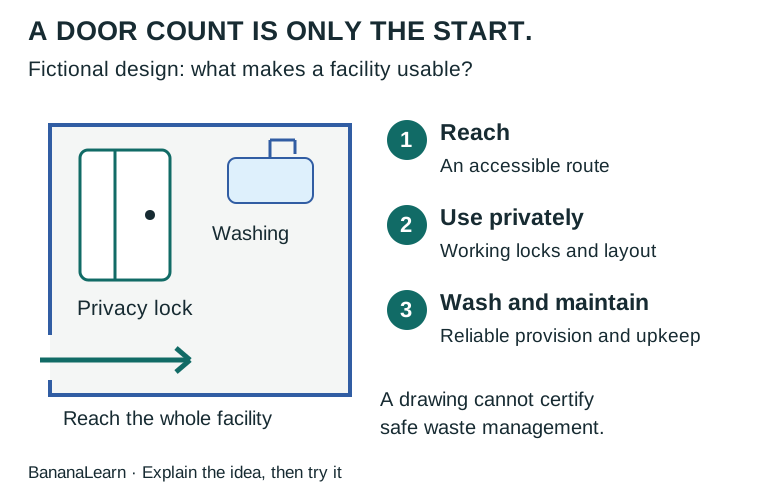
“Counting doors is useful,” Meera said, “but it does not tell us which facilities work for which students.” The group changed its question: Can a person reach the facility, use it with privacy, wash their hands and leave safely? They wrote maintenance and access checks beside the building plan. This is a made-up design discussion, not a report about a real school.
Understand sanitation as a system
Safe sanitation involves more than an isolated fixture. Waste needs to be safely contained and managed, and facilities need to remain usable. Handwashing provision, maintenance and accessibility belong in a discussion of the wider school environment. A drawing of a clean-looking room cannot establish that its waste is safely managed.
Keep the reasoning at design level. This lesson does not ask children to inspect drains, handle waste, enter an unsafe facility, test water or make a treatment device. Any real maintenance or safety concern belongs with responsible adults through the school’s usual process. No classroom observation here certifies drinking-water safety.
Connect equal access with dignity
A usable design considers privacy, safety and different access needs. Menstrual hygiene needs can also affect whether facilities work for students. Discuss these needs calmly and generally, without inviting disclosure or treating one group’s needs as an embarrassment. One feature cannot stand in for the whole system.
Worked comparison: Plan A has an attractive entrance and more doors, but no privacy locks or access route for a wheelchair user. Plan B has fewer doors but addresses the stated access and privacy problems. You still need to examine capacity, maintenance and other requirements before declaring either plan adequate. The better reasoning names what is known and what remains unverified.
Run the activity: choose priorities and give reasons
Minute 0–5: read the passage privately or aloud and underline facts stated in the fictional case. Minute 5–12: pairs sort needs into access, privacy, washing and upkeep. A feature may serve more than one category. Minute 12–22: each pair chooses two first actions for the invented school and explains who each action helps.
Minute 22–30: another pair asks one evidence question, such as How would you know the lock stays repaired? Revise the plan. A defensible response might prioritise the stated access barrier and broken locks, while assigning an adult to check water supply and maintenance. There is no single ranking that is correct without regard to urgency, resources and school procedures.
A fictional data problem: separate counts from conclusions
In a made-up building there are six cubicles. On a planning sheet, four are recorded as open and usable and two are awaiting repair. The recorded usable fraction is 4/6 = 2/3. If one of the two is repaired and checked, the record becomes 5/6. The increase is one cubicle, not proof that every student can now use the facilities.
A percentage does not erase missing information. The record does not establish accessibility, waiting time, privacy for every user or safe waste management. Do not invent a satisfaction survey or claim a health improvement from these numbers. The mathematics answers a narrow count question; the design discussion needs more evidence.
Adapt and conclude without turning it into a personal survey
For younger learners, use four simple headings: Reach, Privacy, Wash and Maintain. Give one fictional obstacle at a time. For older learners, add a limited-resource decision and ask what evidence would change their priority. A pupil can write an individual response instead of speaking in a group.
Finish with a four-sentence explanation: state one need, quote one detail from the fictional case, propose a practical adult-led action, and name a check still needed. Display general design principles rather than names or personal disclosures. Families can use the same questions with a fictional map; no private photographs or accounts are needed.
Fictional design review: evidence before priorities
Copy the record into a notebook or use it to organise your own answer. Blank spaces are for your work.
| Stated obstacle | Who may be affected | Proposed adult-led action | What still needs checking |
|---|---|---|---|
| Broken privacy locks | Users needing privacy | Arrange appropriate repairs | Condition after repair and upkeep |
| A step blocks entry | A wheelchair user in this case | Ask responsible adults for an accessible route | Whether the whole route and facility work |
| Water supply unspecified | People using handwashing provision | Check supply and maintenance arrangements | Reliable operation, not appearance alone |
| Your extra fictional case | ___ | ___ | ___ |
10 questions with explained answers
Try the questions before opening the answers. Explain the reason, then try a changed example to check your understanding.
On what date is World Toilet Day observed?
Show answer and explanation
19 November.
The date is confirmed by UN-Water; the 2026 theme is sanitation and gender equality.Is the story about Arun and Meera a real school report?
Show answer and explanation
No.
It is an original fictional passage for reasoning practice.Why is four doors not enough evidence of usable access?
Show answer and explanation
The case also includes broken locks and a doorway step.
A count does not establish privacy or physical access.Which passage detail is evidence of an access barrier?
Show answer and explanation
The step that prevents a wheelchair user entering.
This is stated in the invented case, rather than inferred from appearance.Does a clean-looking room prove safe waste management?
Show answer and explanation
No.
The appearance does not establish what happens to waste.Four out of six recorded cubicles are usable. Simplify the fraction.
Show answer and explanation
2/3.
Divide numerator and denominator of 4/6 by 2.One more of those six is repaired and checked. What fraction is recorded usable?
Show answer and explanation
5/6.
Five of the unchanged total of six are now recorded usable.Does 5/6 prove every learner has suitable access?
Show answer and explanation
No.
The count does not tell us the needs of each user or all aspects of usability.Must pupils share personal experiences to complete the lesson?
Show answer and explanation
No.
The fictional cases provide all the information needed.Give one useful check after proposing a lock repair.
Show answer and explanation
Ask how responsible adults will check the repair and maintain it.
A one-time plan needs an upkeep process; other relevant adult-led checks can work.
Keep the ideas connected
- Distinguish separation from claims of safe water
- Separate stated details from unsupported conclusions
- Explain what a fraction of a total means
For help with a school-learning difficulty, bring one attempted question to a discussion about tutoring and curriculum fit. Maths is our priority; English and Science tutoring are also available.
Sources, scope and sharing
The examples, diagrams and practice are original BananaLearn work. Grade labels suggest a learning level; teaching sequences and school requirements can differ. Official sources below support the stated facts and resource links. These activities are independent resources, not official exam questions or endorsed campaign materials.
How we prepare learning guides · Report a correction
Share this guide: https://bananalearn.com/learn/world-toilet-day-2026-school-water-sanitation-activity.html