English · Suggested Class 7 · school sequences vary
Cause and Effect: Class 7 Reading Evidence & Paragraphs
“The bell rang, then the lights went out.” The order is clear. The cause is not. Good reading keeps “after” separate from “because”.
Start here
A cause explains why an event happens; an effect is a result. Use textual evidence to distinguish an explicit reason, a plausible inference and an unsupported claim.
On a narrow screen, swipe the diagram or open it full size.
Find a section, worked example or practice question
Read the original passage
At lunchtime, the gardening club found a puddle beside the classroom pots. Noor noticed that one watering-can lid was loose. Ravi remembered carrying the can across the room just before the puddle appeared. The group checked the pots: their trays were dry. They tightened the lid and carried the filled can over an empty tray. No water spilled during that test. They planned to check the lid again before the next club meeting.
This is a fictional investigation written for the lesson. It provides clues, not a record of a real school event. Keep the words that describe observations separate from your explanation of them.
Find an explicit cause and effect
A text can state a cause directly: “Because the lid was loose, water escaped.” That sentence is not in the passage. The passage instead gives observations from which a reader may infer a likely explanation.
Do not quote your inference as if it were a sentence in the source. Write “The clues suggest…” and name the clues that support it.
Separate time order from causation
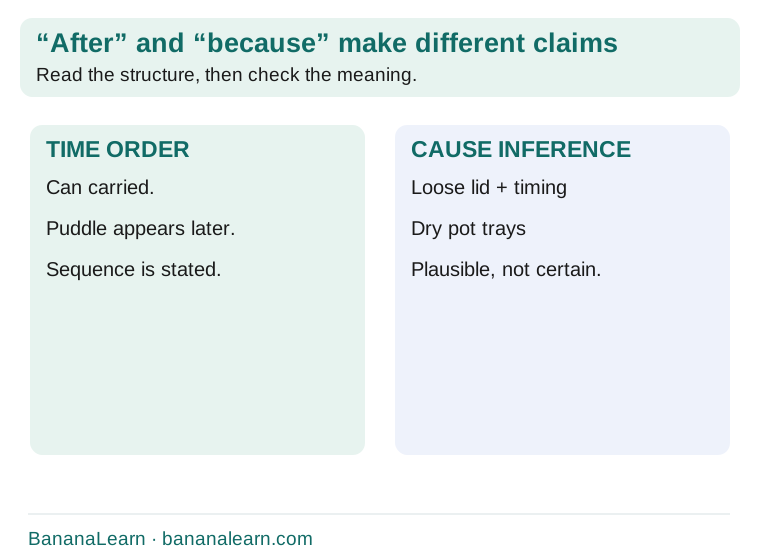
Ravi carried the can before the puddle appeared. This sequence supports investigating the can, but sequence alone does not prove it caused the puddle. Another event could have occurred in the same interval.
After, before and then establish time. Because, so and therefore assert a reason or result. Check whether the evidence supports moving from one kind of statement to the other.
On a narrow screen, swipe the diagram or open it full size.
Use more than one clue
The loose lid, the recent carrying and the lack of water in the pot trays all support a spill from the can as a plausible explanation. The later no-spill test is consistent with the repair helping.
The test does not recreate every earlier condition or prove what happened unseen. A cautious conclusion is stronger than an overconfident one because it fits what the passage actually establishes.
Recognise causes at different levels
A puddle might have an immediate cause, such as escaping water, and contributing conditions, such as a loose lid or a tilted can. Explain the chain rather than treating every detail as an interchangeable cause.
The passage does not say that anyone was careless. A judgment about a person’s attitude goes beyond the observed details. Focus on the action and the mechanism that the text supports.
Write a cause-and-effect paragraph
A useful paragraph begins with the proposed explanation, gives the strongest clues and states the limitation. For example: “The can may have leaked while Ravi carried it. Its lid was loose, and the puddle appeared after that journey. The dry pot trays make overflow from the pots less likely. However, no one saw the spill, so the exact cause is not certain.”
The words may, less likely and not certain are not empty hesitation. They accurately match the incomplete evidence supplied by the passage.
Choose connectors that preserve the claim
Use because before a reason and so before a result: “The lid was loose, so the group checked it.” That sentence describes their decision, which the passage supports. “The lid was loose, so Ravi caused the puddle” makes a stronger claim than the evidence warrants.
A connector does not remove uncertainty. You can write “The clues were consistent with a leak, so the group tested that possibility” without pretending the hypothesis is already proven.
Use the same method in a new text
Make three columns: observation or quoted detail; possible explanation; what else would help you decide. This record works for stories, reports and simple science passages.
For a home discussion, ask which sentence changed the learner’s confidence and why. The task is to connect evidence with a claim, not to guess the one answer an adult has in mind. Accept alternative explanations when they respect the passage and identify their limits.
See the reasoning
Worked examples and checks
1. What most plausibly caused the puddle in the passage?
A spill from the carried can is plausible.
The lid was loose, the journey happened before the puddle, and pot trays were dry.
The passage does not show the spill directly, so present it as an inference.
2. Evaluate “Ravi was careless, therefore the can leaked.”
The text does not state Ravi’s attitude or describe careless handling.
A loose lid and a carrying journey are evidence; the personality judgment is added.
Revise to a supported claim about the can and the possible spill.
3. Rewrite “The group tightened the lid. No water spilled during the test.” as a cautious linked statement.
“After tightening the lid, the group carried the can without a spill in their test.”
This preserves the observed sequence.
“The repair definitely explains the earlier puddle” would go beyond what that single test establishes.
Try, explain, check
12 questions with explained answers
Try each task before opening its explanation. These are original BananaLearn questions, not official exam or past-paper questions. Where several answers can work, the explanation gives the criteria.
Where was the puddle found?
Check answer and reasoning
Beside the classroom pots This is stated directly.
What did Noor observe?
Check answer and reasoning
A loose watering-can lid It is an observed condition, not a proven history of the spill.
What event happened before the puddle appeared?
Check answer and reasoning
Ravi carried the can across the room The passage states the remembered sequence.
Were the pot trays wet?
Check answer and reasoning
No, they were dry That weakens an overflow explanation in this account.
What did the group change?
Check answer and reasoning
They tightened the lid This was the tested repair.
Did anyone directly report seeing water leave the can?
Check answer and reasoning
No The proposed spill is inferred.
Does “after” always mean “because of”?
Check answer and reasoning
No Time order alone does not establish a cause.
Name two clues supporting the can explanation.
Check answer and reasoning
For example: loose lid and carrying before the puddle Other supported combinations can include the dry trays.
Does the no-spill test prove the earlier event exactly?
Check answer and reasoning
No It supports the possibility but does not recreate every earlier condition.
Which is better supported: “Ravi is careless” or “the lid was loose”?
Check answer and reasoning
The lid was loose The passage reports the condition but not that character judgment.
Complete: “The lid was loose, ___ the group checked it.”
Check answer and reasoning
so The second clause gives their resulting action.
Suggest one useful further observation.
Check answer and reasoning
For example: check whether water leaks from the loose lid under similar controlled handling It tests the proposed mechanism; several carefully described checks are possible.
A checking record to use in your notebook
Copy these headings and fill them for one worked task, then for a fresh attempt. Use your own evidence rather than copying the model answer.
Question or sentence
What am I being asked to explain?
Model or evidence
Which diagram, rule or passage detail supports my method?
Work
What steps connect the question to the answer?
Independent check
Can I substitute, recount, trace a path or check the text?
Original BananaLearn explanations, examples, illustrations and practice. Source facts checked 7 November 2026. Suggested levels are learning guides, not a claim that every board or textbook uses the same sequence.