English · Suggested Grade 8
Class 8 Fact, Opinion and Inference: Passage & Practice
“The room was empty” is an observation. “Nobody enjoys the club” is a much larger claim. Good readers notice the gap between what a text says and what someone concludes from it.
Original explanations and practice by BananaLearn · Published 31 October 2026
On a small screen, swipe across the illustration to read every label.
Three different kinds of statement
A factual claim can be checked against evidence, even if checking later shows that it is false. An opinion expresses a judgement, preference or evaluation. An inference is a conclusion drawn from evidence and reasoning rather than a statement copied directly from the text. These categories concern how the statement works, not whether it sounds confident.
An opinion can be well supported, and an inference can be strong or weak. Saying it is an opinion does not automatically make it worthless. Saying it is a fact does not automatically prove it true. In a reading task, first identify what the passage actually states, then consider what can reasonably be concluded.
Read the original passage: The changed garden session
At 12:35 on Friday, Maya reached the school garden with a tray of seedlings. The gate was closed. A card on it read, “Today’s garden club meets in Room 6.” Beside the gate, yesterday’s rain had left a shallow pool. Maya lifted her shoes away from the edge and walked back towards the classrooms. She had spent the evening making labels for the plants and did not want them to get wet.
Room 6 was not empty. Six pupils were sorting seed packets at the back table, and their teacher was spreading newspaper across the front desk. “We can plan the beds here,” the teacher said. “We will move the seedlings when the ground is suitable.” Maya put her labels beside the seed packets. Arjun said an indoor session was boring, but he soon began sketching a path wide enough for a watering can. Before the bell, the group had chosen three beds to measure the following week. Maya’s tray stayed near the window, where the seedlings received light. The pupils left the newspaper stacked for reuse. The garden gate was still closed when Maya passed it on her way to her next lesson.
Locate stated information before interpreting it
The passage directly states the time Maya reached the garden, the new meeting room, the presence of six pupils and the plan to measure three beds the following week. You can answer those questions by locating the relevant wording. You do not need to infer that Room 6 was the new location because the sign explicitly says so.
The passage also states that Arjun called the indoor session boring. The fact is that Arjun expressed that judgement; boring is his evaluation. These can coexist in one sentence. Distinguish the writer reporting an opinion from the opinion becoming an objective property of every indoor club session.
Build an inference from more than one clue
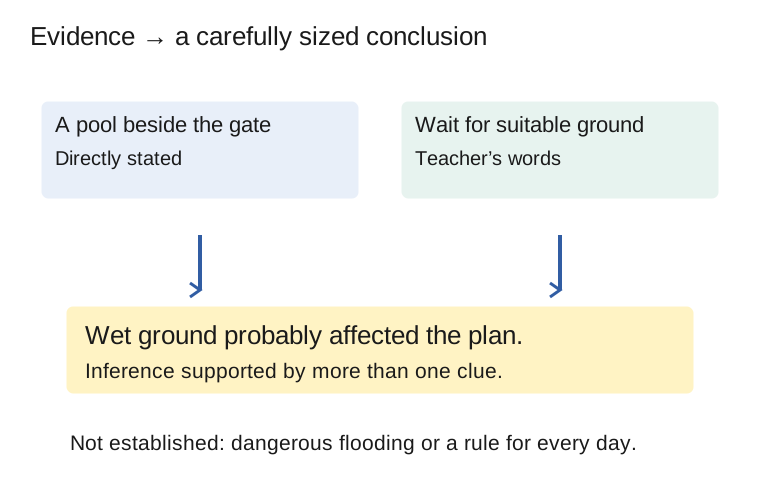
It is reasonable to infer that wet ground affected the outdoor plan. The pool beside the gate, the teacher’s comment about waiting for suitable ground and the move indoors point in the same direction. The text does not explicitly state a cancellation caused by dangerous flooding, so that stronger wording would go beyond the evidence.
Another supported inference is that Maya cared about keeping her labels usable: she made them the previous evening, wanted them dry and brought them to the new room. We cannot reliably conclude that gardening is her favourite subject, that she dislikes every other club or that she will become a botanist.
Choose language that matches the evidence
Use suggests or probably when the conclusion is plausible but not certain. Use the passage states when the information is direct. For example: The move indoors suggests that the weather affected the original activity. That is more careful than The school always closes the garden whenever it rains.
Words such as always, never, everyone and definitely often extend a claim beyond a single scene. Check the scope: six pupils are in this room at this moment; that does not establish the club’s total membership or every pupil’s attendance history. A good answer is precise about who, when and what is known.
Worked example: explain rather than quote-drop
Question: Was the indoor session completely unproductive? A strong response is No. Although Arjun called it boring, the pupils sorted seeds, sketched a path and chose beds to measure. Those actions show planning work was completed. The answer connects details to the judgement instead of copying an unrelated sentence.
A weaker response is No, because Room 6 was not empty. People being present does not by itself prove useful work occurred. Choose evidence that directly supports your reason. When a question asks for two clues, provide two distinct details rather than repeating the same observation in different words.
Use a claim-and-evidence notebook
Create three columns: statement, category and evidence or limitation. Classify a claim only after reading the entire sentence. Some statements combine an observable event with an evaluation, so explain which part you are classifying. The goal is reasoning, not forcing every sentence into a single unexamined label.
For independent practice, write one new inference about Maya and one claim the passage cannot support. Explain the difference. A parent can ask where the evidence is and whether another explanation is possible. Accept a reasonable alternative inference when it is linked to the text and expressed with appropriate uncertainty.
A claim-and-evidence record
Copy the record into a notebook or use it to organise your own answer. Blank spaces are for your work.
| Statement | Fact, opinion or inference? | Text evidence | What remains uncertain? |
|---|---|---|---|
| The club met in Room 6 | ___ | ___ | ___ |
| The indoor session was boring | ___ | ___ | ___ |
| Wet ground affected the plan | ___ | ___ | ___ |
| Your claim | ___ | ___ | ___ |
12 questions with explained answers
Try the questions before opening the answers. Explain the reason, then try a changed example to check your understanding.
Where does the sign direct the club?
Show answer and explanation
Room 6
This location is stated directly.How many pupils are sorting seed packets?
Show answer and explanation
Six
The passage gives that number; it does not give the entire membership.Classify Arjun’s judgement that the session is boring.
Show answer and explanation
Opinion
It evaluates the session rather than reporting a measurable property.Is it a factual claim that Arjun said the session was boring?
Show answer and explanation
Yes
The passage reports his act of expressing the opinion.Give two clues that wet conditions affected the plan.
Show answer and explanation
The pool beside the gate; the teacher says to wait for suitable ground
Together these support an inference about the outdoor plan.Does the text prove the garden was dangerously flooded?
Show answer and explanation
No
A shallow pool and wet ground do not establish that stronger claim.What suggests Maya had prepared in advance?
Show answer and explanation
She made plant labels the previous evening
That detail directly supports preparation before the session.Does the passage establish that Maya will become a botanist?
Show answer and explanation
No
Her actions in one club session do not establish a future career.Give evidence that the indoor session achieved something.
Show answer and explanation
They sorted seeds, sketched a path and chose beds to measure
These specific tasks support a judgement of productive planning.Rewrite The school always closes the garden when it rains more cautiously.
Show answer and explanation
Example: Wet ground appears to have affected this garden session.
This limits the claim to the scene and marks it as an inference.Why is the number six not proof of the club’s total membership?
Show answer and explanation
It counts pupils doing one task at one moment
Other members could be absent or elsewhere; the passage does not settle that.What happened to the newspaper at the end?
Show answer and explanation
It was stacked for reuse
This is directly stated and can support an inference of avoiding waste.
Keep the ideas connected
- Review inference from shorter texts
- Separate main ideas from details
- Explain evidence clearly
- Support comprehension at home
For help with a school-learning difficulty, bring one attempted question to a discussion about tutoring and curriculum fit. Maths is our priority; English and Science tutoring are also available.
Sources, scope and sharing
The examples, diagrams and practice are original BananaLearn work. Grade labels suggest a learning level; teaching sequences and school requirements can differ. Official sources below support the stated facts and resource links. These activities are independent resources, not official exam questions or endorsed campaign materials.
How we prepare learning guides · Report a correction
Share this guide: https://bananalearn.com/learn/class-8-fact-opinion-inference-reading.html