Maths · Suggested Grade 7
Class 7 Unit Price: Best-Buy Problems & Explained Answers
A ₹96 pack can offer better value than a ₹75 pack. Compare the same quantity first; the smaller price tag does not tell you the price of each item.
Original explanations and practice by BananaLearn · Published 31 October 2026
On a small screen, swipe across the illustration to read every label.
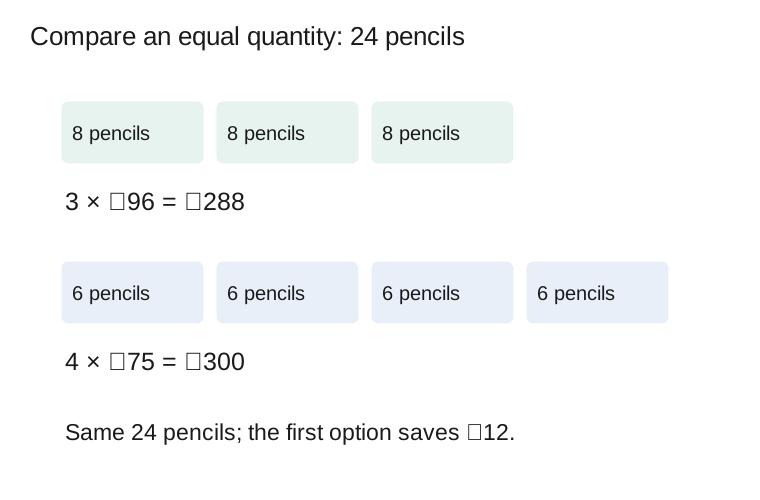
The quantity behind the price
Unit price means cost for one specified unit: one pencil, one kilogram or one litre. Divide total price by the quantity measured in that unit. If 8 pencils cost ₹96, the unit price is ₹12 per pencil. State the unit because ₹12 per pencil and ₹12 per pack describe different things.
You need division, simple fractions or decimals, and conversions such as 1 kg = 1,000 g. All prices in this guide are invented teaching examples, not current offers. We assume the products are comparable in quality, useful quantity and included charges unless the problem states otherwise.
Worked example: two different pack sizes
Pack A has 8 pencils for ₹96, giving 96 ÷ 8 = ₹12 each. Pack B has 6 pencils for ₹75, giving 75 ÷ 6 = ₹12.50 each. Pack A has the lower unit price even though it costs more to buy the whole pack.
An exact comparison can avoid decimals. Buy a common comparison quantity of 24 pencils: three A packs would cost ₹288, while four B packs would cost ₹300. The difference is ₹12 for the same 24 pencils. That agrees with the difference of ₹0.50 per pencil.
Worked example: grams and kilograms
Rice A costs ₹90 for 750 g. Rice B costs ₹116 for 1 kg. Convert A to a per-kilogram price: ₹90 ÷ 0.75 = ₹120 per kg. B is ₹116 per kg, so B has the lower unit price by ₹4 per kg. Comparing 90 with 116 directly would compare unequal quantities.
You can instead compare both at 3 kg: four A packs cost ₹360, and three B packs cost ₹348. Do not divide 90 by 750 and label the answer rupees per kilogram; that quotient is rupees per gram. The arithmetic may be right while the unit label is wrong.
Worked example: a multi-buy offer
A bottle costs ₹48, or three identical bottles cost ₹132. The offer price is 132 ÷ 3 = ₹44 per bottle, saving ₹4 each compared with buying individually. For three bottles the saving is ₹12, not ₹4.
If you only need one bottle and cannot use the other two, spending ₹132 may not be the best decision. Unit price compares mathematical value for a stated quantity; the budget and likely waste still matter. Separate the question which has the lowest unit price from which purchase meets this family’s needs.
Budget constraints can change the chosen pack
Suppose a club needs exactly 14 pencils, can buy only whole packs, and has the two pencil options above. Two A packs provide 16 pencils for ₹192. Three B packs provide 18 pencils for ₹225. One A plus one B provides exactly 14 for ₹171, which is the least cost of these feasible combinations.
The lowest unit-price pack does not by itself solve every whole-pack problem. List sensible combinations and ensure they cover the required quantity. If unused pencils are valuable for future sessions, that may affect a real decision, but the mathematical problem must state whether future use counts.
Read offers before doing arithmetic
A bigger bottle, a bold discount badge or buy more wording is not a unit-price calculation. Check net quantity, whether tax or delivery is included, and whether the offer concerns identical items. In a school exercise, use only the information supplied rather than inventing hidden charges.
Round only at the end if the comparison is close. For 3 items at ₹100 and 6 at ₹199, exact cost per item is 100/3 and 199/6. Compare six items: ₹200 versus ₹199. Both may display ₹33 when rounded to whole rupees, but they are not equal in exact unit price.
Build a small comparison record
Choose two fictional offers and write quantity, total price, a common unit and calculated unit price. Finish with a sentence that answers the actual question. For example, B is ₹4 cheaper per kg; this does not mean its pack is ₹4 cheaper.
A parent can ask the learner to explain which quantities are being held equal. A useful extension adds a budget, required number or waste constraint. Change only one condition at a time so the child sees why the choice changes instead of memorising bigger packs are always cheaper.
Copy this best-buy comparison
Copy the record into a notebook or use it to organise your own answer. Blank spaces are for your work.
| Offer | Quantity in a common unit | Price | Unit price | Fits the required quantity? |
|---|---|---|---|---|
| A | ___ | ___ | ___ | ___ |
| B | ___ | ___ | ___ | ___ |
| Decision and reason | ___ | ___ | ___ | ___ |
10 questions with explained answers
Try the questions before opening the answers. Explain the reason, then try a changed example to check your understanding.
Five notebooks cost ₹85. Find cost per notebook.
Show answer and explanation
₹17
85 ÷ 5 = 17.Compare 4 erasers for ₹28 and 6 for ₹39.
Show answer and explanation
The six-pack
₹7 each versus ₹6.50 each.250 g costs ₹35. Find the per-kilogram price.
Show answer and explanation
₹140 per kg
Four such quantities make 1 kg.Is ₹120 for 1.5 L cheaper per litre than ₹90 for 1 L?
Show answer and explanation
Yes
120 ÷ 1.5 = ₹80 per litre.Three bottles cost ₹132 instead of ₹48 each. Total saving?
Show answer and explanation
₹12
3 × 48 − 132 = 12.Six items cost ₹199; three cost ₹100. Which is lower per item?
Show answer and explanation
The six-item offer
Two smaller packs would cost ₹200 for six.A pack of 8 costs ₹96. Two packs contain how many items and cost how much?
Show answer and explanation
16 items, ₹192
Multiply both quantity and price by two.Can you directly compare ₹80 per litre with ₹65 per 750 mL?
Show answer and explanation
Not without conversion
The reference quantities differ; ₹65 per 0.75 L is about ₹86.67 per L.A club needs 14 pencils. A: 8 for ₹96; B: 6 for ₹75. Find the cheapest whole-pack combination.
Show answer and explanation
One A and one B: ₹171
It supplies exactly 14 and costs less than two A packs or three B packs.Does lowest unit price always mean lowest spending for today?
Show answer and explanation
No
Required quantity, whole packs, budget and waste can change the suitable purchase.
Keep the ideas connected
- Review the unitary method
- Distinguish price comparisons from profit
- Practise interpreting percentage questions
- Support word-problem reasoning at home
For help with a school-learning difficulty, bring one attempted question to a discussion about tutoring and curriculum fit. Maths is our priority; English and Science tutoring are also available.
Sources, scope and sharing
The examples, diagrams and practice are original BananaLearn work. Grade labels suggest a learning level; teaching sequences and school requirements can differ. Official sources below support the stated facts and resource links. These activities are independent resources, not official exam questions or endorsed campaign materials.
How we prepare learning guides · Report a correction
Share this guide: https://bananalearn.com/learn/class-7-unit-price-best-buy-problems.html