IB Maths Tutoring Online: AA & AI, SL & HL Support
“IB Maths” is only the beginning of the conversation. The useful starting point is the course, the level, the assessment year and the precise kind of reasoning your child finds difficult.
BananaLearn offers one-to-one online IB Diploma Programme Maths tutoring for Analysis and Approaches (AA) and Applications and Interpretation (AI), at Standard Level (SL) and Higher Level (HL). Share the course and assessment year so support matches the student’s actual programme.
On a phone, swipe across the illustration to read every label.
Original teaching model; worked reasoning appears below.
Identify the course and assessment year
The IB lists AA SL, AA HL, AI SL and AI HL. These combinations have different emphases and demands, so use the full course name when enquiring. A school report saying simply Mathematics may not identify the pathway clearly enough.
The IB states that the current courses have their final assessment in November 2028. Updated courses start teaching in 2027 for first assessment in 2029. Match guidance and resources to the student’s assessment cohort rather than applying a new document to every current student.
Understand AA and AI without an easy-versus-hard label
AA places particular emphasis on mathematical structure, analytical reasoning and justified argument. AI emphasises mathematical modelling, interpretation and the use of technology in context. Both involve substantial mathematical understanding.
SL and HL also differ in breadth and depth. Course choice should consider school advice and university requirements. Tutoring can support the chosen course; it does not replace admissions advice or the school’s curriculum decisions.
Map support across the subject
The current subject briefs organise learning through number and algebra, functions, geometry and trigonometry, statistics and probability, and calculus. The depth and treatment depend on pathway and level.
A student may calculate a derivative correctly but struggle to interpret it in a model, or operate a calculator while missing the assumptions of a statistical method. Bring the actual task so the teaching focus is specific.
Connect symbolic work and interpretation
Work through a relationship algebraically, graph it, interpret its parameters and explain the limitations of the model. These are complementary ways of understanding the same mathematics.
For a quadratic model, for example, finding a turning point is one step; explaining whether that point lies in the meaningful domain is another. A plausible calculator output still needs a mathematical interpretation.
Use technology with a reason
The IB expects DP Maths students to develop technology skills. The current AA and AI assessment arrangements use technology differently, and updated arrangements must be checked against the correct cohort’s official guidance.
Practise entering a model, checking a window or domain, reading a result and deciding the needed accuracy. Record the reasoning behind a calculation so another reader can understand the method.
Build clear mathematical communication
Practise definitions, notation, units, assumptions and conclusions. An answer should make its logical connection to the question visible, especially in a multi-part problem.
When an error appears, identify the first unsupported step. Correcting that step is more useful than rewriting every line without understanding why the original route failed.
Support exploration through student-owned thinking
For the mathematical exploration, tutoring can help a student understand a method, consider whether a question is workable and reflect on assumptions or limitations. The student should develop the investigation and author the submitted work.
Discuss the school’s guidance, current stage and the mathematical issue needing explanation. A useful conversation makes the student better able to justify their own choices.
Plan support around current demands
Share AA or AI, SL or HL, intended assessment year, current topic, recent feedback and preferred lesson times. Note whether the priority is a prerequisite, a current unit, exam-style communication or mathematical modelling.
Agree the starting task and a review point. Keep a worked sample and a later independent response to see whether the student can explain and transfer the method.
See the teaching approach
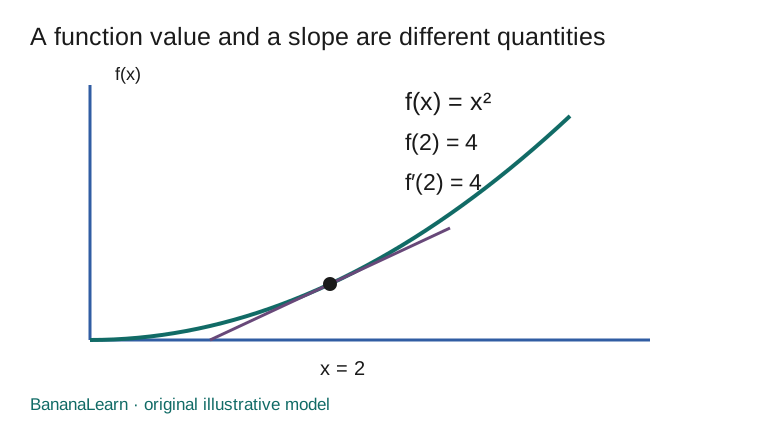
A function and its rate of change
For f(x) = x², f(2) = 4 and f′(x) = 2x, so f′(2) = 4. The point’s height and the tangent’s slope happen to have the same numerical value here, but they describe different quantities.
At x = 3, the height is 9 and the slope is 6. Comparing the two points helps distinguish evaluating a function from evaluating its derivative.
Interpret a model in its domain
An illustrative model is h(t) = −t² + 6t + 1 for 0 ≤ t ≤ 6. Completing the square gives h(t) = 10 − (t − 3)², so the maximum is 10 at t = 3.
The maximum occurs within the stated domain. Units and the real situation would be needed before interpreting this as a physical height; the expression alone does not establish a measured experiment.
Check what data can support
An invented dataset is 2, 4, 4, 6. Its mean is 16 ÷ 4 = 4 and its median is 4. Replacing the final 6 with 20 changes the mean to 7.5 while the median stays 4.
The example shows sensitivity to an extreme value. It does not by itself justify a distributional assumption or establish a relationship between two variables.
Six questions to check the idea
These original questions illustrate reasoning. They are not an official exam paper or a placement score.
For f(x) = 3x + 2, find f(4).
14. Substitute 4 for x: f(4) = 3 × 4 + 2 = 14. The notation f(4) asks for the output, not multiplication by a function called f.
Differentiate x³ with respect to x.
3x². Use the power rule: multiply by the original exponent 3 and reduce that exponent by 1.
Evaluate the integral of 2x from 0 to 2.
4. An antiderivative is x². Evaluate at the bounds and subtract: 2² − 0² = 4.
Find the mean of 3, 5, 7, 9.
6. The total is 3 + 5 + 7 + 9 = 24; dividing by the four observations gives 24 ÷ 4 = 6.
For h(t) = 10 − (t − 3)² on 0 ≤ t ≤ 6, where is the maximum?
At t = 3, with value 10. A square is non-negative, so subtracting (t − 3)² cannot give more than 10. The square is zero at t = 3, which lies in the domain.
Why state a model’s domain?
It identifies where the input and resulting interpretation are intended to apply.
Questions parents and students ask
Which IB programmes does this page cover?
This page describes Diploma Programme Maths tutoring for AA and AI at SL and HL. For another IB programme, identify it explicitly in the enquiry.
Which syllabus should a student taking exams in 2028 use?
Check the school’s cohort guidance. The IB states that the current courses have their final assessment in November 2028; the revised courses have first assessment in 2029.
Can support include both exam preparation and current classwork?
Yes. Give the course, level, assessment year and immediate learning priority so the plan can address the appropriate tasks.
Is BananaLearn an IB school or the exam board?
BananaLearn provides independent tutoring. Official curriculum, assessment and programme requirements are set by the IB and administered through the student’s school.
Share the student’s class or course, current topic, country/time zone and preferred lesson windows. For an exam course, include the intended assessment date or year. We will discuss teaching priorities and availability.